C. PLĪNIUS TRAIĀNŌ IMPERĀTŌRĪ
In aquae ductum, domine, Nīcomēdēnsēs impendērunt HS |X̅X̅X̅| C̅C̅C̅X̅V̅I̅I̅I̅, quī imperfectus adhūc omissus, dēstrūctus etiam est; rūrsus in alium ductum ērogāta sunt C̅C̅. Hōc quoque relictō novō impendiō est opus, ut aquam habeant, quī tantam pecūniam male perdidērunt. (2) Ipse pervenī ad fontem pūrissimum, ex quō vidētur aqua dēbēre perdūcī, sīcut initiō temptātum erat, arcuātō opere, nē tantum ad plāna cīvitātis et humilia perveniat. Manent adhūc paucissimī arcūs: possunt et ērigī quīdam lapide quadrātō, quī ex superiōre opere dētractus est; aliqua pars, ut mihi vidētur, testāceō opere agenda erit, id enim et facilius et vīlius. (3) Sed in prīmīs necessārium est mittī ā tē vel aquilegem vel architectum, nē rūrsus ēveniat quod accidit. Ego illud ūnum adfirmō, et ūtilitātem operis et pulchritūdinem saeculō tuō esse dignissimam.
notes
An aqueduct for Nicomedia.
- read more
-
Both at the capital Nicomedia and at the great city of Sinope (see letter 10.90), there was apparently till Pliny’s time no external supply of water. Pliny's schemes for aqueducts at both, and that for a canal at Nicomedia (letters 10.41 and 42), alone of his building projects are strongly approved by Trajan. In the rest of Asia Minor, lengthy aqueducts seem to be an introduction of the Roman period. Even Alexandria Troas, a favored city, had only wells and cisterns until the time of Hadrian. The technical development of the aqueduct had taken place in Italy, even if some of the architects were Greek. This may be one reason for the persistent failure of the Nicomedian architects (Sherwin-White).
aquae ductum: merged into one word, this became our “aqueduct” (Kingery).
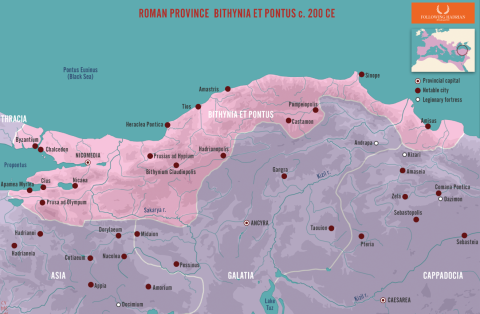
Nīcomēdēnsēs: the inhabitants of Nicomedia, the former name of Izmit, Turkey, located about 100km east of Istanbul. Nicomedia is also mentioned in Pliny’s letter about a fire company (10.34).
HS |X̅X̅X̅| C̅C̅C̅X̅V̅I̅I̅I̅: 3,318,000 sesterces, a considerable but not enormous sum. For comparison, an ordinary legionary earned about 900–1,200 sesterces per year, while the property qualification for membership in the Roman Senate was 1 million sesterces. Thus the Nicomedians had already spent more than three times the fortune required of a senator and the equivalent of several thousand years of a soldier's pay.
HS represents sestertii; once sums become large, the Romans commonly reckon in sestertia, i.e. thousands of sesterces, with lines over the characters. For even larger sums, they reckoned in units of 100,000 sesterces, expressed by enclosing the figure in a box. Thus, |X̅X̅X̅| = 30 × 100,000 = 3,000,000; C̅C̅C̅X̅V̅I̅I̅I̅ = 318 × 1,000 = 318,000; total = 3,318,000 sesterces.
quī … est: “which, left unfinished, has been abandoned, and even (in part) demolished” (Kingery).
dēstrūctus: evidently for the sake of using the blocks of cut stone for building material elsewhere (see section 2), as so many ancient ruins at Rome were destroyed in the middle and later ages (Merrill).
ductum: (aquae) ductum.
C̅C̅: i.e., 200,000 sesterces (ducenta milia sestertium).
relictō: “abandoned.”
novō impendiō: abl. with opus est, as normal. LS opus III.A.
ut … habeant: purpose clause.
male: adv., take with perdidērunt, “mischievously.”
perdidērunt: “squandered.”
(2) Ipse: “I, myself.”
perdūcī: complementary infinitive off of debēre.
arcuātō opere: “supported on arches,” as in the Roman Campagna. The Roman aqueducts did not follow the elevations and depressions of the ground, but were carried through tunnels and on arches at a level or a gentle grade (Kingery).
- read more 2
-
These structures had a cement-lined channel (specus) for the water, were open to the air at certain points, and carried at a gradual rate of descent from the source to the city upon continuous supports of arched masonry, like those that still remain in the neighborhood of Rome, as in other parts of the Roman world. The Romans were perfectly acquainted with the principle of hydrostatics that water in a closed pipe “finds its own level,” and this principle they followed in the distribution of water through cisterns, mains, and service-pipes of lead within the city. But the lack of cast-iron pipes, which would withstand the great pressure of an underground aqueduct, and the demands of their system of settling and filtering the water, and cleaning the conduit, as well as the cheapness of labour, led them to conduct their water-supply into reservoirs within their cities in the form of streams flowing at a gentle rate in an artificial channel (Merrill).
nē … perveniat: negative purpose clause, “that it may reach the higher parts of the city as well as the lower" (Kingery).
tantum: (adv.) "only."
The expense of lofty arches of masonry might be saved, to be sure, by leading the water quickly down from the hills to the plain, whence the channel could be built near or below the surface of the ground for a considerable portion of its length (as was the case with some of the aqueducts at Rome); but in that case the water would flow into the city at so low a level as not to supply its upper regions (Merrill).
manent: from the former structure (Kingery).
Some completed arches of the former work were yet standing, and could be used; certain others had indeed been torn down, but the squared blocks of stone of which they were originally built had not been carried off, and they could easily be re-erected; the rest of the structure might better be built of brick-faced concrete (opus testaceum), from motives of economy, instead of carrying out the original plan of building in cut stone (opus quadratum, lapis quadratus). Pliny follows the fashion of building in the earlier form of constructing walls and vaults in brick-faced concrete, which remarkably withstood time and was highly durable in comparison to the more elegant structures, or interior, covered with fine decorated stucco or incrustation of marble (Merrill).
quīdam: supply arcūs.
lapide quadrātō: as opposed to testāceō opere, below.
ex superiōre opere: ablative of source.
ut mihi vidētur: “as it seems to me,” “in my opinion.”
testāceō opere: “brickwork.” Testa = "brick." Opus testaceum, also called opus latericium (> later lateris n., brick) is a Roman construction technique where walls are built with a core of Roman concrete (opus caementicium) faced with fired brick. It became the dominant wall-facing method during the Roman Empire, used for major public buildings, baths, and insulae.
agenda erit: future passive periphrastic indicating necessity: “will have to be done,” or more idiomatically, “must be done.”
id: the brickwork.
(3) mittī ā tē: “that (acc.) be sent by you,” “that you send” + acc.
vel aquilegem vel architectum: Trajan ignores this request, which he refuses in letters 10.18 and 10.40 (Sherwin-White).
nē … ēveniat: negative purpose clause.
quod accidit: i.e., some jobbery for personal profit (see Trajan’s answer in the next letter) (Merrill).
illud unum: "this one point." See 9.31.2.
adfirmō: affirmō, "I positively assert," "I promise."
ūtilitātem … esse: indirect statement after adfirmō.
saeculō tuō: abl., with dignissimam.
vocabulary
ductus –ūs, m.: a leading, conveyance
Nīcomēdēnsis –e: of Nicomedia
impendō –pendere –pendī –pēnsum: to expend, spend
HS: abbreviation for sestertius, a sesterce, a small silver coin
omittō –mittere –mīsī –missus: to let go, abandon
dēstruō –struere –strūxī –strūctus: to destroy
ērogō –āre: to expend, pay out from the public treasury
impendium –ī, n.: money laid out, outlay
opus, n.: (indeclinable) need
pūrus –a –um: pure2
perdūcō –dūcere –dūxī –ductum: to bring to/over
temptō –āre –āvī –ātus: to try
arcuātus –a –um: having arches
plānus –a –um: level, flat
humilis –e: low-lying
arcus arcūs, m.: arch
ērigō ērigere ērēxī ērēctus: to set up, erect
quadrātus –a –um: squared; (of stone) cut into right-angled form, dressed
dētrahō –ere –trāxī –tractum: to take away from
testāceus –a –um: consisting of bricks or tiles
vīlis –e: cheap
imprīmīs (in prīmīs): especially3
necessārius –a –um: necessary, essential
aquilex –egis (–icis), m.: a conduit-master, water-inspector
architectus –ī, m.: architect, engineer
ēveniō –venīre –vēnī –ventus: to come about, happen
adfirmō adfirmāre adfirmāvī adfirmātus: to strengthen, prove, assert
ūtilitās ūtilitātis, f.: usefulness
pulchritūdō –inis, f.: beauty