C. PLĪNIUS GEMINŌ SUŌ S.
Ummidia Quadrātilla paulō minus octōgēnsimō aetātis annō dēcessit usque ad novissimam valētūdinem viridis, atque etiam ultrā mātrōnālem modum, compactō corpore et rōbustō. (2) Dēcessit honestissimō testāmentō: relīquit hērēdēs ex besse nepōtem, ex tertiā parte neptem. Neptem parum nōvī, nepōtem familiārissimē dīligō, adulēscentem singulārem nec iīs tantum, quōs sanguine attingit, inter propinquōs amandum. (3) Ac prīmum cōnspicuus fōrmā, omnēs sermōnēs malignōrum et puer et iuvenis ēvāsit, intrā quārtum et vīcēnsimum annum marītus, et, sī deus adnuisset, pater. Vīxit in contuberniō aviae dēlicātae sevērissimē, et tamen obsequentissimē. (4) Habēbat illa pantomīmōs fovēbatque, effūsius quam prīncipī fēminae convenit. Hōs Quadrātus nōn in theātrō, nōn domī spectābat, nec illa exigēbat. (5) Audīvī ipsam, cum mihi commendāret nepōtis suī studia, solēre sē ut fēminam in illō ōtiō sexūs laxāre animum lūsū calculōrum, solēre spectāre pantomīmōs suōs, sed cum factūra esset alterutrum, semper sē nepōtī suō praecēpisse abīret studēretque; quod mihi nōn amōre eius magis facere quam reverentiā vidēbātur.
(6) Mīrāberis, et ego mīrātus sum. Proximīs sacerdōtālibus lūdīs, prōductīs in commissiōne pantomīmīs, cum simul theātrō ego et Quadrātus ēgrederēmur, ait mihi: 'Scīs mē hodiē prīmum vīdisse saltantem aviae meae lībertum?' Hoc nepōs. (7) At, hercule, aliēnissimī hominēs in honōrem Quadrātillae (pudet mē dīxisse honōrem per adūlātiōnis officium) in theātrum cursitābant exsultābant plaudēbant mīrābantur ac deinde singulōs gestūs dominae cum canticīs reddēbant; quī nunc exiguissima lēgāta, theātrālis operae corōllārium, accipient ab hērēde, quī nōn spectābat.
(8) Haec, quia solēs, sī quid incīdit novī, nōn invītus audīre, deinde quia iūcundum est mihi quod cēperam gaudium scrībendō retractāre. Gaudeō enim pietāte dēfūnctae, honōrē optimī iuvenis; laetor etiam quod domus aliquandō C. Cassī, huius quī Cassiānae scholae prīnceps et parēns fuit, serviet dominō nōn minōrī. (9) Implēbit enim illam Quadrātus meus et decēbit, rūrsusque eī prīstinam dignitātem celebritātem glōriam reddet, cum tantus ōrātor inde prōcēdet, quantus iūris ille cōnsultus. Valē.
notes
Pliny tells the story of a feisty grandmother and her heir.
Geminō suō: Rosianus Geminus, Pliny's young senatorial protege. Pliny recommends him to Trajan in 10.26. He had been quaestor consularis to Pliny in 100, and seems by 109 to have held the praetorship and possibly a legionary command (Sherwin-White).
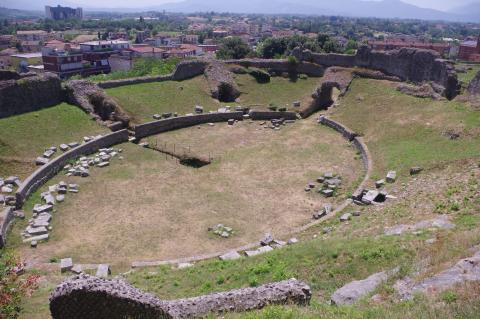
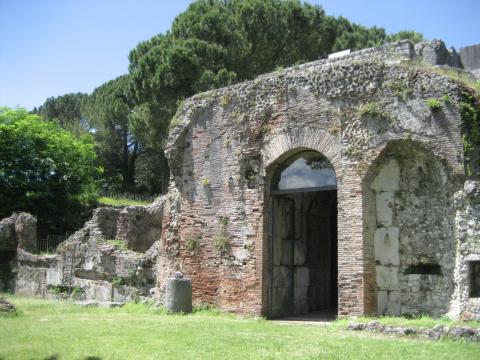
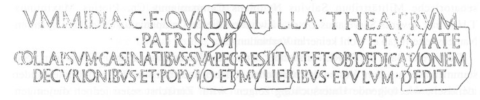
Ummidia Quadrātilla: her liking for theatrical shows is perhaps indicated by the fact of her building an amphitheater and temple at Casinum, remains of which still exist. See the inscription (Orelli 781, EDCS-15300344) now preserved in the cloisters of the monastery of Monte Cassino (Merrill).
Evidently born about AD 26, she is the daughter of C. Ummidius Durmius Quadratus of Casinum, whose long career reached from a quaestorship in AD 14 to the governorship of Syria, where he died in office, himself a septuagenarian, in AD 60. Compare Tacitus, Annals 14.26 (Sherwin-White).
paulō minus octōgēnsimō aetātis annō: being in one's eightieth year means being 79, not 80 years old. Ummidia was "just short of being in her eightieth year." Therefore she was 78. Radice translates, "having almost attained the age of seventy-nine." An ordinal numeral + aetatis anno is a normal way to express age in Latin.
usque ad novissimam valētūdinem: “up until her most recent bout of ill-health.”
viridis: “vigorous." LS viridis II.
atque etiam: "and furthermore," "and in fact," strengthening the previous point. LS atque IV.2.
ultrā mātrōnālem modum: “beyond what is typical for a matrona."
(2) honestissimō testāmentō: i.e., she left her property to her natural heirs, and not to legacy hunters, to whose wiles a woman of Ummidia's life, as she was especially exposed, might have been expected to be especially susceptible (Merrill).
relīquit hērēdēs ex besse nepōtem, ex tertiā parte neptem: her grandson inherited two-thirds of the estate, and her granddaughter the remaining third.
parum: adverbial with nōvī; “a bit,” “a little,” “slightly.”
nepōtem: C. Ummidius Quadratus, about whom nothing is known beyond what is stated in, or in the notes upon, this letter, except that he was consul suffectus in 118 A.D., and suffered under the displeasure of Hadrian (Merrill).
dīligō: milder than amō, but expressing special regard or liking for a person. OLD diligo 2.
iīs ... quōs sanguine attingit: “by those whom he touched by blood,” i.e. his relatives.
iīs: dative of agent with amandum (est).
amandum: take with adulēscentem.
(3) cōnspicuus … puer … iuvenis … marītus … pater: all refer to the same adulēscēns.
fōrmā: ablative of respect with cōnspicuus, “striking in form,” i.e. handsome.
sermōnēs: "gossip," "scandal" with regard to sexual improprieties. His good looks made this a predictable problem.
ēvāsit: "escaped."
intrā quārtum et vīcēnsimum annum: “before he was twenty-four.”
sī deus adnuisset: past contrary to fact condition, “if the god had approved (but he didn’t).”
Vīxit: refers to the adulēscēns, as do sevērissimē and obsequentissimē which modify this verb.
in contuberniō aviae dēlicātae: “in the house of a grandmother addicted to pleasure.” LS delicatus II.
The connotation of dēlicātae varies from the wanton to the merely idle and luxurious. Pliny implies only that Quadratilla enjoyed all the luxurious frivolities of the age (Sherwin-White).
sevērissimē: sevērus is the opposite of dēlcātus: strict in personal behavior, not lax or frivolous, austere. OLD severus 2.
obsequentissimē: despite his very different ways he was obedient and obliging (obsequēns) to his grandmother, not judgmental or harsh.
(4) Habēbat ... fovēbat: implies financial support.
pantomīmōs: the Roman pantomime drama of the Principate was a combination of tragedy, opera, and ballet, in which the leading part was played by the pantomimus. This was a highly trained actor who united the social and dramatic role and temperament of a modern prima donna and prima ballerina, and was supported by a chorus, corps de ballet, and orchestra. Pliny here uses pantomini in the plural for the whole troop (Sherwin-White).
effūsius: "more extravagantly."
quam prīncipī fēminae convenit: "than is fitting for a woman of high status." For impersonal convenit + dative, see LS convenio II.B.2.γ.
- read more
-
Emily Ann Hemelrijk writes, “From local inscriptions we know that Ummidia Quadratilla built a temple and an amphitheater [at Casinum], and that she repaired the theater which may have been built or decorated by her father, probably giving a public banquet to the decurians, the people, and the women of the town to celebrate its dedication….
Ummidia Quadratilla was clearly a public and popular figure in her hometown and Pliny seems not to have overstated her elevated position alluding to her as the ‘leading lady’ (princeps femina) a term which has imperial overtones. Her high rank and her generosity not only brought her fame among her fellow citizens during her lifetime, but also after her death. The theater and amphitheater on the hill overlooking the town have kept her memory alive to the present day; the monumental mausoleum between these grand structures is also believed to be hers—though not necessarily rightly so, since no inscription has survived. If social recognition and the perpetuation of her memory were the main motives for her lavish benefactions, she surely succeeded."
Emily Ann Hemelrijk, Hidden Lives, Public Personae: Women and Civic Life in the Roman West (Oxford University Press, 2015), p. 111.
Hōs Quadrātus nōn in theātrō: supply spectābat.
nec illa exigēbat: “and she was not demanding (that he see them).”
(5) Audīvī ipsam ... solēre sē ... laxāre: "I heard her (say) that she herself was accustomed to relax."
mihi commendāret ... studia: Pliny was specifically invited to supervise the young man's introduction to the law and the law courts, as the leading advocate of the day (Sherwin-White).
ut fēminam in illō ōtiō sexūs: “as (is natural for) a woman in that leisure time of her gender,” "with all a woman’s idle hours to fill" (Radice). LS ut I.B.4. Illō implies that the thing referred to is well-known. LS ille II.A.
lūsū calculōrum: some sort of board game, either duodecim scripta or latrunculi.
alterutrum: “either” of her two diversions.
sē ... praecēpisse: indirect statement. Praecēpisse takes the dative (nepōtī suō) and in indirect command (abīret studēretque), “she ordered him” + indirect command.
mihi: dat., with vidēbātur, “seemed to me,” + facere.
amōre ... reverentiā: ablatives of cause, “out of love … out of reverence.”
magis ... quam: correlatives; negated by nōn, “not more … than….”
(6) in commissiōne: "at the beginning of the games."
Quadratilla had not hired them out, as Merrill suggested, but entered them for a competition, at some occasion like the Quinquatria, organized on the lines of a Greek festival. The term commissio is used in a similar context in Suetonius, Augustus 89.3. The abolition of public performances of pantomimes by Domitian, reimposed by Trajan, cannot have lasted long (Pliny, Panegyricus 46.1–3) (Sherwin-White).
theātrō: ablative of separation after ēgrederēmur.
hodiē prīmum: adverbial, “today was the first time.”
lībertum: direct object of vīdisse, “a freedman," i.e. any of her freedmen.
Hoc nepōs: supply dīxit.
(7) At ... aliēnissimī hominēs: the cool indifference of Quadratilla's grandson is contrasted with the enthusiastic flattery of "people who were nothing to Quadratilla" (Radice). It is implied they were looking for a legacy in her will.
dīxisse honōrem per adūlātiōnis officium: “to call (this) service of flattery an honor.”
exsultabant: "kept leaping to their feet."
singulōs gestūs dominae ... reddēbant: “they were copying every gesture of their mistress.”
Pliny affects to consider Ummidia as simply the leader of the claque, but her gestures were doubtless the natural ones of genuine admiration (Merrill).
canticīs: "shrieks" of delighted approval (Merrill).
lēgāta: “legacies.” LS lego II 2.
theātrālis operae corōllārium: "the tip due to a hired claqueur." A claque is an organized body of professional applauders in ancient Roman (or modern French) theatres.
(8) haec: supply scribēbam, or scripsī—another of the hundred instances of Pliny's free ellipsis of verbs of whatever kind and in whatever form. Compare here the old English ellipsis in addresses, 'To Mr. Ebenezer Woodruff, these.' (Merrill)
sī quid incīdit novī: take after audīre, “if anything new has happened.”
quod cēperam gaudium: “the joy that I received.”
scrībendō: abl. gerund; “by writing.”
pietāte ... honōrē: abl. of cause after gaudeō.
honōrē optimī iuvenis: the respect shown to Quadratus by his grandmother in her will. Optimī iuvenis is objective genitive.
laetor etiam quod: “I am also happy that.”
domus aliquandō C. Cassī, huius quī: "the house that once belonged to Gaius Cassius, the man who...." Domus is the subject of serviet.
C. Cassius Longinus was consul in 30 A.D. He enjoyed great reputation as a jurisconsult, composed a treatise on civil law, which served as a mine for later excerptors, and founded a school of legal interpretation, which was called by his name (Merrill).
dominō nōn minōrī: i.e. Quadratus, who will carry on the tradition of Cassius' style of jurisprudence. Dative with serviet.
(9) eī: “to it,” i.e., the Cassian school.
tantus ... quantus: "as great ... as."
orator: the promise of Quadratus as an orator is celebrated in 6.11, where he is said to have made Pliny his praeceptor and model (cf. secion 5 of this letter) (Merrill).
quantus iūris ille cōnsultus: “as he (Cassius) was a jurist.” Usually iūrisconsultus is written as one word. LS consulo II.1.B.
vocabulary
Ummidia –ae, f.: Ummidia (name)
octōgēsimus –a –um: 80th (octōgintā, 80)
dēcēdō –cēdere –cessī –cessus: to die
valētūdō –inis, f.: health, good or bad
viridis –e: green, vigorous
mātrōnālis –e: relating to a matron
compingō –pingere –pēgī –pāctus: to join together
rōbustus –a –um: strong
testāmentum –ī, n.: last will and testament 2
bēs bessis, m.: two-thirds of any whole
familiāris –e: domestic, intimate
adulēscēns –ntis: young person
singulāris –e: single
attingō –tingere –tigī –tāctus: to touch
propinquus –a –um: near, related
cōnspicuus –a –um: in view, visible3
malignus –a –um: malignant, wicked, malicious, grudging
iuvenis –is, m.: youth
ēvādō –vādere –vāsī –vāsus: to escape, evade
vīcēsimus –a –um: 20th (vīgintī, 20)
adnuō –ere –uī –ūtus (–rare): to nod to, approve of + dat.
contubernium –ī, n.: cohabitation, dwelling in the same house
avia –ae, f.: grandmother
dēlicātus –a –um: self-indulgent, wanton, luxury-loving
sevērus –a –um: serious, austere
obsequēns –entis: yielding, compliant. obliging
pantomīmus –ī, m.: a ballet-dancer, pantomime4
foveō fovēre fōvī fōtus: to cherish, support, favor
effūsus –a –um: overflowing, excessive
commendō –āre –āvī –ātus: to entrust, recommend, approve5
sexus –ūs, m.: a sex, gender (male or female)
laxō –āre –āvī –ātus: to relax
lūsus –ūs, m.: play, game
calculus –ī, m.: small stone; pebble
alteruter –utra –utrum: one or the other, either this or that
nepōs –ōtis m.: grandson
reverentia –ae, f.: timidity, respect
sacerdōtālis –e: of or belonging to priests, priestly, sacerdotal6
lūdus –ī, m.: game
prōdūcō –dūcere –dūxī –ductus: to bring forward
commissiō (comisātiō) –ōnis, f.: the start of games
Quadrātus –ī, m.: Quadratus (name)
saltō –āre –āvi –ātus: to dance
lībertus –ī, m.: freedman
hercle (hercule): by Hercules!7
pudeō pudēre puduī puditus: to make ashamed
adūlātiō –ōnis, f.: cringing flattery, adulation
theātrum –ī, n.: theater
cursitō –āre –āvī –ātus: to run about
exsultō (exultō) –are –āvī –ātus: to leap up
plaudō plaudere plausī plausum: to applaud
gestus –ūs, m.: posture, gesture, action
canticum –ī, n: a song
exiguus –a –um: small, little
legātum –ī, n.: legacy, bequest
theatrālis –e: related to the theater
corōllārium –ī, n.: a gratuity, tip
hērēs hērēdis, m. / f.: heir
quis quid: anyone/thing, someone/thing (after sī, nisī, ne, or num)8
invītus –a –um: unwilling
iūcundus –a –um: pleasant, delightful, agreeable
retrāctō –trāctāre –trāctāvī –trāctātus: to handle again; gripe or grasp again
dēfungor –fungī –fūnctus sum: to finish, complete
laetor –ārī –ātus sum: to rejoice, be glad
Cassius –iī, m.: Cassius (name)
Cassiānus –a –um: of or belonging to Cassius
schola –ae, f.: school
prīnceps –ipis: chief, first
prīstinus –a –um: former9
celebritās –ātis, f.: crowd; fame
ōrātor –ōris, m.: speaker
iuris consultus iuris consultī, m.: a lawyer, jurist (also written as one word)