C. PLĪNIUS NEPŌTĪ SUŌ S.
(1) Adnotāsse videor facta dictaque virōrum fēminārumque alia clāriōra esse alia maiōra. (2) Cōnfirmāta est opīniō mea hesternō Fanniae sermōne. Neptis haec Arriae illīus, quae marītō et sōlācium mortis et exemplum fuit. Multa referēbat aviae suae nōn minōra hōc sed obscūriōra; quae tibi exīstimō tam mīrābilia legentī fore, quam mihi audientī fuērunt.
(3) Aegrōtābat Caecīna Paetus, marītus eius, aegrōtābat et fīlius, uterque mortiferē, ut vidēbātur. Fīlius dēcessit, eximiā pulchritūdine, parī verēcundiā, et parentibus nōn minus ob alia cārus quam quod fīlius erat. (4) Huic illa ita fūnus parāvit, ita dūxit exsequiās, ut ignōrāret marītus. Quīn immō quotiēns cubiculum eius intrāret, vīvere fīlium atque etiam commodiōrem esse simulābat, ac persaepe interrogantī, quid ageret puer, respondēbat; ‘Bene quiēvit, libenter cibum sūmpsit.’ (5) Deinde, cum diū cohibitae lacrimae vincerent prōrumperentque, ēgrediēbātur; tunc sē dolōrī dabat; satiāta, siccīs oculīs, compositō vultū, redībat, tamquam orbitātem forīs relīquisset. (6) Praeclārum quidem illud eiusdem, ferrum stringere, perfodere pectus, extrahere pūgiōnem, porrigere marītō, addere vōcem immortālem ac paene dīvīnam: ‘Paete, nōn dolet.’ Sed tamen ista facientī, ista dīcentī, glōria et aeternitās ante oculōs erant; quō maius est sine praemiō aeternitātis, sine praemiō glōriae, abdere lacrimās, operīre lūctum, āmissōque fīliō, mātrem adhūc agere.
(7) Scriboniānus arma in Illyricō contrā Claudium mōverat; fuerat Paetus in partibus, et, occīsō Scriboniānō, Rōmam trahēbātur. (8) Erat ascēnsūrus nāvem; Arria mīlitēs ōrābat, ut simul impōnerētur. ‘Nempe enim’ inquit ‘datūrī estis cōnsulārī virō servolōs aliquōs, quōrum ē manū cibum capiat, ā quibus vestiātur, ā quibus calciētur; omnia sola praestābō.’ (9) Nōn impetrāvit: condūxit piscātōriam nauculam, ingēnsque nāvigium minimō secūta est.
Eadem apud Claudium uxōrī Scribōniānī, cum illa profitērētur indicium, ‘Ego’ inquit ‘tē audiam, cuius in gremiō Scriboniānus occīsus est, et vīvis?’ Ex quō manifēstum est eī cōnsilium pulcherrimae mortis nōn subitum fuisse.
(10) Quīn etiam, cum Thrasea, gener eius, dēprecārētur, nē morī pergeret, interque alia dīxisset: ‘Vīs ergō fīliam tuam, sī mihi pereundum fuerit, morī mēcum?’, respondit: ‘Sī tam diū tantāque concordiā vīxerit tēcum quam ego cum Paetō, volō.’ (11) Auxerat hōc respōnsō cūram suōrum; attentius cūstōdiēbātur; sēnsit et ‘Nihil agitis’ inquit; ‘potestis enim efficere ut male moriar, ut nōn moriar nōn potestis.’ (12) Dum haec dīcit, exsiluit cathedrā adversōque parietī caput ingentī impetū impēgit et corruit. Focilāta, ‘Dīxeram’ inquit ‘vōbīs inventūram mē quamlibet dūram ad mortem viam, sī vōs facilem negāssētis.’
(13) Videnturne haec tibi maiōra illō, ‘Paete, nōn dolet’, ad quod per haec perventum est? Cum interim illud quidem ingēns fāma, haec nūlla circumfert. Unde colligitur, quod initiō dīxī, alia esse clāriōra alia maiōra. Valē.
notes
Pliny tells some lesser known stories about Arria as reported to him by her granddaughter Fannia.
- read more
-
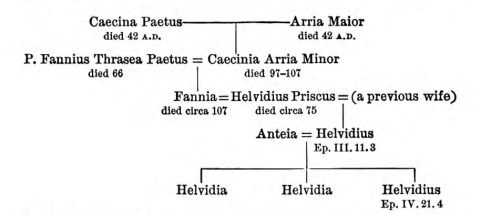
Pliny here relates some of the noble sayings and deeds of Arria, wife of Caecina Paetus, who was put to death by the Emperor Claudius, A.D. 42, as having been concerned in the revolt of Scribonianus (Suetonius, Claudius 13). Arria's daughter of the same name became the wife of Thrasea Paetus, the circumstances of whose death under Nero, A.D. 67, are related by Tacitus (Annals 16.34). Fannia, Pliny's informant, was the daughter of this Thrasea, and the wife of Helvidius Priscus (Church).
(1)
Adnotāsse videor: “I seem to have taken notice” + indirect statement.
facta dictaque ... maiōra: order: alia facta dictaque virōrum fēminārumque clāriōra esse, alia maiōra (esse).
alia ... alia: "some ... others." I.e. the maiōra and the clāriōra are not one and the same. Some of the greater ones are not as well-known.
hesternō Fanniae sermōne: “in speaking to Fannia yesterday.”
Arriae: Arria Maior, Fannia’s grandmother, was a model of Roman virtue. She was married to a man named Caecina Paetus, and when Paetus was condemned to commit suicide, and he hesitated because of fear, Arria took the sword, and stabbed herself in the stomach. She had time to tell her husband before she died that the wound that she made did not hurt and to allay his fears about dying (for more information about Fannia, Arria Minor and Arria Maior see letter 7.19).
illīus: "the well known"(Kingery).
marītō: can be taken with both sōlācium and exemplum, “a comfort to and an example for her husband.”
mortis: “in death,” genitive defining both solācium and exemplum.
Roman authors such as Pliny saw suicide as highly honorable in certain circumstances, especially when it represented a dramatic gesture of resistance to political tyranny.
- read more.
-
"Lucretia was a Roman noble woman of early times, raped by Sextus Tarquinius, son of the last Roman king. After binding her husband Collatinus to vengeance, and despite being innocent herself of any crime, Lucretia stabbed herself, an act romanticized by later historians and poets as the ultimate defense of her chastity. Tradition said that outrage over the incident sparked a revolt that put an end to the monarchy itself. Lucretia was treated as a paragon of chastity, proof that remaining sexually pure could be more important to a Roman woman than life itself. It was an extreme example of suicide motivated not by private despair but by honor and shame, and the story was told and re-told by authors who stressed the Roman attachment to a sense of personal honor. Anthropologists would say that Lucretia's act relates to an ethical system based not on guilt, which requires intent, but on pollution, which can be contracted regardless of any criminal intent.
"A case on the male side involved Cato the Younger, the politician and devotee of Stoic philosophy who was an inflexible partisan of the old republican system of government and an implacable opponent of Julius Caesar, whose rise to power he rightly saw as dooming that system. Defeated with his army in the civil war against Caesar he chose to fall on his sword rather than live on under the tyrant. This was another "honor" suicide. Caesar likely would have let him live, as he did other prominent opponents such as Brutus and Cassius, and Cato advised his friends and his own son to make peace with Caesar. But Cato held himself to a higher standard. The night before he killed himself he read Plato on the immortality of the soul twice before falling asleep. Cato's calm, philosophical fortitude was an inspiration to later generations of Roman nobles, and quite a few killed themselves rather than live under (or be executed by) tyrannical emperors. They did so in spectacular Catonian fashion, so as to bring maximum ill-will to the emperor: not alone in private misery, but like Socrates, surrounded by grieving friends, discoursing on philosophy and dictating their last words. The fashion for such "brave" political suicides at Rome was powerfully set by the example of Cato. Seneca the philosopher criticizes this wastage more than once (calling it "the mere appearance and semblance of courage"), but when the time came, and he was falsely implicated in a conspiracy against his old student the emperor Nero, Seneca opened his veins, as did his wife, who insisted on following him.
"The traditional Roman admiration for honor suicide and its moral/philosophical justification are attacked at length by St. Augustine, who argues that an innocent person who kills him or herself is simply a murderer, nothing more. In taking aim at the moral authority of Lucretia and Cato, he avoids the neutral-sounding phrase mors voluntaria, which emphasizes moral autonomy, and harps again and again on the verbal phrase se occidere, 'to murder oneself,' which employs the same verb used in the Latin version of the sixth commandment, 'thou shalt not kill' (non occides). Pagan Roman documents that record suicides, in sharp contrast to Christian and medieval ones, rarely carry a hint that the act itself might be blameworthy, and the terms they use for it are euphemistic: 'to take oneself away' (se auferre), 'to bring violence to oneself' (vim sibi affere), 'to decide on oneself' (de se statuere). Christian authors, influenced by the prohibition of suicide elaborated by Augustine and others, tend to use pejorative terms such as se ipsum occidere and ad mortem festinare ('to hasten to death')."
Christopher Francese, Ancient Rome in So Many Words (New York: Hippocrene, 2007) s.v. mors voluntaria.
referēbat: here the subject switches to Fannia.
nōn minōra: “not less (great)” + abl. of comparison.
hōc: ablative of comparison, “than this (story),” i.e., the famous story about her death.
obscūriōra: "less well known" (Wescott).
tibi ... legentī: “when you read them.”
tam … quam: correlatives, “just as…as.”
fore: = futura esse. AG 170.a.
mihi audientī: “when I heard them,” i.e. when Fannia told them to him yesterday.
(3)
uterque mortiferē, ut vidēbātur: “both mortally, (or) so it seemed.” I.e. at the time it seemed that both Arria’s son and her husband were likely to die.
eximiā pulchritūdine, parī verēcundiā: ablatives of description. "A most beautiful boy with an unassuming manner no less remarkable" (Radice). Note the balanced phrasing. Verecundia is an attitude of restraint arising from respect for others, a proper humility, modesty (OLD verecundia 1)—qualities highly valued in the young.
parentibus: dative with cārus, “dear to his parents.”
parentibus ... fīlius erat: order: cārus (suīs) parentibus nōn minus ob alia quam quod fīlius erat: "dear to his parents for reasons beyond the fact that he was their son" (Radice).
(4)
illa: Arria.
ut ignōrāret marītus: result clause set up by ita, “that (as a result) her husband didn’t know.” i.e. Arria managed to keep her husband in the dark about her son’s death, since he too was deathly ill and she was trying to protect him.
Quīn immō quotiēns cubiculum eius intrāret: iterative subjunctive, denoting a repeated action. AG 518.c.
etiam commodiōrem esse: “that his condition was even improving.”
quid ageret puer: indirect question, set up by interrogantī, “asking how the boy was.”
(5)
diū cohibitae lacrimae: “her long-restrained tears,” subject of vincerent and prōrumperent.
vincerent prōrumperentque: more iterative subjunctives, denoting repeated action. With vincerent supply eam as the direct object.
satiāta: “having satisfied (herself) (with crying).”
siccīs oculīs, compositō vultū: ablatives of manner.
tamquam orbitātem forīs relīquisset: subjunctive in a clause of comparison, “as if she had left her grief outside the house.”
(6)
Praeclārum quidem illud eiusdem: “It was a glorious deed of the same woman, to be sure.” Quidem concedes the point that her famous suicide (about to be described with a brisk series of infinitives) was a great deed, but looks forward to Sed tamen just below.
porrigere: supply ferrum or pūgiōnem as a direct object.
vōcem: "remark." LS vox II.A.
immortālem ac paene dīvīnam: “immortal and nearly divine.” It was immortalized by Martial as well, Epigrams 3.15.
ista facientī: “while (she was) doing those very things.” LS iste I.B.
ante oculōs: "before her eyes," as an incentive, since this was a public act she knew would be remembered and widely admired.
quō maius est: "how much greater (a deed) it is," looking forward to the series of infinitives describing the deed: abdere ... operīre ... agere. Quō is ablative of degree of difference with the comparative maius. AG 414.
āmissōque fīliō: abl. absol., with a concessive feeling, “even though her son was lost (to her).”
mātrem adhūc agere: "to still act as a mother," "to behave as a mother still."
(7)
Scribonianus ... moverat: Scribonianus, it appears, was governor of Dalmatia, which in the time of the Empire politically coincided with Illyricum, the province being sometimes spoken of under the first name, sometimes, as here, under the latter. The revolt of Scribonianus occurred during the reign of Claudius. It was very brief, and was over in fifteen days (Church).
arma ... moverat: "had started a revolt."
in Illyricō: the modern Dalmatia and Albania (Montague).
fuerat Paetus in partibus: "Paetus had been a partisan," i.e. in the conspiracy (Prichard).
Rōmam trahēbātur: “he was dragged to Rome (as a prisoner).”
(8)
Erat ascēnsūrus: “he was about to board.”
ōrābat ut simul impōnerētur: indirect command, “she was begging that she might be taken aboard at the same time.”
Nempe: "surely," justifying a remark or attitude by a statement which it is assumed the other party will not contradict. OLD nempe 1.
datūrī estis: “you are about to give.”
cōnsulārī: goes with virō, “to a man of consular rank.”
servolōs aliquōs: “some young servants.” Servolus = servulus.
quōrum: “(some) of whom,” i.e., of the servants.
ā quibus: “by (some of) whom.” This alsso refer to the servants.
calciētur: “he will be shod,” i.e. shoes will be put on him. Calciō = calceō:
omnia: "all these services," acc. object of praestābō.
sola: nom. with praestābō, “I alone will provide,” LS praesto2 II.C.2.d.
(9)
Nōn impetrāvit: “she did not obtain (it),” i.e., they did not agree and she did not get to go on the boat with her husband.
condūxit: "rented," "hired."
Nauculam: naviculam.
minimō: “with that little (boat),” “in that little boat.”
apud Claudium: ”in Claudius’s presence,” i.e. when they came to trial before the emperor.
cum illa profitērētur indicium: “when that woman (the wife of Scribonianus) was volunteering information,” about the revolt. Indicium profiteri = "to volunteer information against an accomplice." OLD profiteor 3.c.
tē audiam: audiam is the present deliberative subjunctive, “am I to listen to you?” This use of the subjunctive is argumentative and shows that the speaker has no intention of listening to her.
cuius in gremiō: lit., “in whose lap.” The implication is that Scribonianus died in the presence of his wife, who showed none of Arria's loyalty or resolve.
et vīvis: supply tu: “and yet you live,” “when you are still alive.” Contrast the subjunctive used earlier to denote the fact that the speaker is not going to listen to this woman, who is still very much alive, when she’s allowed her own husband to die and yet she lives on. We know from the “Paete non dolet” story that Arria does not believe that this sort of behavior is commendable.
It is remarkable that even so cautious a person has Pliny tells this tale in a way that glorifies open rebellion against an emperor who had not suffered damnatio memoriae. But Camillus had posed as a restorer of the old Republic, not as a claimant to the principate. The family celebrated its connection with a daughter of Pompey the Great (Sherwin-White).
Ex quō manifēstum est: “from this (statement) it’s clear (that)” + indirect statement.
eī: dative of possession. Take with cōnsilium, “her plan.”
nōn subitum fuisse: “was not sudden.”
(10)
Thrasea: Thrasea Paetus, son-in-law of Caecina Paetus. A native of Patavium, a friend of the poet Persius, who was a relative of his wife; active in the senate, A.D. 58-63, accused of maiestas (high treason) in 66, and condemned to suicide. The literature of the period is full of references to this Cato of his generation. He used to say "Nero may kill me but cannot harm me" (Wescott).
filiam tuam mori mecum: twenty-four years later, as Thrasea foresaw, a decision had to be made on this point, which resulted in his persuading Arria the younger to survive him for the sake of their daughter Fannia (Prichard).
dēprecārētur nē morī pergeret: “was pleading with her not to proceed in dying.” Pergo + infin. = "to proceed in a course of action with the intent to complete it." OLD pergo 3.
sī mihi pereundum fuerit: “if it was (necessary) for me to undertake my own death,” i.e., “if I had to die.” This sentiment is prescient, since this is the fate that actually befell Thrasea.
tam diū tantāque concordiā: “for so long and with such happiness.”
vīxerit: the subject here is Arria’s daughter, Arria Minor.
quam ego cum Paetō: supply vīxī, “as I (have lived) with Paetus.”
(11)
hōc respōnsō: abl. of means with auxerat, “she increased by means of this response.”
cūram suōrum: “the concern of her relatives.”
nihil agitis: “you are accomplishing nothing,” "it's no use." LS ago II.D.1.d.
efficere ut male moriar: “to make it so that I die with difficulty.” Male here can mean, “in a painful or wretched manner,” rather than simply “badly.”
(12)
Dum haec dīcit: present tense with dum. She’s not joking. This is all going on while she is speaking.
cathedrā: abl. of place from which with ex understood because of exsiluit.
adversōque parietī: dat. with impēgit, “against the wall.” This manner of suicide was not unknown in the ancient world. According to Seneca (Epistulae Morales 77.14), young Spartans bashed their heads against walls to avoid slavery. And according to Plutarch (Cato Minor 68.5) Cato threatened to kill himself in this manner if his son kept hiding his sword.
ingentī impetū: ablative of means, “with great force.”
Focilāta: “having been revived,” “after she was resuscitated."
Dīxeram vōbīs: “I had told you” + indirect statement.
inventūram mē: “that I would find.”
quamlibet dūram: “howsoever harsh,” “no matter how harsh.” LS quamlibet II.
Facilem: supply viam.
(13)
Videnturne: -ne = nonne.
haec: i.e., these stories. The new and lesser known stories he’s told us about Arria.
illō: ablative of comparison with maiōra, “than that famous (story).”
ad quod ... perventum est: "to which she arrived through these (other) deeds," or "which was their culmination" (Radice). Perventum est is impersonal passive, emphasizing the verbal action rather than the doer. AG 208.d. The idea is that Arria was (unconsciously) working up to her famed death the whole time.
Cum interim illud quidem ingēns fāma: "and yet while wide fame (attends) this incident."
haec nūlla circumfert: “these (stories) do not circulate at all." OLD circumfero 6.b. Nulla is adverbial, "not a bit," OLD nullus 6.
quod initiō dīxī: “what I said as I began (the letter).”
vocabulary
(1)
adnotō –notāre –notāre: to note, notice
dictum –ī, n.: word; saying
(2)
cōnfīrmō –āre –āvi –ātus: to confirm, strengthen
opīniō –ōnis, f.: opinion
hēsternus –a –um: of yesterday, yesterday's
Fannia –ae, f.: Fannia (name)
neptis –is f.: granddaughter
sōlācium –I(ī), n.: comfort
avia –ae, f.: grandmother
obscūrus –a –um: obscure, little-known
mīrābilis –e: wonderful, extraordinary
(3)
aegrōtō –āre –āvi: to be ill
Caecina –ae, m.: Caecina (name)
mortifer –era –erum: deadly, mortal
dēcēdō –cēdere –cessī –cessus: to die, pass away
eximius –a –um: exceptional, distinguished
pulchritūdō –inis, f.: beauty
verēcundia –ae, f.: modesty
(4)
exsequiae –ārum, f.: funeral rites
īgnōrō –āre –āvī –ātus: to not know; ignore
immō: no indeed
cubiculum –ī, n.: bedroom
commodus –a –um: favorable
simulō –āre –āvī –ātus: to imitate, pretend
persaepe: very often
libenter: willingly
(5)
cohibeō –ēre –uī –itus: to hold together
prōrumpō –rumpere –rūpī –ruptus: to cause to burst forth; cast forth
satiō –āre –āvī –ātum: to satisfy sate
siccus –a –um: dry
tam ... quam…. : so much...as
orbitās –ātis, f.: destitution, bereavement
forīs: out of doors, outside, abroad
(6)
praeclārus –a –um: very famous
stringō stringere strīnxī strictum: to draw (a sword from a scabbard, etc.)
perfodiō –fodere –fōdī –fossus: to dig or pierce through
extrahō –trahere –trāxī –tractum: to draw out
pūgiō –ōnis m.: a dagger
porrigō –rigere –rēxī –rēctum: to stretch forth
immortālis –e: immortal
dīvīnus –a –um: divine
Paetus –ī, m.: Paetus (name)
aeternitās –tātis, f.: eternity, timelessness; eternal life
quō: (expresses degree of difference)
abdō –dere –didī –ditum: to withdraw; conceal
operiō –īre –uī –tum: to cover, hide
lūctus –ūs, m.: mourning, grief
(7)
Scrībōniānus –ī, m.: Scribonianus (name)
Illyricum –ī, n.: Illyricum
Claudius –ī m.: the emperor Claudius
Rōma –ae, f.: Rome
(8)
nempe: indeed
cōnsulāris –e: of consular rank
servulus –ī, m.: young slave
vestiō –īre –iī (–īvī) –ītum: to clothe
calceō –āre –āvī –ātum: to furnish with shoes
(9)
impetrō –āre –āvī –ātus: to obtain
condūcō –ducere –dūxī –ductus: to hire, rent
piscātōrius –a –um: of a fisherman
nāvicula –ae, f.: a small boat
nāvigium –iī, n.: boat
profiteor profitērī professus sum: to confess, announce
indicium –i(ī), n.: information, evidence
gremium –i(ī), n.: lap, bosom
manifēstus –a –um: clear, manifest
subitus –a –um: having come up suddenly; unexpected
(10)
Thrasea –ae, m.: Thrasea Paetus, the senator
gener –ī, m.: son–in–law
dēprecor –precārī –precātus sum: to ward off (from one's self or others) by earnest prayer
tamdiū: so long, for so long a time
concordia –ae, f.: agreement, harmony
(11)
rēspōnsum –ī, n. (rēsponsus –ūs, m.): an answer, response
attentus –a –um: attentive, frugal
custōdiō –īre –īvī –ītus: to guard
(12)
exsiliō –silīre –siluī: to spring forth
cathedra –ae, f.: a chair
pariēs –tis, m.: wall
impingō –pingere –pēgī –pāctus: to fasten upon; drive
corruō –ere –uī: to fall completely; fall down
focillo –āre –āvī –ātum: to revive or refresh
quamlibet: however, in whatever degree
(13)
circumferō –ferre –tulī –lātus: to bear round; pass around, circulate