C. PLĪNIUS CORNĒLIŌ TACITŌ SUŌ S.
(1) Rīdēbis, et licet rīdeās. Ego, ille quem nōstī, aprōs trēs et quidem pulcherrimōs cēpī. 'Ipse?' inquis. Ipse; nōn tamen ut omnīnō ab inertiā meā et quiēte discēderem. Ad rētia sedēbam; erat in proximō nōn vēnābulum aut lancea, sed stilus et pugillārēs; meditābar aliquid ēnotābamque, ut sī manūs vacuās, plēnās tamen cērās reportārem. (2) Nōn est quod contemnās hoc studendī genus; mīrum est ut animus agitātiōne mōtūque corporis excitētur; iam undique silvae et sōlitūdō ipsumque illud silentium quod vēnātiōnī datur, magna cōgitātiōnis incitāmenta sunt. (3) Proinde cum vēnābere, licēbit auctōre mē, ut pānārium et lagunculam sīc etiam pugillārēs ferās: experiēris nōn Diānam magis montibus quam Minervam inerrāre. Valē.
notes
Pliny writes to Cornelius Tacitus about how he went boar hunting.
Cornēliō Tacitō: Tacitus, the able and brilliant historian (ca. 55–118 AD), was a close friend of Pliny's. Their letters show that the two men were not only linked by strong ties of personal affection; certainly each respected the other's literary gifts and sought the other's criticism (Poteat).
(1)
licet rīdeās: "you may laugh." Licet can be used with the infinitive or with the subjunctive (with or without ut). AG 565 note 2.
Ego, ille: note the double pronoun, proper where ille is used with the first or second person (Westcott). “I, the one.”
nōstī: syncopated form of (cog)nōvistī.
aprōs: the largest and fiercest game animal of ancient Italy. A common (and safe) method of hunting it was to place strong nets across its runways and then have it driven by dogs or human beaters into this snare, near which the hunter sat at his ease. This was Pliny's method (ad retia sedēbam; see Horace, Epodes 2.31-33) (Kingery).
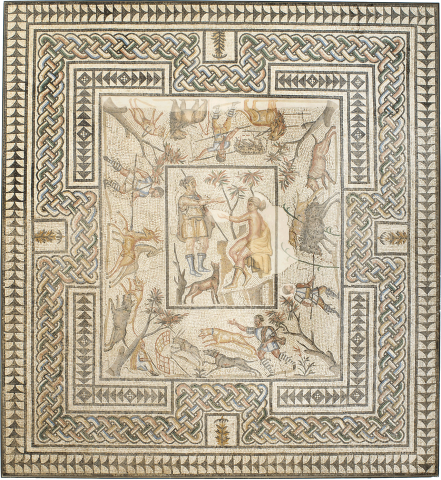
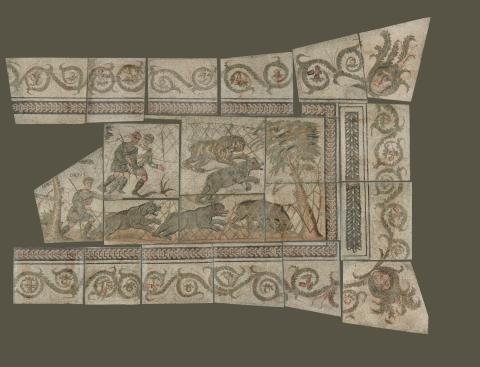
Scenes of hunters forcing bears and other animals into nets and traps are depicted on mosaics throughout the Roman Empire. Compare the 2nd c. AD example from Villelaure in France, and the 4th c. AD fragmentary mosaic of a bear hunt, now in the Getty Museum. Both clearly show the nets.
et quidem pulcherrimōs: quidem here intensifies pulcherrimōs “and very attractive (ones) indeed.”
Cowan remarks upon the frequent omission of the pronoun before quidem in Pliny and also in Cicero; here we might expect et eōs or et illōs quidem. There are several instances in Tacitus of this usage, but there is said to be only one in Quintilian (Westcott).
'Ipse?' ... Ipse: emphatic here, and changes person depending on who is talking. Pliny is imagining that his friend will be incredulous when he hears that he has actually caught not only one boar but three. “‘You yourself?’”...”Me myself.”
nōn tamen ut omnīnō … discēderem: "but (I did this, i.e. captured the boars) not (in such a way) that I entirely departed….” Omnīnō modifies discēderem. Supply a verb, like cēpī, in the clause that governs the ut and sets up the imperfect tense of the subjunctive in a clause of result (AG 537).
inertiā: inertia = otium, which does not necessarily mean idleness, but often the quiet pursuit of literature or science. The Romans did not consider literary labor as work, but only a dignified form of idleness (Westcott).
rētia: "nets," surrounding a part of the wood into which the game was driven by beaters (Westcott).
sedēbam: our Pliny was not designed by nature to be a big-game hunter. Even as a fisherman he had his limitations: in Letter 9.7 he remarks that one of his villas is so close to the lake that "you can cast your line into the water from the bedchamber—and almost from the bed" (Poteat).
Compare the seated figure at the bottom on the Villelaure hunting mosaic.
in proximō: "close by." Proximum governed by various prepositions is frequent in Pliny to express proximity (Prichard).
venabulum, lancea: the former was the usual hunting-spear for thrusting, with a long and broad blade; the latter was used for throwing, especially with the help of an amentum (Merrill).
stilus: a stick, made usually of ivory or bone, sometimes of iron or bronze, with one end sharpened for writing and the other flat or knobbed for purposes of erasure (Poteat). Bronze example in the Metropolitan Museum.
pugillārēs: supply tabulae, the word pugillares, a name frequently given to tablets covered with wax, is derived from pugillus (handful), because they were small enough to be held in the hand (Prichard).
meditābar aliquid: “I was meditating (on) something,” “I was pondering something.”
ēnotābamque: “writing down my thoughts.”
ēnotāre = "noting down thoughts of my own," while adnotare, often used in the letters, means "make notes upon" (Kingery).
manūs vacuās: “empty hands," i.e. empty-handed. Supply reportārem.
(2)
Nōn est quod contemnās: “There is no reason why you should condemn.” “There is no reason for you to condemn.” LS sum I.B.5.δ.
hoc studendī genus: direct object of contemnās.
mīrum est: introduces a noun clause, “it is amazing that….”
mirum est ... excitetur: a rather remarkable statement in view of ad retia sedebam, above; one wonders just what Pliny considered vigorous bodily activity; hunting of so sedentary a sort would scarcely stir up body or mind (Poteat).
agitātiōne mōtūque corporis: a hendiadys—"active movement." To a modern athlete there would not seem to be much activity in sitting beside a net with notebook in hand; but Pliny was not an athlete (Kingery).
undique silvae: “woods all around,” “woods on all sides.”
ipsumque illud: Both words modify silentium, “that silence itself.”
The order is the reverse of the normal one (Westcott).
silentium: Lord Orrery contrasts this silent method of hunting with ours, and says, "The sages of antiquity were rather poachers than sportsmen; they had no kind of delicacy in the music of the hounds or the composition of the pack. They had no ear; deepness, loudness, or sweetness of cry were undistinguished, and disregarded by the Greeks and Romans. Their dependance was upon their nets, more than upon their dogs" (Cowan).
vēnātiōnī datur: "is typical of hunting." See OLD do 20.b, "to give over (for a stated purpose)."
magna cōgitātiōnis incitāmenta: “great aids to reflection.”
(3)
vēnābere: alternative form of 2nd singular vēnāberis.
licēbit ... ferās: "you ought to take with you" (Cowan).
auctōre mē: ablative absolute, "with me as (your) advisor," "taking me as an example."
“upon the strength of my example” (Westcott).
ut pānārium et lagunculam sīc etiam pugillārēs: Ut and sīc are correlatives, “not only…but also.”
“not only a lunch-basket and wine-sack but also writing tablets.” (Kingery)
experiēris: "you see in practice"; introduces indirect statement. Nicely echoes the 2nd person singular future in vēnābere.
Diānam ... Minervam: the hunt traditionally belongs to Diana, but Pliny’s academic pursuits are also geared towards the domain of Minerva. Thus Minerva wanders in the woods as much as Diana.
The woods and mountainsides were the natural haunts of Diana, but only a student like Pliny would expect to meet there the goddess of wisdom and patron of literature (Kingery).
nōn … magis … quam: “not more than.”
montibus: ablative of place where with in understood. Others see it as dative after inerrare.
vocabulary
(1)
aper aprī m.: wild boar
omnīnō: entirely
inertia –ae, f.: laziness, leisure
quiēs –tis, f.: sleep, rest, relaxation
rēte rētis, n.: net, trap
proximus –a –um: nearest
vēnābulum –ī, n.: hunting–spear
lancea –ae, f.: lance
stilus –ī m.: a pen
pugillārēs –ium, m.: writing tablet
meditor –ārī –ātus sum: to think, meditate
ēnotō –āre –āvi –ātum: to note down, write down
cēra –ae, f.: wax
reportō –portāre –portāvī –portātus: to carry back, bring back
mīrus –a –um: marvelous, wonderful
(2)
agitātiō –ōnis, f.: movement, motion, agitation
mōtus mōtūs, m.: motion, movement
excitō –citāre –citāvī –citātus: to stir up, arouse, put into motion
sōlitūdō –inis, f.: solitude, peace
silentium (silentum) –i(ī), n.: silence
vēnātiō –ōnis, f.: hunting
cōgitātiō –ōnis, f.: thinking, thought
incitāmentum –ī, n.: incitement, motivation
(3)
proinde (proin): just as
venōr –ārī –ātus sum: to hunt, go hunting
pānārium –(i)ī n.: bread basket, picnic basket
laguncula –ae, f.: a small flask, flask
inerrō –errāre — — : to wander, ramble about