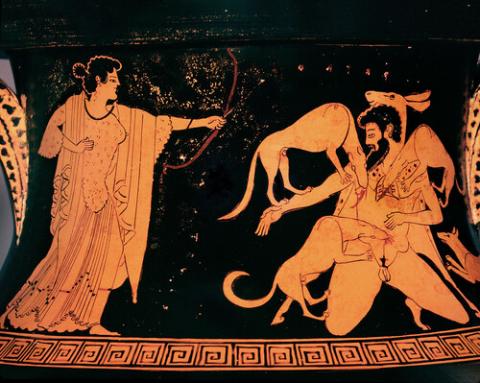
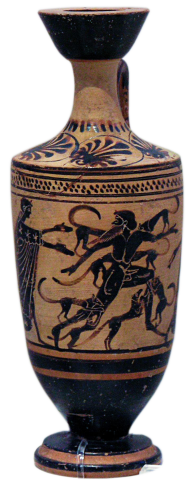
(1) φασὶν Ἀκταίωνα ὑπὸ τῶν ἰδίων κυνῶν καταβρωθῆναι. (2) τοῦτο δὲ ψευδές· κύων γὰρ δεσπότην καὶ τροφέα μάλιστα φιλεῖ, ἄλλως τε καὶ αἱ θηρευτικαὶ πάντας ἀνθρώπους σαίνουσιν. (3) ἔνιοι δέ φασιν ὡς Ἄρτεμις μὲν <εἰς ἔλαφον μετέβαλεν> αὐτόν, ἔλαφον δὲ ἀνεῖλον αἱ κύνες. (4) ἐμοὶ δὲ δοκεῖ Ἄρτεμιν μὲν δύνασθαι ὅ τι θέλοι ποιῆσαι· οὐ μέντοι ἐστὶν ἀληθὲς ἔλαφον ἐξ ἀνδρὸς ἢ ἐξ ἐλάφου ἄνδρα γενέσθαι· τοὺς δὲ μύθους τούτους συνέθεσαν οἱ ποιηταί, ἵνα οἱ ἀκροώμενοι μὴ ὑβρίζοιεν εἰς τὸ θεῖον. (5) τὸ δὲ ἀληθὲς ἔχει ὧδε. (6) Ἀκταίων ἦν ἀνὴρ τὸ γένος Ἀρκάς, φιλοκύνηγος. (7) οὗτος ἔτρεφεν ἀεὶ κύνας πολλὰς καὶ ἐθήρευεν ἐν τοῖς ὄρεσιν, τῶν δὲ αὑτοῦ πραγμάτων ἠμέλει. (8) οἱ δὲ τότε ἄνθρωποι αὐτουργοὶ πάντες ἦσαν οἰκέτας τε οὐκ εἶχον [, ἀλλ’ ἑαυτοῖς ἐγεώργουν], καὶ οὗτος ἦν πλουσιώτατος ὃς [αὐτὸς ἐγεώργει καὶ] ἐργατικώτατος ὑπῆρχε. (9) τῷ οὖν Ἀκταίωνι ἀμελοῦντι τῶν οἰκείων, μᾶλλον δὲ κυνηγετοῦντι, διεφθάρη ὁ βίος. (10) ὅτε δὲ οὐκέτι εἶχεν οὐδέν, ἔλεγον οἱ ἄνθρωποι “δείλαιος Ἀκταίων, ὃς ὑπὸ τῶν ἰδίων κυνῶν κατεβρώθη,” ὥσπερ καὶ νῦν ἐάν τις πορνοβοσκῶν ἀτυχήσῃ, λέγειν εἰώθαμεν “ὑπὸ τῶν πορνῶν κατεβρώθη.” (11) τοιοῦτον δή τι καὶ τὸ περὶ τὸν Ἀκταίωνα γέγονεν.
notes
Myths about Actaeon vary widely. The basic elements are that he was a hunter from Thebes and that he was devoured by his own dogs after being turned into a deer by the goddess, Artemis. The reasons for this transformation vary. It could be that Actaeon boasted of being a better hunter than the goddess, that he stumbled upon her while she was bathing, or that he angered Zeus (and Artemis by proxy) by courting Semele (Gantz 478-479). Whatever the case, P. dismisses the transformation element of the myth as pure fantasy and focuses on the core tale that, once upon a time, a hunter was eaten by his own dogs.
For the basic elements of this myth, see Apollodorus Bibliotheca 3.4.4; Diodorus Siculus 4.81.3–5; Ovid Metamorphoses 3.138–252.
For depictions of this myth, see Actaeon, Artemis, and hounds ca. 480 BCE; Actaeon, Artemis, and hounds ca. 480–470 BCE; Actaeon and hounds ca. 390-380/370 BCE; Actaeon plate ca. 350-340.
1
φασὶ: “people say.”
2
ἄλλως τε καὶ: “and especially.”
3
<εἰς ἔλαφον μετέβαλεν>: angled brackets within the Greek text indicate that the word has been added by the editor.
αὐτόν: refers to Actaeon.
ἀνεῖλον: 3rd pl. aor. indic. act. > ἀναιρέω.
4
ὅ τι θέλοι: 3rd sing. pres. opt. act. > ἐθέλω. The iterative optative suggests a repeated/habitual action in the past, “whatever she fancied.”
ὅ τι: “whatever.” A space is placed between ὅ and τι to distinguish the neuter singular indefinite relative pronoun (ὅστις, ἥτις, ὅ τι) from the conjunction ὅτι “that,” “because.”
οὐ μέντοι … ἄνδρα γενέσθαι: P. largely avoids rationalizing the “unbelievable” actions of the gods in the way Euhemerus will do later in the Hellenistic period. Here P’s commitment to the Peripatetic notion of species fixity leads him to an awkward situation in which he must limit the goddess’s supposed powers while attempting to compensate for this with the caveat that Artemis can do whatever she pleases. Compare his remarks on Zeus in Ch. 15.
οὐ μέντοι ἐστὶν ἀληθὲς: “but it is not in fact true that,” when the particle μέντοι replaces the δέ in a μέν … δέ clause it suggests an even stronger contrast.
ἔλαφον ἐξ ἀνδρὸς ἢ ἐξ ἐλάφου ἄνδρα γενέσθαι: indirect statement.
τοὺς δὲ μύθους τούτους συνέθεσαν: “but poets composed these stories.”
ἵνα … ὑβρίζοιεν: purpose clause. For P., poets and logographers (as well as artists, see Ch. 45) play a secondary role in myth creation (Koning 2020: 279). The tales originate from misinterpretations, and then artists add further to this misinterpretation. Sometimes, these additions are meant to entertain/amaze, but here, they are meant to instruct.
5
ἔχει ὧδε: “is as follows” (LSJ ἔχω B.II.2).
6
τὸ γένος: accusative of respect, “Arcadian by birth.”
φιλοκύνηγος: in apposition to ἀνὴρ.
7
ἀεὶ: “constantly.”
τῶν δὲ αὑτοῦ πραγμάτων: “his own affairs” referring to Ἀκταίων.
8
οἱ δὲ τότε ἄνθρωποι: “the people of that time.”
αὐτουργοὶ: when used substantively in the masculine, “one who works the land oneself,” i.e., not by slaves (LSJ αὐτουργός I.2).
[, ἀλλ’ ἑαυτοῖς ἐγεώργουν]: square brackets indicate a word or phrase that the editor suspects to be an explanatory note that was added by a reader and became part of the text.
ἑαυτοῖς: dative of interest, “for themselves.”
οὗτος ἦν πλουσιώτατος ὃς: “the wealthiest man was the one who.”
[αὐτὸς ἐγεώργει καὶ]: see previous note.
9
τῷ οὖν Ἀκταίωνι … διεφθάρη ὁ βίος: the particle οὖν marks a change of topic from discussion of ancient lifestyles back to Actaeon’s specific plight.
Ἀκταίωνι: “for Actaeon.”
ἀμελοῦντι: takes a genitive object. Agrees with Ἀκταίωνι.
τῶν οἰκείων: “household affairs,” “property.”
κυνηγετοῦντι: agrees with Ἀκταίωνι.
ὁ βίος: “his livelihood.”
10
οὐκέτι εἶχεν οὐδέν: “no longer had anything at all,” double negatives intensify one another rather than cancel one another out when the second negative is a compound word. Here, οὐκέτι “no longer” is followed by οὐδ|έν “not one.”
ἐάν τις πορνοβοσκῶν ἀτυχήσῃ: present general protasis, “if someone ever fails at running a brothel” (LSJ ἀτυχέω 2). P. is not referring to a hypothetical John but a “brothel-keeper” (πορνοβοσκός). The verb, βόσκω, means “to feed a herd” in the active and “to feed oneself” in the middle. Actaeon and the hard-luck brothel-keeper pointedly succeed at the former and fail at the latter.
εἰώθαμεν: 1st pl. pf. indic. act. > ἔθω, present simple apodosis.
11
τοιοῦτον δή τι: “clearly, a thing such as this.”
καὶ: adverbial.
τὸ περὶ τὸν Ἀκταίωνα: “the story about Actaeon.” The neuter singular article turns the prepositional phrase into a noun phrase, which is the subject of γέγονεν.
γέγονεν “became,” 3rd sing. pf. indic. act. > γίγνομαι.
vocabulary
1
Ἀκταίων –ωνος, ὁ Actaeon, a mythical hunter
κύων κυνός, ὁ/ἡ dog
καταβιβρώσκω, καταβρώσομαι, κατέβρωξα/ κατέβρων, καταβέβρωκα, καταβέβρωμαι, κατεβρώθην to devour
2
ψευδής –ες false
τροφεύς –έως, ὁ one who nourishes or raises, caretaker
φιλέω, contr. to love
θηρευτικός –ή –όν hunting, of hunting, sporting
σαίνω, σανῶ, ἔσηνα, —, —, — to fawn over, welcome; (lit.) to wag the tail
3
ἔνιος –α –ον some (often found in the plural with the same meaning)
Ἄρτεμις –ιδος, ἡ Artemis, the Greek goddess of the hunt
ἔλαφος –ου, ὁ/ἡ deer
μεταβάλλω, μεταβαλῶ, μετέβαλον, μεταβέβληκα, μεταβέβλημαι, μετεβλήθην to transform
4
μῦθος –ου, ὁ tale
συντίθημι, συνθήσω, συνέθηκα, συντέθεικα, συντέθειμαι, συνετέθην to combine
ἀκροάομαι, ἀκροάσομαι, ἠκροασάμην, ἠκρόαμαι, ἠκροάθην to listen
ὑβρίζω, ὑβριῶ, ὕβρισα, ὕβρικα, ὕβρισμαι, ὑβρίσθην to behave arrogantly, insolently
6
Ἀρκάς –άδος, ὁ of Arcadia, Arcadian
φιλοκύνηγος –ον passionate about hunting
7
θηρεύω, θηρεύσω, ἐθήρευσα, τεθήρευκα, τεθήρευμαι, ἐθηρεύθην to go hunting, hunt
ἀμελέω, contr. to neglect (+ gen.)
8
αὐτουργός –όν one who works the land for oneself; a farmer
οἰκέτης –ου, ὁ slave of a household
πλούσιος –α –ον wealthy
ἐργατικός –ή –όν industrious
9
κυνηγετέω, contr. to go hunting, hunt
10
δείλαιος –α –ον unfortunate
πορνοβοσκέω, contr. to keep a brothel
ἀτυχέω, contr. to be unlucky; fail at (+ ptc.)
ἔθω, —, —, εἴωθα, —, — to be accustomed (perfect has present sense)
πόρνη –ης, ἡ prostitute