(1) ὁ περὶ Πανδώρας οὐκ ἀνεκτὸς λόγος, ὡς ἐκ γῆς ἀναπλασθεῖσαν ἀναδοῦναι αὐτὴν καὶ ἄλλοις τὸ πλάσμα. (2) ἐμοὶ δὲ οὐ δοκεῖ τοῦτο· ἀλλὰ Πανδώρα γυνὴ ἐγένετο Ἕλλην μάλιστα πλουσία, καὶ ὅτε ἐξίοι, ἐκοσμεῖτο καὶ ἐχρίετο πολλῇ τῇ γῇ. (3) πρώτη γὰρ αὕτη ἐξεῦρε χρίεσθαι πολλῇ τῇ γῇ τὸ χρῶμα (ὡς καὶ νῦν πολλαί· ὀνομάζεται δὲ οὐδεμία διὰ τὸ πλεῖστον). (4) καὶ τὸ μὲν ἔργον οὕτως ἔχει· ὁ δὲ λόγος ἐπὶ τὸ ἀμήχανον ἐτράπη.
notes
The oldest account of the Pandora myth is found in the poetry of Hesiod. After Prometheus stole fire from the gods and gifted it to humanity, Zeus ordered Hephaestus to create a “gift”—Pandora’s name consists of the roots πᾶν (“all,” “every”) and δῶρον (“gift”)—to punish them. Hephaestus crafted Pandora, the first human woman, out of the earth, and various gods and goddesses helped imbue her with physical beauty and a “deceitful” nature. Pandora possessed a jar containing various plagues and evils, which she unleashed on humankind.
For a fuller version of the story that Palaephatus is responding to, see Hesiod Works and Days 61–105, Theogony 571–612.
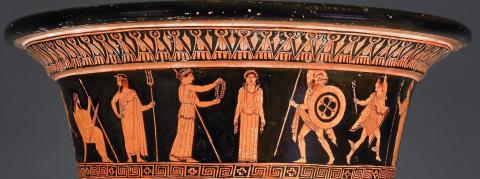
For ancient depictions of this myth, see Creation of Pandora, red-figure calyx krater ca. 460–450 BCE.
1
ὁ … λόγος: supply ἐστι.
ὡς ἐκ γῆς ἀναπλασθεῖσαν ἀναδοῦναι αὐτὴν καὶ ἄλλοις τὸ πλάσμα: indirect statement with ὡς/ὅτι can sometimes be followed by an accusative + infinitive construction (S. 2628); "that, having been molded from earth (clay), she passed on her bodily form to others as well."
ἄλλοις: indirect object of ἀναδοῦναι. In the myth the "others" are women, the race descended from Pandora; the masculine lightly generalizes P.'s objection that a figure made of earth cannot impart its form to anyone.
τὸ πλάσμα: "her (molded) form," picking up ἀναπλασθεῖσαν.
αὐτὴν: i.e., Pandora, who is the subject of the indirect statement.
καὶ: adverbial.
- read more
-
The Pandora chapter was omitted (deliberately?) in the B branch of the manuscript tradition, and the three witnesses that do transmit it give three different readings of this sentence. See Villa 2.2, who believes the passage is probably corrupt. The printed text is a reasonable reconstruction by Festa of what Palaephatus may have written. Palaephatus is objecting to the general idea that a thing molded from earth can impart its bodily form to others. The masculine ἄλλοις seems to mark the generality of the objection, and πλάσμα, which can have the meaning of bodily form, picks up ἀναπλασθεῖσαν - perhaps a weak pun.
2
ὅτε ἐξίοι: the iterative optative (without ἄν) in a past-time temporal clause indicates a habitual or repeated action, “whenever she went out.”
πολλῇ τῇ γῇ: the “earth” mentioned here refers to white lead, which was used as a facial cosmetic by Athenian women.
3
ὡς: conjunction, “as.”
καὶ: adverbial.
ὀνομάζεται: “is made famous.”
διὰ τὸ πλεῖστον: “because it is so common.”
4
οὕτως ἔχει: “happened in that way” (LSJ ἔχω B.II.2).
ἐτράπη: 3rd sing. aor. indic. pass. > τρέπω.
vocabulary
1
Πανδώρα –ας, ἡ Pandora
ἀνεκτός –όν tolerable
ἀναπλάττω, –πλάσω, –έπλασα, –πέπλακα, –πέπλασμαι, –επλάσθην to form, mould
ἀναδίδωμι, ἀναδώσω, ἀνέδωκα, ἀναδέδωκα, ἀναδέδομαι, ἀνεδόθην to impart
πλάσμα –ατος, τό form
2
Ἕλλην –ηνος of Hellas, Hellene, Greek
πλούσιος –α –ον wealthy
ἔξειμι, —, —, —, —, — to go out
κοσμέω, contr. to adorn, decorate
χρίω to rub, apply something to one’s skin
3
ἐξευρίσκω, ἐξευρήσω, ἐξηῦρον/ ἐξεῦρα (dialectal: ἐξεῦρον), ἐξηύρηκα, ἐξηύρημαι, ἐξηυρέθην to discover, detect
χρῶμα –ατος, τό color
4
ἀμήχανος –ον unworkable, impossible