(1) περὶ Πασιφάης μυθεύεται ὡς ἠράσθη ταύρου νεμομένου, Δαίδαλον δὲ ποιῆσαι βοῦν ξυλίνην καὶ ἐγκλεῖσαι τὴν Πασιφάην εἰς αὐτήν, οὕτω δὲ τὸν ταῦρον ἐπιβάντα μιγῆναι τῇ γυναικί, τὴν δὲ κυῆσαι καὶ τεκεῖν παῖδα σῶμα μὲν ἔχοντα ἀνδρός, κεφαλὴν δὲ βοός. (2) ἐγὼ δὲ τοῦτο οὔ φημι γενέσθαι. (3) πρῶτον μὲν γὰρ ἀδύνατον ἐρασθῆναι ζῷον ἕτερον ἑτέρου μὴ ὁμοίως ἔχον τὴν μήτραν τοῖς αἰδοίοις· οὐ γὰρ δυνατὸν κύνα καὶ πίθηκον καὶ λύκον τε καὶ ὕαιναν ἀλλήλοις μίγνυσθαι οὐδὲ βούβαλον ἐλάφῳ (ἑτερογενῆ γὰρ ὑπάρχει), οὐδὲ ἀλλήλοις μιγνύμενα γεννᾶν. (4) ταῦρος δὲ οὐ δοκεῖ μοι πρῶτον μὲν ἀναμιχθῆναι ξυλίνῃ βοΐ· πάντα γὰρ τὰ τετράποδα [ζῷα] ὀσφραίνεται τῶν αἰδοίων τοῦ ζῴου πρὸ τῆς μίξεως, καὶ οὕτως ἀναβαίνει ἐπ’ αὐτό· οὐδ’ ἂν ἠνέσχετο ταύρου ἐπιβαίνοντος ἡ γυνή, οὐδὲ φέρειν δύναται γυνὴ ἔμβρυον κέρατα ἔχον. (5) τὸ δ’ ἀληθὲς ἔχει ὧδε. (6) Μίνωά φασιν ἀλγοῦντα τὰ αἰδοῖα τεθεραπεῦσθαι ὑπὸ Πρόκριδος τῆς Πανδίονος ἐπὶ τῷ κυνιδίῳ καὶ τῷ ἀκοντίῳ *** Κέφαλον. (7) κατὰ δὲ τὸν χρόνον τοῦτον Μίνῳ ἠκολούθει νεανίας κάλλει διαφέρων, ᾧ ὄνομα ἦν Ταῦρος. (8) τούτου Πασιφάη ἔρωτι ἁλοῦσα καὶ πείσασα μίγνυται, καὶ ἐγέννησεν ἐξ αὐτοῦ παῖδα. (9) Μίνως δ’ ἐπιλογισάμενος τὸν χρόνον τῆς ἀλγηδόνος τῶν αἰδοίων, καὶ ἐπιγνοὺς ὡς οὐκ ἔστιν ἐξ αὐτοῦ ὁ παῖς διὰ τὸ μὴ συγκοιμᾶσθαι, ἐξετάζων τὸ ἀκριβὲς ἐπέγνω ὅτι ἐκ τοῦ Ταύρου ἐστὶ τὸ γεννηθέν. (10) ἀποκτεῖναι μὲν οὖν οὐκ ἔδοξεν αὐτῷ διὰ τὸ δοκεῖν ἀδελφὸν εἶναι τῶν παίδων· ἀποπέμπει δὲ αὐτὸν εἰς τὸ ὄρος ὅπως αὐξηθεὶς ὑπάρχῃ ἐν θεράποντος μοίρᾳ τοῖς ποιμέσιν. (11) ἀνδρωθεὶς δὲ οὗτος οὐχ ὑπήκουε τῶν βουκόλων. (12) πυθόμενος δὲ ὁ Μίνως καταντᾶν αὐτὸν ἐκέλευσεν εἰς τὴν πόλιν, κρατεῖν δὲ αὐτόν· καὶ εἰ μὲν ἑκὼν ἕποιτο, λελυμένον ἐλθεῖν, εἰ δὲ μή, δέσμιον. (13) αἰσθόμενος δ’ ὁ νεανίας ἀφίσταται εἰς τὰ ὄρη, καὶ ἁρπάζων βοσκήματα οὕτω διέζη. (14) πέμψαντος δὲ τοῦ Μίνωος πλείονα ὄχλον εἰς τὸ συλλαβεῖν αὐτόν, ὁ νεανίας ὄρυγμα βαθὺ ποιήσας καθεῖρξεν ἑαυτὸν εἰς ἐκεῖνο. (15) ἔνθα ὄντι αὐτῷ τὸν μὲν ἄλλον χρόνον εἰσεβάλλοντο πρόβατα καὶ αἶγας, καὶ ἔζη σιτούμενος· ὁπότε δὲ Μίνως ἄνθρωπον ἠβούλετο τιμωρήσασθαι, τούτῳ καθειργμένῳ ἐν τῷ οἰκήματι εἰσέπεμπε, καὶ οὕτως ἀνῃρεῖτο. (16) καὶ τὸν Θησέα ἄνδρα πολέμιον λαβὼν ὁ Μίνως ἤγαγε ἐπὶ τὸν τόπον ὡς ἀποθανούμενον· ἡ δὲ Ἀριάδνη προεισπέμπει ξίφος εἰς τὴν εἱρκτήν, ἐν ᾧ ὁ Θησεὺς ἀνεῖλε τὸν Μινώταυρον *** τοιούτου δὲ τοῦ συμβάματος γενομένου, ἐπὶ τὸ μυθῶδες οἱ ποιηταὶ τὸν λόγον ἐξέτρεψαν.
notes
According to myth, Poseidon gifted Minos, the Cretan king, a flawless bull on the promise that the king would sacrifice the bull. Minos broke that promise by keeping the bull. As a consequence, Poseidon cursed Minos’s wife, Pasiphae, to fall in love with the beast. With the help of Daedalus, the legendary inventor, Pasiphae succeeded in sleeping with it and giving birth to the so-called Minotaur, a creature with the head of a bull and the body of a man.
For the basic elements of the myth, see Apollododorus, Bibliotheca 3.1.3–4, Epitome 1.7–9; Diodorus Siculus 4.77.1–4; Hyginus, Fabulae 40.
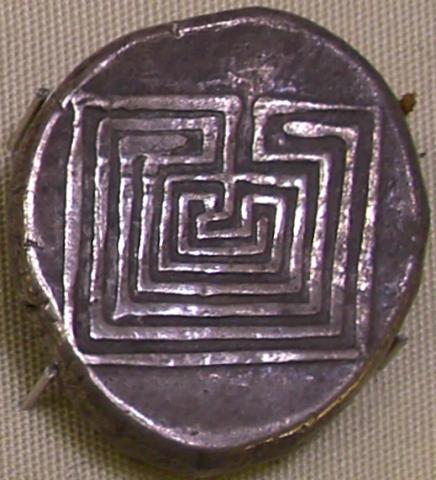
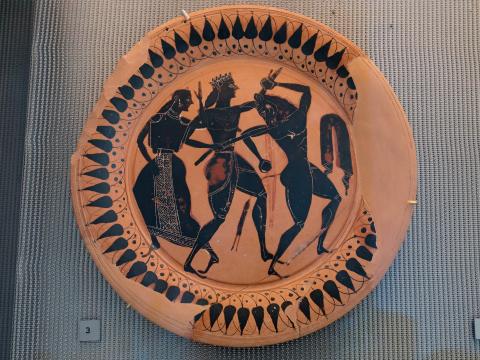
For ancient depictions of the myth, see Pasiphae and infant Minotaur 340-320 BCE, Labyrinth depicted on coin ca. 400 BCE, Theseus killing the Minotaur with Ariadne (?) 540-550 BCE, and Myron’s Minotaur ca. 400 BCE.
1
περὶ Πασιφάης μυθεύεται ὡς: this sentence contains several strings of indirect discourse, beginning with ὡς … νεμομένου, followed by three successive clauses in the accusative-infinitive construction: (1) Δαίδαλον … ποιῆσαι, (2) ταῦρον … μιγῆναι, (3) τὴν δὲ … κυῆσαι … τεκεῖν.
μυθεύεται: take impersonally, “the story is told that.”
ἠράσθη: 3rd sing. aor. indic. dep. > ἔραμαι; the passive of this verb has a middle sense. Takes a genitive direct object. The subject is Πασιφάη.
εἰς αὐτήν: refers to βοῦν ξυλίνην.
τὸν ταῦρον … μιγῆναι: aor. infin. pass. > μίγνυμι. Accusative-infinitive construction within an indirect statement; μίγνυμι takes a dative direct object.
ἐπιβάντα: ptc. sing. aor. act. masc. acc., “having mounted [her].”
τὴν δὲ: refers to Πασιφάη.
ἔχοντα: agrees with παῖδα.
2
οὔ φημι: “I deny that.”
3
πρῶτον: adverbial, “first of all.”
ἀδύνατον: supply ἐστι, “it is impossible that” + indirect statement.
ἐρασθῆναι: aor. infin. dep. > ἔραμαι; infinitive within an indirect statement. Takes a genitive direct object.
ζῷον: accusative subject within an indirect statement.
ἕτερον ἑτέρου: correlatives, “one type [of animal] makes love with another type [of animal].”
μὴ ὁμοίως ἔχον τὴν μήτραν τοῖς αἰδοίοις: “not being the same in their genitals as far as the womb is concerned.” The negative μή is occasioned by the generic nature of what the participle modifies.
ἔχον: “is (+adv)” (LSJ ἔχω B.II.2).
τὴν μήτραν: accusative of respect.
οὐ γὰρ δυνατὸν: supply ἐστι, “for it is impossible that.”
καὶ κύνα καὶ πίθηκον καὶ λύκον τε καὶ ὕαιναν: accusative subjects within an indirect statement.
καὶ … καὶ … καὶ … τε καὶ: the conjunction τε signals that what it follows is the first of an enumeration. Thus, the sequence of conjunction indicates two pairings: both dog and monkey as well as wolf and hyena.
μίγνυσθαι: infinitive within an indirect statement. Takes a dative direct object.
οὐδὲ βούβαλον ἐλάφῳ: supply δύνατον ἐστι μίγνυσθαι again.
(ἑτερογενῆ … ὑπάρχει): the implied subject is ἐκεῖνα ζῷα, “those animals.”
ὑπάρχει: singular verb with neuter plural subject.
οὐδὲ ἀλλήλοις μιγνύμενα γεννᾶν: supply δύνατον ἐστι, “nor is it possible that.”
μιγνύμενα: accusative subject of γεννᾶν; takes a dative direct object. The implied subject is once again ἐκεῖνα ζῷα, referring to all of the animals just listed.
4
ταῦρος δὲ οὐ δοκεῖ μοι: “And a bull does not seem to me like it would (+ infin.).”
πρῶτον: adverbial, “first of all.”
ἀναμιχθῆναι: aor. infin. pass. > ἀναμίσγω. Takes a dative direct object.
πάντα γὰρ τὰ τετράποδα [ζῷα]: neuter plural subjects of ὀσφραίνεται. Square brackets indicate a word or phrase that the editor suspects to be an explanatory note that was added by a reader or a scribe and subsequently became incorporated into the text.
ὀσφραίνεται: singular verb with neuter plural subject; takes a genitive object. Many four-legged mammals do engage in this practice. But not all.
καὶ οὕτως: “and then.”
ἐπ’ αὐτό: refers to τοῦ ζῴου.
οὐδ’ ἂν ἠνέσχετο: 3rd sing. aor. indic. mid. > ἀνέχω. The apodosis of a counterfactual conditional triggered by ἐπιβαίνοντος, “then the woman would not have endured.”
ταύρου ἐπιβαίνοντος: translate the circumstantial participle as the protasis of a past counterfactual condition: “if the bull mounted [her].”
ἔμβρυον: subject of ἔχον.
κέρατα: object of ἔχον.
5
τὸ δ’ ἀληθὲς ἔχει ὧδε: “the truth is as follows” (LSJ ἔχω B.II.2).
6
φασιν: “people say that.”
τὰ αἰδοῖα: accusative of respect.
τεθεραπεῦσθαι: “had been healed,” pf. infin. mid.-pass. > θεραπεύω; infinitive verb within an indirect statement.
ὑπὸ Πρόκριδος τῆς Πανδίονος: “by Procris, daughter of Pandion.” According to myth, Procris fled to King Minos’s court after being caught cheating on her husband, Cephalus. Minos was suffering from a curse inflicted by his wife, Pasiphae, in revenge for his own infidelity. The curse caused him to ejaculate scorpions, snakes, and centipedes, which killed his previous lover. When Procris arrived at Knossos, she cured Minos with an herb.
ἐπὶ τῷ κυνιδίῳ καὶ τῷ ἀκοντίῳ: “in exchange for” (LSJ ἐπί B.III).
*** Κέφαλον: the asterisks indicate that there is a chunk of text missing. Presumably, P. is alluding to the next part of the Procris myth. After being healed, Minos showed his gratitude to Procris by giving her a magical hound and javelin. She gave these gifts to her husband Cephalus to earn his forgiveness. Whatever version of the story P. is responding to, we can safely assume that he rejects the fantastical details about scorpions, snakes, and centipedes, as well as the magical dog and javelin.
7
κατὰ δὲ τὸν χρόνον τοῦτον: “and during this time.”
κάλλει διαφέρων: “excelling in beauty” (LSJ διαφέρω III.4).
8
τούτου: i.e., Ταῦρος.
ἔρωτι: “by desire,” dative of cause with ἁλοῦσα.
ἁλοῦσα: ptc. sing. aor. pass. fem. nom. > ἁλίσκομαι, with active/intransitive sense, “having been caught/overcome.”
πείσασα: act. aor. ptc., “having persuaded him,” “having seduced him.” The implied object is Ταῦρος.
μίγνυται: historical present. Used in narratives to underscore turning points. Translate as past tense.
ἐγέννησεν ἐξ αὐτοῦ παῖδα: “she gave birth to his child” (LSJ ἐκ A.III.2).
9
ἐπιγνοὺς: ptc. sing. aor. act. masc. nom. > ἐπιγιγνώσκω.
ἔστιν: when ἐστι is followed by οὐκ, it takes a recessive accent.
ἐξ αὐτοῦ: “his (i.e., Minos).” (LSJ ἐκ A.III.2).
διὰ τὸ μὴ συγκοιμᾶσθαι: articular infinitive, “because they were not sleeping together.” The articular infinitive is always negated by μή.
τὸ ἀκριβὲς: adverbial accusative, “carefully.”
ἐπέγνω: 3rd sing. aor. indic. act. > ἐπιγιγνώσκω.
ἐκ τοῦ Ταύρου ἐστὶ τὸ γεννηθέν: “the one born is Taurus’s [child].” The article (τὸ) turns the neuter participle (γεννηθέν) into a noun. (LSJ ἐκ A.III.2).
10
ἀποκτεῖναι: supply τὸν παῖδα as the direct object.
οὖν: the particle signals a change of topic. Here, it is from the story of Minos to the story of the “Minotaur.”
οὐκ ἔδοξεν αὐτῷ: “it did not seem right to him (i.e., Μίνως) … (+ infin.)” (LSJ δοκέω II.4.b).
διὰ τὸ δοκεῖν … εἶναι: articular infinitive; supply τὸν παῖδα as the subject, “because of (the child) seeming to be.”
τῶν παίδων: i.e., of Minos’s legitimate children.
ἀποπέμπει: historical present. Used in narratives to underscore turning points. Translate as past tense.
αὐτὸν: i.e., the child of Ταῦρος and Πασιφάη, a.k.a., the “Minotaur.” P. never gives the child a name, and he only mentions the nickname, Μινώταυρος, at the end of the chapter.
ὅπως αὐξηθεὶς ὑπάρχῃ: purpose clause.
αὐξηθεὶς: “after growing up,” sing. aor. pass. masc. nom. > αὐξάνω. Subject is the child of Ταῦρος and Πασιφάη.
τοῖς ποιμέσιν: dative of interest with θεράποντος.
11
οὗτος: refers to the child of Ταῦρος and Πασιφάη.
ὑπήκουε: takes a genitive direct object.
12
πυθόμενος: “having been informed of this,” ptc. sing. aor. dep. masc. nom. > πυνθάνομαι.
καταντᾶν αὐτὸν ἐκέλευσεν: “ordered him to come down (from the mountain).”
κρατεῖν δὲ αὐτόν: supply ἐκέλευσεν again, “and he gave orders to apprehend him” (LSJ κελεύω I.9).
καὶ εἰ μὲν ἑκὼν ἕποιτο, λελυμένον ἐλθεῖν, εἰ δὲ μή, δέσμιον: continued indirect discourse triggered by ἐκέλευσεν from the previous clause.
εἰ μὲν ἑκὼν ἕποιτο: a future condition embedded in indirect discourse; the original subjunctive has shifted into the oblique optative, “if he should follow willingly.”
λελυμένον ἐλθεῖν: “(Minos ordered that) he come unfettered.”
εἰ δὲ μή, δέσμιον: the same syntax as the previous conditional clause, “(Minos ordered that), if he will not (follow willingly), (he be) bound.”
13
αἰσθόμενος: “having perceived (what was happening),” ptc. sing. aor. dep. masc. nom. > αἰσθάνομαι.
ἀφίσταται: 3rd sing. pres. indic. mid. > ἀφίστημι. Historical present. Used in narratives to underscore turning points. Translate as past tense.
ἁρπάζων … διέζη: supplementary participle, “he stayed alive by stealing.”
14
πέμψαντος δὲ τοῦ Μίνωος: genitive absolute.
εἰς τὸ συλλαβεῖν: articular infinitive governed by εἰς, “to capture (acc.)” (LSJ εἰς I.4.a).
αὐτόν: refers to the “Minotaur.”
εἰς ἐκεῖνο: “into that,” refers to the ὄρυγμα (the “pit/tunnel”). P’s oblique way of rationalizing the myth of the labyrinth. According to legend, Minos had Daedalus construct a maze-like prison (the so-called labyrinth) in which he kept the Minotaur.
καθεῖρξεν: 3rd sing. aor. indic. act. > κατείργω.
15
ἔνθα ὄντι αὐτῷ: “to him while he was in there” (i.e., in the pit/tunnel).
αὐτῷ: refers to the “Minotaur.” The people above tossed down (εἰσεβάλλοντο) sheep and goats to him while he was in the bottom of the pit/tunnel.
τὸν … ἄλλον χρόνον: accusative of duration of time which, “for the rest of his days.”
ὁπότε δὲ Μίνως … ἠβούλετο: “And when Minos wanted to.”
ἠβούλετο: 3rd sing. impf. indic. dep. > βούλομαι. In the Attic dialect, the verbs βούλομαι, δύναμαι, and μέλλω start to receive the augment ἠ– instead of ἐ– in the 4th century BCE. This is around the time that P. is writing.
τιμωρήσασθαι: “to punish.”
τούτῳ καθειργμένῳ ἐν τῷ οἰκήματι εἰσέπεμπε: “he sent (whomever Minos wished to punish) to that man (i.e., the “Minotaur”) who was shut inside his dwelling.”
ἀνῃρεῖτο: the subject is the hypothetical person (the indefinite ἄνθρωπον earlier in the sentence) whom Minos wishes to punish.
16
ἄνδρα πολέμιον: in apposition to τὸν Θησέα. According to myth, the Athenians owed Minos an annual tribute of seven boys and seven girls. Among them was the Greek hero Theseus. When these youths arrived, Minos sent them into the labyrinth to die.
τὸν τόπον: i.e., the pit/tunnel.
ἀποθανούμενον: future participle expressing purpose: “in order to die.”
ἡ δὲ Ἀριάδνη προεισπέμπει ξίφος: according to myth, Minos’s daughter, Ariadne snuck a ball of thread to Theseus which he used to track his progress through the labyrinth.
προεισπέμπει: historical present. Used in narratives to underscore turning points. Translate as past tense.
τὴν εἱρκτήν: i.e., the pit/tunnel. P. subtly transforms it from a hideout to a prison.
ἐν ᾧ: “armed with which,” the relative pronoun refers back to the sword (ξίφος) sent ahead by Ariadne. For this instrumental use of ἐν, compare the phrase ἐν τοῖς ὅπλοις, “armed,” “under arms” (LSJ ἐν A.I.3).
τὸν Μινώταυρον ***: P. at last gives the name “Minotaur,” a portmanteau of Μίνως (his stepfather) and Ταῦρος (his real father). Since P. never spells out who came up with this name and why, the editor Festa suspects—rightly or wrongly—that a piece of the text is missing, which is indicated by the three asterisks.
τοιούτου δὲ τοῦ συμβάματος γενομένου: genitive absolute.
τὸ μυθῶδες: the article turns the adjective into a noun, “something legendary.”
vocabulary
1
Πασιφάη –ης, ἡ Pasiphaë, wife of Minos
μυθεύω, —, ἐμύθευσα, μεμύθευκα, μεμύθευμαι, ἐμυθεύθην to tell a tale
ἔραμαι, —, —, —, ἤρασμαι, ἠράσθην to love, make love with (+ gen.)
νέμω, νεμῶ, ἔνειμα, νενέμηκα, νενέμημαι, ἐνεμήθην to graze
Δαίδαλος –ου, ὁ Daedalus, a mythical craftsman and inventor
ξύλινος –η –ον wooden
ἐγκλείω, ἐγκλείσω, ἐνέκλεισα, ἐγκέκλεικα, ἐγκέκλῃμαι, ἐνεκλείσθην to shut in
ἐπιβαίνω, ἐπιβήσομαι, ἐπέβησα, ἐπιβέβηκα, —, — to mount
κυέω, contr. to be/become pregnant
3
ὁμοίως, adv. in conformity with, the same in regard to (+ dat.)
μήτρα –ας, ἡ womb
αἰδοῖον –ου, τό genitalia, private parts
κύων, κυνός, ὁ/ἡ dog
πίθηκος –ου, ὁ monkey, ape
λύκος –ου, ὁ/ἡ wolf
ὕαινα –ης, ἡ hyena
βούβαλος ‑ου, ὁ antelope
ἔλαφος ‑ου, ὁ/ἡ deer
ἑτερογενής ‑ές of a different species
4
ἀναμίσγω, ἀναμ(ε)ίξω, ἀνέμ(ε)ιξα, ἀναμέμιχα, ἀναμέμ(ε)ιγμαι, ἀνεμ(ε)ίχθην to mingle; to have sex with (+ dat.)
τετράπους –ουν (gen. –ποδος) four-legged, quadruped
ὀσφραίνομαι, ὀσφρήσομαι, ὠσφρόμην, —, —, ὠσφράνθην to sniff (+ gen.)
μίξις –εως, ἡ intercourse, sex
ἀνέχω, ἀνέξω or ἀνασχήσω, ἀνέσχον, ἀνέσχηκα, —, — to put up with, endure (+ gen.)
ἔμβρυον –ου, τό fetus, embryo
κέρας –αος, (contr. –ως), τό horn
6
Μίνως –ωος, ὁ Minos, a mythical king of Knossos, Crete
ἀλγέω, contr. to feel pain
θεραπεύω to help
Πρόκρις –ιδος, ἡ Procris
Πανδίων –ονος, ὁ Pandion, father of Procris
κυνίδιον –ου, τό puppy
ἀκόντιον –ου, τό javelin
Κέφαλος –ου, ὁ Cephalus
7
ἀκολουθέω, contr. to follow (+ dat.)
διαφέρω, διοίσω, διήνεγκα/διήνεγκον, διενήνοχα, διενήνεγμαι, διηνέχθην to excel in (+ dat.)
8
ἔρως –ωτος, ὁ love
9
ἐπιλογίζομαι, ἐπιλογιοῦμαι, ἐπελογισάμην, —, ἐπιλελόγισμαι, — to take into account
ἀλγηδών, ἀλγηδόνος, ἡ ailment, pain, suffering
ἐπιγιγνώσκω, ἐπιγνώσομαι, ἐπέγνων, ἐπέγνωκα, ἐπέγνωσμαι, ἐπεγνώσθην to recognize
συγκοιμάομαι, συγκοιμήσομαι, —, —, συγκεκοίμημαι, συνεκοιμήθην to sleep with
ἐξετάζω, ἐξετάσω, ἐξήτασα, ἐξήτακα, ἐξήτασμαι, ἐξητάσθην to examine thoroughly
10
ἀποπέμπω, ἀποπέμψω, ἀπέπεμψα, ἀποπέπομφα, ἀποπέπεμμαι, ἀπεπέμφθην to send off
αὐξάνω, αὐξήσω, ηὔξησα, ηὔξηκα, ηὔξημαι, ηὐξήθην to grow up
μοῖρα –ας, ἡ lot in life; role of (+ gen.)
ποιμήν –ένος, ὁ shepherd
11
ἀνδρόω, contr. to become a grown man
ὑπακούω, ὑπακούσομαι, ὑπήκουσα, ὑπακήκοα, —, ὑπηκούσθην to listen to (+ gen.)
βουκόλος –ου, ὁ herdsman
12
καταντάω, contr. to come down
ἑκών, ἑκοῦσα, ἑκόν willing
δέσμιος –ον bound, shackled
13
ἀφίστημι, ἀποστήσω, ἀπέστησα, —, —, — to move aside; (mid.) to remove oneself, withdraw
ἁρπάζω, ἁρπάσω, ἥρπασα, ἥρπακα, ἥρπασμαι, ἡρπάσθην/ ἡρπάγην to steal
βόσκημα –ατος, τό livestock
διαζάω, contr. to make a living; stay alive
14
πλείων, πλεῖον more, greater; more numerous
ὄχλος –ου, ὁ crowd, throng, mob
συλλαμβάνω, συλλήψομαι, συνέλαβον, συνείληφα, συνείλημμαι, συνελήφθην to capture
ὄρυγμα –ατος, τό ditch, tunnel, trench
βαθύς –εῖα –ύ deep
κατείργω, καθείρξω, καθεῖρξα, —, καθεῖργμαι, καθείρχθην to shut in
15
εἰσβάλλω, εἰσβαλέω, εἰσέβαλον, εἰσβέβληκα, εἰσβέβλημαι, εἰσεβλήθην to throw into, drive into
πρόβατον –ου, τό sheep
αἴξ, αἰγός, ὁ/ἡ goat
σιτέω, σιτήσομαι, ἐσίτησα, —, —, ἐσιτήθην to eat
οἴκημα –ατος, τό dwelling
εἰσπέμπω, εἰσπέμψω, εἰσέπεμψα, εἰσπέπομφα, εἰσπέπεμμαι, εἰσεπέμφθην to send to (+ dat.)
16
Θησεύς –έως, ὁ Theseus, an Athenian hero
Ἀριάδνη –ης, ἡ Ariadne, daughter of Minos
προεισπέμπω, προεισπέμψω, προεισέπεμψα, προεισπέπομφα, προεισπέπεμμαι, προεισεπέμφθην to send ahead beforehand
ξίφος –ους, τό sword
εἱρκτή –ῆς, ἡ enclosure, prison
σύμβαμα –ατος, τό event, misfortune
μυθώδης –ες fabulous, legendary
ἐκτρέπω, ἐκτρέψω, ἐξέτρεψα, —, ἐκτέτραμμαι, ἐξετράπην to change