(1) λέγεται ὅτι Αἴολος ἄνθρωπος ἦν κυριεύων πνευμάτων, ὅστις ἔδωκεν Ὀδυσσεῖ τοὺς ἀνέμους ἐν ἀσκῷ· περὶ δὲ τούτου, ὡς οὐχ οἷόν τε γίνεσθαι, δῆλον εἶναι πᾶσιν οἶμαι. (2) εἰκὸς δὲ ἀστρολόγον γενόμενον Αἴολον φράσαι Ὀδυσσεῖ τοὺς χρόνους καὶ καθ’ ἃς ἐπιτολὰς ἄνεμοί τινες πνευσοῦνται. (3) φασὶ δὲ ὅτι καὶ χαλκοῦν τεῖχος τῇ πόλει αὐτοῦ περιεβέβλητο, ὅπερ ἐστὶ ψεῦδος· ὁπλίτας γὰρ εἶχε τὴν πόλιν αὐτοῦ φυλάττοντας.
notes
According to Homer, Aeolus was a king of the bronze-walled Island Aeolia. He was made master of the winds by Zeus. When Odysseus arrived at the island, Aeolus entrusted the hero with a sack that contained all of the tempestuous winds. As long as the sack remained shut tight, it ensured that Odysseus would have a safe course home to Ithaca. P. takes issue with both the idea that a human can master winds in this way and that a city can have walls made entirely of bronze.
For the basic elements of this myth, see Homer, Odyssey 10.1–76; Apollodorus, Epitome 7.10.
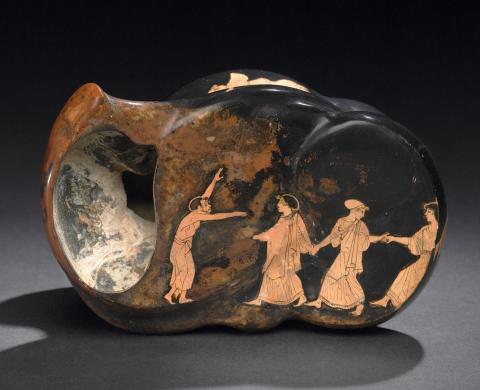
For depictions of this myth, see Aeolus teaching the clouds to dance ca. 470-450 BCE.
1
λέγεται: “it is said.”
ἔδωκεν: 3rd sing. aor. indic. act. > δίδωμι.
ὡς: “that,” indirect exclamation triggered by δῆλον εἶναι πᾶσιν οἶμαι.
οὐχ οἷόν τε: > οὐχ οἷόν τε ἐστί, “it is not possible to (infin.).”
2
εἰκὸς: “it seems likely that,” triggers an indirect statement.
καθ’ ἃς ἐπιτολὰς (= ἐπιτολὰς καθ’ ἃς): “the rising signs in accordance with which,” the antecedent is incorporated within the relative clause. We do the same thing in English, He took what tools he needed, where tools is technically the antecedent to what.
ἐπιτολὰς: a “rising sign” is the constellation of the zodiac that is just ascending over the horizon at any particular time.
3
καὶ: adverbial.
αὐτοῦ: refers to Aeolus.
περιεβέβλητο: 3rd sing. plupf. indic. mid.-pass. > περιβάλλω. The subject is χαλκοῦν τεῖχος.
ὅπερ: the antecedent is the entire main clause. The suffix –περ gives the relative clause a sense of exclusivity, “which in particular.”
αὐτοῦ: refers to Aeolus.
vocabulary
1
Αἴολος –ου, ὁ Aeolus
κυριεύω to be master of (+ gen.)
πνεῦμα –ατος, τό wind
Ὀδυσσεύς –έως, ὁ Odysseus [Greek hero]
ἄνεμος –ου, ὁ wind
ἀσκός –οῦ, ὁ leather sack, wineskin
οἴομαι/οἶμαι, οἰήσομαι, —, —, —, ᾠήθην to think
2
ἀστρολόγος –ου, ὁ astrologer
ἐπιτολή –ῆς, ἡ rising (astrological) sign
πνέω, πνεύσω, ἔπνευσα, πέπνευκα, πέπνυμαι, ἐπνεύσθην to blow
3
χάλκεος –η –ον of bronze, bronze
περιβάλλω, περιβαλῶ, περιέβαλον, περιβέβληκα, περιβέβλημαι, περιεβλήθην to throw around; (pass.) to be constructed around
ψεῦδος –ους, τό falsehood
ὁπλίτης –ου, ὁ hoplite