(1) φασὶν ὅτι Πέλοψ ἦλθεν ἔχων ἵππους ὑποπτέρους εἰς Πῖσαν μνηστευσόμενος Ἱπποδάμειαν τὴν Οἰνομάου θυγατέρα. (2) ἐγὼ δὲ τὰ αὐτὰ λέγω ἅπερ καὶ περὶ τοῦ Πηγάσου. (3) ἐπεὶ Οἰνόμαος, εἰ ᾔδει ὑποπτέρους ὄντας τοὺς ἵππους τοῦ Πέλοπος, οὐκ ἂν δὴ τὴν θυγατέρα αὑτοῦ ἔδωκεν ἐπὶ τὸ ἅρμα αὐτοῦ ἀναβιβάσαι. (4) ῥητέον οὖν ὅτι Πέλοψ ἦλθεν ἔχων πλοῖον, ἐπεγέγραπτο δὲ ἐπὶ τῆς σκηνῆς “Ἵπποι ὑπόπτεροι,” ἁρπάσας δὲ τὴν κόρην ᾤχετο φεύγων. (5) ἔλεγον δὲ οἱ ἄνθρωποι ὡς ἁρπάσας τὴν Οἰνομάου θυγατέρα ἐπὶ τῶν Ἵππων ὑποπτέρων ᾤχετο φεύγων. (6) καὶ ὁ μῦθος προσανεπλάσθη.
notes
Here P. is narrowly focused on one detail (concerning Pelops’s horses) from a larger myth about Pelops and Hippodameia. According to that myth, Hippodameia’s father, Oenomaus, demanded that anyone wishing to marry his daughter had to defeat him in a chariot race, and if they lost, they would be killed. Pelops won the race by convincing Oenomaus’s charioteer, Myrtilus, to sabotage his chariot, causing him to crash.
For a fuller version of the myth concerning Hippodameia and Pelops, see Apollodorus, Epitome 2.1–9; Apollonius Rhodius, Argonautica 1.752–8.
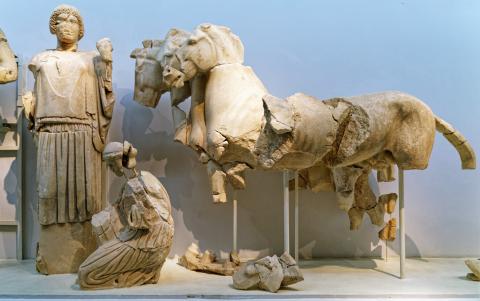
For ancient depictions of this myth, see Temple of Zeus at Olympia sculpture ca. 470–456 BCE.
1
φασὶν: “people say.”
μνηστευσόμενος: future participle implying purpose, “in order to court.”
2
τὰ αὐτὰ λέγω ἅπερ καὶ περὶ τοῦ Πηγάσου: “I say the same thing which (I said) also specifically about Pegasus.” See Ch. 28, “Bellerophon.”
ἅπερ: the suffix –περ gives the relative clause a sense of exclusivity, “which … specifically.”
καὶ: adverbial.
3
εἰ ᾔδει …, οὐκ ἂν … ἔδωκεν: past counterfactual condition: “If he had known …, he would not have given.”
ᾔδει: 3rd sing. plupf. indic. act. > οἶδα. Since οἶδα is a “defective” verb that lacks an aorist tense, the pluperfect stands in for the aorist in conditional sentences.
ἔδωκεν: here means “allowed” (LSJ δίδωμι III).
αὑτοῦ: refers reflexively to Oenomaus (notice the rough breathing mark).
αὐτοῦ: refers to Pelops (notice the smooth breathing mark).
4
ῥητέον: a verbal adjective implying necessity, “it must be said.”
οὖν: the particle marks a change of topic. Here, it is a change from the description of the myth to the description of the historical deed.
ἐπεγέγραπτο …“Ἵπποι ὑπόπτεροι”: the name of the ship, “Winged Horses,” serves as the singular subject of the verb ἐπεγέγραπτο.
ἐπεγέγραπτο: 3rd sing. plupf. indic. pass. > ἐπιγράφω.
ᾤχετο φεύγων: “he fled.” The verb οἴχομαι means “go” and can combine with a participle to indicate the manner of the departure.
5
ἐπὶ τῶν Ἵππων ὑποπτέρων: as in many of Palaephatus’s stories, the myth arises from the ambiguous use of a word or phrase—in this case, confusion between the ship named “Winged Horses” versus actual winged horses.
ᾤχετο φεύγων: see note above.
vocabulary
1
Πέλοψ –οπος, ὁ Pelops, son of Tantalus, who served Pelops to the gods; Demeter ate his shoulder (later replaced with ivory)
ὑπόπτερος –α –ον winged
Πῖσα –ης, ἡ Pisa, a city in the Peloponnese
μνηστεύω to woo; seek the hand of
Ἱπποδάμεια –ας, ἡ Hippodameia
Οἰνόμαος –ου, ὁ Oenomaus
2
Πήγασος –ου, ὁ Pegasus
3
ἅρμα –ατος, τό chariot
ἀναβιβάζω, ἀναβιβάσω, ἀνεβίβασα, ἀναβεβίβακα, ἀναβεβίβασμαι, ἀνεβιβάσθην to mount, embark
4
πλοῖον –ου, τό boat, vessel
ἐπιγράφω, ἐπιγράψω, ἐπέγραψα, ἐπιγέγραφα, ἐπιγέγραμμαι, ἐπεγράφην to inscribe, write upon
σκηνή –ῆς, ἡ ship’s cabin (LSJ σκηνή III.2)
ἁρπάζω, ἁρπάσω, ἥρπασα, ἥρπακα, ἥρπασμαι, ἡρπάσθην/ ἡρπάγην to carry away, snatch
κόρη –ης, ἡ girl
οἴχομαι, οἰχήσομαι, —, ᾤχηκα and ᾤχωκα, ᾤχημαι, — to go
6
μῦθος –ου, ὁ tale
προσαναπλάττω, —, προσανέπλασα, —, —, προσανεπλάσθην to fabricate in addition