(1) λέγεται περὶ Ἀταλάντης καὶ Μειλανίωνος ὡς ὁ μὲν ἐγένετο λέων, ἡ δὲ λέαινα. (2) ἦν δὲ τὸ ἀληθὲς τοιοῦτον. (3) Ἀταλάντη καὶ Μειλανίων ἐκυνηγέτουν. (4) ἀναπείθει δὲ τὴν κόρην ὁ Μειλανίων μιγῆναι αὐτῷ. (5) εἰσέρχονται δὲ εἴς τι σπήλαιον μιχθησόμενοι. (6) ἦν δὲ ἐν τῷ ἄντρῳ εὐνὴ λέοντος καὶ λεαίνης, οἳ δή, ἀκούσαντες φωνῆς, ἐξελθόντες ἐμπίπτουσι τοῖς περὶ Ἀταλάντην καὶ ἀναιροῦσιν αὐτούς. (7) μετὰ δὲ χρόνον τοῦ λέοντος καὶ τῆς λεαίνης ἐξελθόντων, ἰδόντες τούτους οἱ συγκυνηγετοῦντες τῷ Μειλανίωνι, ἔδοξαν αὐτοὺς εἰς ταῦτα τὰ ζῷα μεταβληθῆναι. (8) εἰσβάλλοντες οὖν εἰς τὴν πόλιν διεφήμιζον ὡς οἱ περὶ Ἀταλάντην [καὶ Μειλανίωνα] εἰς λέοντας μετεβλήθησαν.
notes
Atalanta is one of the mightiest heroines in Greek mythology. And there are many myths about her. The only one P. includes in his collection regards her unfortunate final act. As with the myth of Daedalus and Icarus, P. is the first author to relate this myth. The story goes that Atalanta had spent her life rejecting suitors until Melanion won her affections. (Many later authors call him Hippomenes). While on a hunt, the two lovers were overcome with passion and found a nearby place to make love in secret. Unfortunately, the place was sacred to a deity (either Zeus or Cybele), who turned them both into lions.
For the basic elements of this myth, see Apollodorus, Bibliotheca 3.9.2; Ovid, Metamorphoses 10.560–704; Hyginus, Fabulae 185.
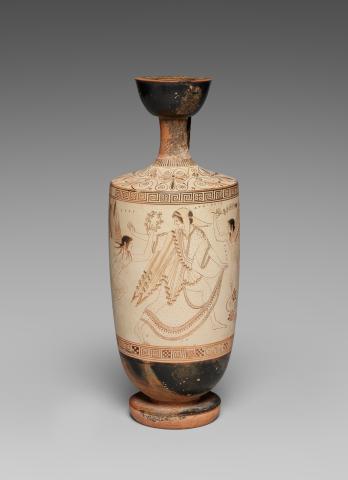
For depictions of this myth, see Atalanta being tempted by erotes ca 500-470 BCE; Atalanta and Hippomenes (Melanion) as lions [modern].
1
λέγεται: “it is said.”
ὁ μὲν … ἡ δὲ: “he … she,” articles combined with the particles μέν and δέ express a contrast between individuals or groups.
4
ἀναπείθει: historical present. Used in narratives to underscore turning points. Translate as past tense.
μιγῆναι: aor. infin. pass. > μίγνυμι, with middle sense.
5
εἰσέρχονται: historical present.
εἴς: receives an accent because it is followed by an enclitic τι.
μιχθησόμενοι: ptc. pl. fut. dep. masc. nom. > μίγνυμι. The future participle indicates intention/purpose.
6
ἐν τῷ ἄντρῳ: “in a further recess (of the cave).” P. uses a different word for cave perhaps to differentiate sections of it. This better explains ἐξελθόντες.
οἳ δή: “who thereupon,” antecedents are λέων and λεαίνα.
ἐμπίπτουσι … ἀναιροῦσιν: historical presents.
τοῖς περὶ Ἀταλάντην: “Atalanta and company,” (LSJ περί C.I.2). Presumably, P. is only referring to Atalanta and Melanion. Another way of reading this substantivized prepositional phrase: “Atalanta’s attendants” (i.e., a group of people opposed perhaps to οἱ συγκυνηγετοῦντες τῷ Μειλανίωνι in the next sentence). The latter seems less likely.
7
μετὰ δὲ χρόνον: “after some time.”
τοῦ λέοντος καὶ τῆς λεαίνης ἐξελθόντων: genitive absolute.
τούτους: refers to λέων and λεαίνα.
αὐτοὺς: refers to Ἀταλάντη and Μειλανίων.
μεταβληθῆναι: aor. infin. pass. > μεταβάλλω.
8
οὖν: the particle marks a change of topic. Here, it is from what happened to what was said about what happened, i.e., from deeds to words.
οἱ περὶ Ἀταλάντην [καὶ Μειλανίωνα]: “Atalanta and Melanion” (LSJ περί C.I.2). The οἱ περὶ construction can periphrastically refer to the individuals named. Square brackets indicate a word or phrase that the editor suspects to be an explanatory note that was added by a reader and became part of the text.
vocabulary
1
Ἀταλάντη –ης, ἡ Atalanta, a Greek heroine
Με(ι)λανίων –ωνος, ὁ Melanion, a Greek hero
λέων –οντος, ὁ lion
λεαίνα –ης, ἡ lioness
3
κυνηγετέω, contr. to go hunting
4
ἀναπείθω, ἀναπείσω, ἀνέπεισα, ἀναπέπεικα, ἀναπέπεισμαι, ἀνεπείσθην to persuade
κόρη –ης, ἡ girl
5
εἰσέρχομαι, εἰσελεύσομαι, εἰσῆλθον, εἰσελήλυθα, —, — to go in
σπήλαιον –ου, τό cave
6
ἄντρον –ου, τό cave
εὐνὴ –ῆς, ἡ den, lair
ἐξέρχομαι, ἐξελεύσομαι, ἐξῆλθα/ἐξῆλθον, ἐξελήλυθα, —, — to go out
ἐμπίπτω, ἐμπεσοῦμαι, ἐνέπεσον, ἐμπέπτωκα, —, — to fall upon, attack (+ dat.)
7
συγκυνηγετέω, contr. to hunt with (+ dat.)
ζῷον –ου, τό animal, living being
μεταβάλλω, μεταβαλῶ, μετέβαλον, μεταβέβληκα, μεταβέβλημαι, μετεβλήθην to transform
8
εἰσβάλλω, εἰσβαλῶ, εἰσέβαλον, εἰσβέβληκα, —, εἰσεβλήθην to rush into
διαφημίζω, —, διεφήμισα, —, —, — to make known, divulge