(1) ὁ αὐτὸς λόγος καὶ περὶ Κύκνου τοῦ ἐν Κολωναῖς· καὶ γὰρ κἀκεῖνόν φασιν ὅτι ἄτρωτος ἦν. (2) καὶ αὐτὸς ἦν αἰχμητὴς καὶ ἐπιστήμων μάχης· ἀπέθανε δὲ ἐν Τροίᾳ ὑπὸ Ἀχιλλέως λίθῳ βληθείς, καὶ οὐδὲ τότε ἐτρώθη. (3) ἔλεγον οὖν οἱ ἄνθρωποι, ὁρῶντες τὸν νεκρὸν αὐτοῦ, ὅτι ἄτρωτος ἦν, ὥσπερ καὶ νῦν λέγουσιν τοὺς ἀγωνιστάς, ἐάν τις ἄτρωτος ᾖ. (4) οὕτως κἀκεῖνοι ἐκλήθησαν ἄτρωτοι. (5) κατηγορεῖ δὲ τούτων τῶν λόγων καὶ ἐμοὶ μαρτυρεῖ Αἴας ὁ Τελαμώνιος· καὶ γὰρ κἀκεῖνος ἐλέγετο ἄτρωτος, καὶ ἀπέθανε ξίφει τρωθεὶς ὑφ’ ἑαυτοῦ.
notes
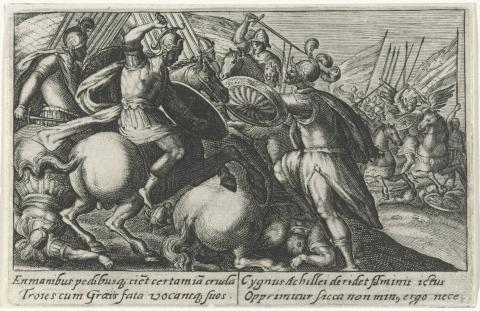
Like Caeneus, Cycnus was a great warrior, granted invulnerability at birth by his father, Poseidon. An ally to the Trojans during their war against the Greeks, he faced Achilles in battle. Achilles’ sword and spear had no effect, so the Greek hero bludgeoned him with a rock. According to the Roman poet, Ovid, when Achilles went to strip the armor of his fallen foe, the corpse vanished; Poseidon had transformed Κύκνος into κύκνος (“a swan”). P. ignores the metamorphosis and focuses on the question of invulnerability.
For the basic elements of this myth, see Apollodorus, Epitome 3.31; Ovid, Metamorphoses 12.71–145.
For depictions of this myth, see Cycnus and Achilles 1603-7 CE.
1
ὁ αὐτὸς λόγος: supply λέγεται, “the same story (is said),” as the one told about Caeneus. P. will recycle the same general explanation for Cycnus’s invulnerability as he used in the rebuttal of the Caeneus myth from the previous chapter.
καὶ: adverbial.
τοῦ ἐν Κολωναῖς: P. is specifying which Cycnus he is referring to. There were quite a few. Most turned into swans.
καὶ γὰρ: “for even.”
κἀκεῖνόν: > καὶ ἐκεῖνόν. serves as the subject of the indirect statement despite standing outside of it. This construction is called prolepsis (πρόληψις “taking before”), in which the nominative subject of a subordinate clause is pulled forwards in the sentence to become the direct object of the main verb (S. 2182), “and people say of that man too, that he.” A famous example of prolepsis in English is, “consider the lilies of the field, how they grow.” The καί is adverbial.
φασιν: “people say.”
2
λίθῳ: dative of instrument.
βληθείς: ptc. sing. aor. pass. masc. nom. > βάλλω.
καὶ οὐδὲ: “and not even.”
ἐτρώθη: 3rd sing. aor. indic. pass. > τιτρώσκω.
3
οὖν: the particle marks a change of topic. Here, it is from what happened to what was said about what happened, i.e., from deeds to words.
ὅτι ἄτρωτος ἦν: supply Cycnus as the subject of ἦν.
καὶ: adverbial.
λέγουσιν: “people say of,” present simple apodosis.
ἐάν … ᾖ: present general protasis.
4
κἀκεῖνοι: > καὶ ἐκεῖνοι. Refers apparently to an idiom describing athletes who have won “unscathed.” The καί is adverbial.
ἐκλήθησαν: 3rd pl. aor. indic. pass. > καλέω.
5
κατηγορεῖ: “speaks against (gen.).” The subject is Αἴας. P. is assuming the language of the courtroom.
καὶ γὰρ: “for even.”
κἀκεῖνος: > καὶ ἐκεῖνος. The καί is adverbial, “that man too,” i.e., Ajax. According to myth, Ajax despairingly took his own life by falling on his sword.
καὶ: adverbial.
ξίφει: dative of instrument.
τρωθεὶς: ptc. sing. aor. pass. masc. nom. > τιτρώσκω.
vocabulary
1
Κύκνος –ου, ὁ Cycnus, a Trojan warrior
Κολωναί –ῶν, αἱ Kolonai, a Troad city (pluralized city name, like Athens)
ἄτρωτος –ον uncut, unwounded; invulnerable
2
αἰχμητὴς –οῦ, ὁ warlike; (lit.) armed with a spear
ἐπιστήμων –ον skilled in (+ gen.)
Τροία –ας, ἡ Troy, a city in Asia Minor
Ἀχιλλεύς –έως, ὁ Achilles, the Greek hero
τιτρώσκω, τρώσω, ἔτρωσα, τέτρωκα, τέτρωμαι, ἐτρώθην to wound, injure
3
νεκρός –οῦ, ὁ corpse
ἀγωνιστής –οῦ, ὁ athlete
5
κατηγορέω, contr. to speak against (+ gen.)
μαρτυρέω, contr. to testify, serve as a witness to (+ dat.)
Αἴας –αντος, ὁ Ajax, a Greek hero
Τελαμώνιος –α –ον Telamonian, of Telamon (father of Ajax)
ξίφος –ους, τό sword