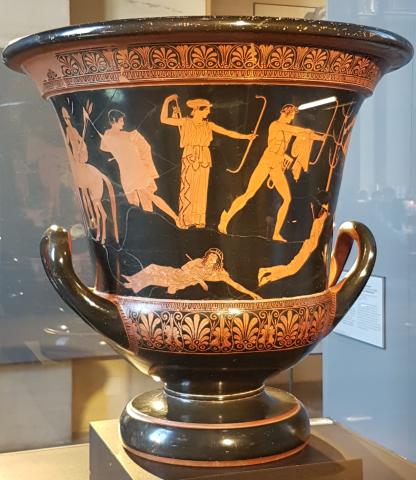
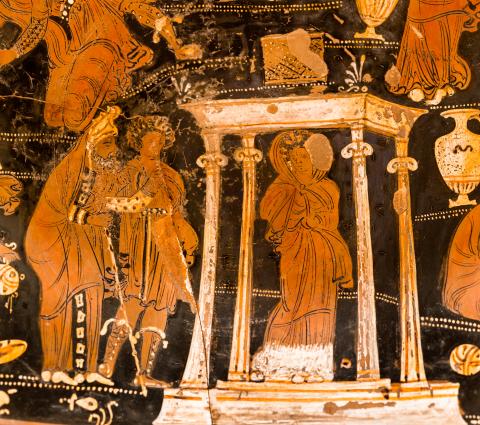
(1) φασὶν ὡς Νιόβη γυνὴ ζῶσα λίθος ἐγένετο ἐπὶ τῷ τύμβῳ τῶν παίδων· ὅστις δὲ πείθεται ἐξ ἀνθρώπου λίθον γενέσθαι ἢ ἐκ λίθου ἄνθρωπον, εὐήθης ἐστί. (2) τὸ δὲ ἀληθὲς ἔχει ὧδε. (3) Νιόβης ἀποθανόντων τῶν παίδων, ποιήσας τις εἰκόνα λιθίνην ἔστησεν ἐπὶ τῷ τύμβῳ [τῶν παίδων]. (4) ἔλεγον οὖν οἱ παριόντες “Νιόβη λιθίνη ἕστηκεν ἐπὶ τῷ τύμβῳ· ἐθεασάμεθα ἡμεῖς αὐτήν,” ὥσπερ καὶ νῦν λέγεται “παρὰ τὸν χαλκοῦν Ἡρακλέα ἐκαθήμην” καὶ “παρὰ τὸν Πάριον Ἑρμῆν ὤν.” (5) τοιοῦτον ἦν κἀκεῖνο, ἀλλ’ οὐχὶ Νιόβη αὐτὴ λιθίνη ἐγένετο.
notes
Niobe was the daughter of Tantalus, the King of Sipylus in Lydia. She was famous for bearing a great number of children and for boasting that she was better than Leto, who only had two children, the gods Apollo and Artemis. The latter two took revenge on behalf of their mother; Apollo murdered Niobe’s sons, and Artemis, her daughters. Grief-stricken, Niobe returned to the homeland of her father. She wandered the countryside and eventually turned into a stone waterfall at Mount Sipylus, running forever with tears.
For the basic elements of this myth, see Apollodorus, Bibliotheca 3.5.6; Diodorus Siculus 4.74; Ovid, Metamorphoses 6.146–312.
For depictions of this myth, see Niobid Massacre ca. 450 BCE; Niobe in grave naiskos ca. 320-300.
1
φασὶν: “people say.”
τῶν παίδων: “her children,” i.e., Niobe’s. The article is often used to indicate unemphatic possession.
ὅστις: absolute relative clause, “whoever.”
εὐήθης: predicate nominative with ὅστις.
2
ὧδε ἔχει: “is as follows” (LSJ ἔχω B.II.2).
3
ἀποθανόντων τῶν παίδων: genitive absolute.
ἔστησεν: 3rd sing. aor. indic. act. > ἵστημι.
[τῶν παίδων]: “her children,” i.e., Niobe’s. Square brackets indicate a word or phrase that the editor suspects to be an explanatory note that was added by a reader and became part of the text.
4
οὖν: the particle marks a shift in narrative. Here, it is from what happened to what was said about what happened, i.e., from deeds to words. P. lists two idiomatic expressions that explain the ambiguity that gave rise to the myth.
καὶ: adverbial, “even.”
λέγεται: “it is said.”
παρὰ τὸν Πάριον Ἑρμῆν ὤν: “I’m near the Parian Hermes,” probably a generic reference to a herm statue type.
Πάριον: made from Parian marble. This single adjective may have been impetus enough for some later interpreters to suppose that P. was originally from Paros or Parion.
ὤν: > εἰμί, periphrastic use of the participle (LSJ εἰμί Β.2).
5
τοιοῦτον ἦν κἀκεῖνο: “This too was like that.”
κἀκεῖνο: crasis of καὶ ἐκεῖνο; refers to the expression used to speak about the Niobe statue; the καὶ in this expression is adverbial.
οὐχὶ: an emphatic form of the negative. In translation, one might put the word in italics.
vocabulary
1
Νιόβη –ης, ἡ Niobe, daughter of Tantalus and wife of Amphion, king of Thebes
τύμβος –ου, ὁ tomb, tombstone
εὐήθης –ες naïve
2
εἰκών –όνος, ἡ likeness
λίθινος –η –ον of stone, stone
3
παρεῖμι, —, —, —, —, — to go by
θεάομαι, θεάσομαι, ἐθεάσάμην, τεθέαμαι, —, ἐθεάθην to see, witness
χάλκεος –η –ον of bronze, bronze
Ἡρακλῆς –έους, ὁ Heracles, the Greek hero
κάθημαι, καθήσομαι, —, —, —, — to sit, be seated
Πάριος –α –ον of Paros, Parian
Ἑρμῆς –οῦ, ὁ Hermes, Greek god of commerce, trickery