(1) περὶ τῆς Καδμείας Σφιγγὸς λέγεται ὡς θηρίον ἐγένετο σῶμα μὲν κυνὸς ἔχον, τὴν δὲ κεφαλὴν καὶ τὸ πρόσωπον κόρης, πτέρυγας δὲ ὄρνιθος, φωνὴν δὲ ἀνθρώπου. (2) καθίζουσα δὲ ἐπὶ Φικίου ὄρους αἴνιγμά τι ἑκάστῳ τῶν πολιτῶν ᾖδεν· ὃν δ’ ἂν εὗρε διαλύσασθαι μὴ δυνάμενον, τοῦτον ἀνῄρει. (3) διαλυσαμένου δὲ τὸ αἴνιγμα Οἰδίποδος, ῥίψασα ἑαυτὴν ἀνεῖλεν. (4) ἔστι δὲ ἄπιστος καὶ ἀδύνατος ὁ λόγος. (5) οὔτε γὰρ ἰδέα τοιαύτη δύναται γενέσθαι, τό τε τοὺς μὴ δυναμένους διαλύεσθαι [τὰ] αἰνίγματα κατεσθίεσθαι ὑπ’ αὐτῆς, παιδαριῶδες, τό τε τοὺς Καδμείους μὴ κατατοξεῦσαι τὸ θηρίον, ἀλλὰ περιορᾶν τοὺς πολίτας ὡς πολεμίους κατεσθιομένους, μάταιον. (6) ἔχει οὖν ἡ ἀλήθεια ὧδε. (7) Κάδμος ἔχων γυναῖκα Ἀμαζονίδα, ᾗ ὄνομα Σφίγξ, ἦλθεν εἰς Θήβας, καὶ ἀποκτείνας Δράκοντα τήν τε οὐσίαν καὶ βασιλείαν παρέλαβε, μετὰ δὲ καὶ τὴν ἀδελφὴν Δράκοντος, ᾗ ὄνομα Ἁρμονία. (8) αἰσθομένη δὲ ἡ Σφὶγξ ὅτι ἄλλην ἐπέγημε, πείσασα πολλοὺς τῶν πολιτῶν συναπᾶραι αὐτῇ, καὶ τῶν χρημάτων τὰ πλεῖστα ἁρπάσασα, καὶ τὸν ποδώκη κύνα, ὃν ἧκεν ὁ Κάδμος ἄγων, λαβοῦσα, μετὰ τούτων ἀπῆρεν εἰς τὸ καλούμενον ὄρος Φίκιον, καὶ ἐντεῦθεν ἐπολέμει τῷ Κάδμῳ· ἐνέδρας δὲ ποιουμένη κατὰ τὴν ὥραν ἀνῄρει οὓς διαρπάζουσα ᾤχετο. (9) καλοῦσι δὲ οἱ Καδμεῖοι τὴν ἐνέδραν αἴνιγμα. (10) ἐθρύλλουν οὖν οἱ πολῖται λέγοντες “Σφὶγξ ἡμᾶς ἡ ἀγρία αἰνίγματι ὑφισταμένη διαρπάζει, καὶ καθίζει ἐπὶ τοῦ ὄρους. (11) ἐξευρεῖν δὲ τὸ αἴνιγμα οὐδεὶς δύναται, ἔκ τε τοῦ προφανοῦς μάχεσθαι ἀδύνατον· οὐ γὰρ τρέχει, ἀλλὰ πέτεται καὶ κύων καὶ γυνή [, οὕτω ποδώκης ἐστί].” (12) κηρύττει δὲ ὁ Κάδμος τῷ ἀποκτενοῦντι τὴν Σφίγγα χρήματα δώσειν πολλά. (13) ἐλθὼν οὖν ὁ Οἰδίπους, ἀνὴρ Κορίνθιος τά τε πολεμικὰ ἀγαθός, ἵππον ἔχων ποδώκη, καὶ λόχους τῶν Καδμείων ποιήσας καὶ διὰ νυκτὸς ἐξιὼν καὶ ἐνεδρεύσας αὐτήν, εὗρε τὸ αἴνιγμα [τουτέστι τὴν ἐνέδραν] καὶ ἀπέκτεινεν τὴν Σφίγγα. (14) τούτων γενομένων τὰ λοιπὰ ἐμυθεύθη.
notes
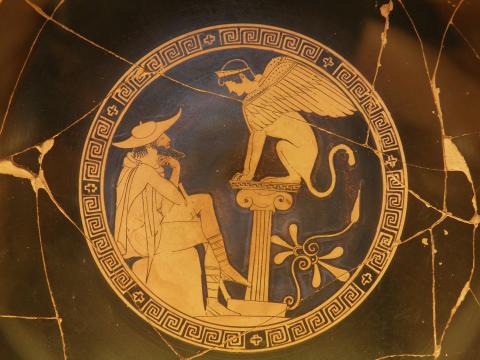
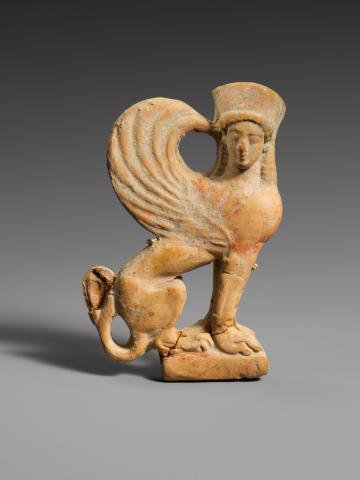
In the Greek tradition, the Sphinx is a mythical female monster typically depicted in art as having a lion’s body, a woman’s head, and wings. However, Palaephatus suggests that she has the body of a dog (see below). Her likeness adorns much Greek architecture, often seen crouching atop columns. In myth, she was known to violently pursue young men. She was also a poser of riddles. In the myth refuted by Palaephatus, the gods sent the Sphinx to torment Thebes. The monster settled on a nearby mountain, attacking the city. To banish her, one had to solve her riddle: Who walks on all fours in the morning, on two feet at midday, and on three feet in the evening? Failure to answer correctly meant death. Eventually, Oedipus arrived and supplied the correct answer: a human, who crawls as an infant, walks as an adult, and uses a cane when old. With the riddle solved, Thebes was freed from the terror of the Sphinx.
For the basic elements of this myth, see Apollodorus, Bibliotheca 3.5.8; Diodorus Siculus 4.64.3–4; Hyginus, Fabulae 67.
For depictions of this myth, see hydria with sphinxes ca 700 BCE, red Figure cup Oedipus and Sphinx ca 470-460 BCE, Terracotta relief of a sphinx ca 475 BCE
1
λέγεται: “it is said that.”
ἐγένετο: “came to be.”
ἔχον: the subject is θηρίον. Takes five direct objects (σῶμα, κεφαλὴν, πρόσωπον, πτέρυγας, and φωνὴν) all organized into an extended μέν … δέ clause.
2
ὃν δ’ ἂν εὗρε διαλύσασθαι μὴ δυνάμενον: to emphasize that an action occurred repeatedly, ἄν can be added to the imperfect or aorist indicative.
ὃν δ’... διαλύσασθαι μὴ δυνάμενον: “whomever … not being able to solve (it).” The antecedent is τοῦτον in the main clause, which is delayed. The negative μή is occasioned by the generic nature of what the participle modifies, i.e., “whomever.”
3
διαλυσαμένου … Οἰδίποδος: genitive absolute.
ἀνεῖλεν: 3rd sing. aor. indic. act. > ἀναιρέω. The subject is the Sphinx.
4
ἔστι: takes a recessive accent when appearing at the beginning of the sentence.
5
τό … κατεσθίεσθαι … παιδαριῶδες: the first of two long articular infinitive phrases; here, the idea of people being eaten (τό … κατεσθίεσθαι) is dismissed as “childish” (παιδαριῶδες).
τοὺς μὴ δυναμένους διαλύεσθαι: the whole substantivized participial phrase is the accusative subject of the articular infinitive (τό … κατεσθίεσθαι), “people who cannot solve.” The negative μή is occasioned by the generic force of the participle.
[τὰ] αἰνίγματα: square brackets indicate a word or phrase that the editor suspects to be an explanatory note that was added by a reader and became part of the text. Here, the article adds specificity, “the (specific) riddles.”
ὑπ’ αὐτῆς: refers to the Sphinx, “being eaten by her”
τό … μὴ κατατοξεῦσαι … ἀλλὰ περιορᾶν … μάταιον: the second of the two long articular infinitive phrases; here, the idea of people not shooting (τό … μὴ κατατοξεῦσαι) the Sphinx with arrows, but instead simply watching (περιορᾶν) their fellow citizens being eaten alive as if they were enemies, is dismissed as “foolish” (μάταιον).
τό τε τοὺς Καδμείους μὴ κατατοξεῦσαι: articular infinitive. The articular infinitive is always negated by μή. The word Καδμείους is the accusative subject of the articular infinitive, appearing as usual between the neuter article (τό) and the infinitive.
περιορᾶν: = τὸ περιορᾶν; another articular infinitive. Here, the article is omitted because περιορᾶν takes the same subject as the previous articular infinitive (τό … μὴ κατατοξεῦσαι) and works in tandem with it to express a single idea (S. 1143).
τοὺς πολίτας: direct object of περιορᾶν.
ὡς: = ὥσπερ.
κατεσθιομένους: modifies τοὺς πολίτας.
μάταιον: in apposition to the preceding articular infinitives.
6
ἔχει … ὧδε: “is as follows” (LSJ ἔχω B.II.2).
οὖν: the particle marks a change of topic. Here, it is from a description of what people say to a description of what really happened, i.e., from myth to history.
7
Ἀμαζονίδα: according to myth, the Amazons were a tribe of female warriors. In Ch. 32, P. argues that the Amazons were a tribe whose male warriors, though militaristic, were effeminate and thus called “women.” Whether P. is thinking of the tribe of the original myth or his rationalized version is unclear. The choice to make Sphinx an Amazon is most likely motivated by the need to account for her remarkable skill in fighting which becomes evident later.
ἀποκτείνας Δράκοντα: here, P. refers to the chapter in which Cadmus is shown to have killed the king of Thebes, whose name was Snake.
μετὰ: “thereafter,” here the preposition functions independently as an adverb. In prose, this use of the preposition is largely restricted to μετά and πρός.
καὶ: adverbial.
τὴν ἀδελφὴν Δράκοντος: resupply the verb παρέλαβε.
8
ἐπέγημε: 3rd sing. aor. indic. act. > ἐπιγαμέω. Subject Κάδμος.
ἄλλην: refers to Ἁρμονία.
τὸν ποδώκη κύνα: the direct object of λαβοῦσα.
καλούμενον: “so-called.”
ἐπολέμει: takes a dative object.
ἐνέδρας δὲ ποιουμένη: “and setting ambushes.”
κατὰ τὴν ὥραν: “periodically.”
οὓς διαρπάζουσα ᾤχετο: “whomever she carried away as plunder.” The verb οἴχομαι means “go” and can combine with a participle to indicate the manner of the departure; in this case, leaving while seizing captives (διαρπάζουσα).
9
καλοῦσι δὲ οἱ Καδμεῖοι τὴν ἐνέδραν αἴνιγμα: P. seems to be suggesting that αἴνιγμα is the Theban term for ambush.
10
οὖν: the particle marks a change of topic. Here, it is from what happened to what was said about what happened, i.e., from deeds to words.
Σφὶγξ: in apposition to ἡ ἀγρία.
αἰνίγματι: dative of instrument, “with a trick.”
11
ἔκ τε … τοῦ προφανοῦς: “out in the open.” The shadowiness of Sphinx helps afford the misinterpretation of who she really was.
ἔκ: takes an accent because it is followed by the enclitic, τε.
πέτεται: as in English, the Greek verb “to fly” is often used metaphorically to refer to something or someone that moves fast.
καὶ κύων καὶ γυνή: both are the subject of the singular verb πέτεται. The grammar of this expression is meant to help explain the misconception that the Sphinx was part woman and part dog.
[, οὕτω ποδώκης ἐστί]: “so swift they are.” Square brackets around a word or phrase indicate that the editor suspects it to be an explanatory note that was added by a reader and became part of the text.
12
κηρύττει: historical present. Used in narratives to underscore turning points. Translate as past tense.
13
ἐλθὼν οὖν ὁ Οἰδίπους … ἐνεδρεύσας αὐτήν: according to myth, Oedipus was a clever man who solved the riddle of the Sphinx. For P., he is a militaristic man who outmaneuvered her ambushes. P. uses five participial phrases (ἐλθὼν … ἔχων … ποιήσας … ἐξιὼν … ἐνεδρεύσας), all agreeing with ὁ Οἰδίπους, to reinvent who the Greek hero was and what his actual deeds were.
οὖν: the particle marks a change of topic. Here, it is the introduction of our hero, Oedipus.
ἀνὴρ: in apposition to Οἰδίπους and modified by the adjectives Κορίνθιος and ἀγαθός.
πολεμικὰ: accusative of respect.
λόχους τῶν Καδμείων ποιήσας: “having organized the Cadmeians into platoons.”
διὰ νυκτὸς ἐξιὼν: the mention of traveling at night recalls the riddle of the Sphinx. Horse riding, mentioned earlier, is also a way of traveling on four feet. P. may include these details as a way of tacitly alluding to the Sphinx’s riddle.
αὐτήν: refers to the Sphinx.
εὗρε τὸ αἴνιγμα: “he detected the trick.”
[τουτέστι τὴν ἐνέδραν]: “i.e., the ambush.”
τούτων γενομένων: genitive absolute.
τὰ λοιπὰ: “the rest,” neut. pl. nom., subject of a verb in the singular, as usual.
vocabulary
1
Καδμεῖος –α –ον Cadmeian, of Cadmus (founder of Thebes)
Σφίγξ, Σφιγγὸς, ἡ Sphinx, a mythical monster
θηρίον –ου, τό beast
κύων κυνός, ὁ/ἡ dog
κόρη –ης, ἡ girl
πτέρυξ –υγος, ἡ wing
ὄρνις –ιθος, ὁ/ἡ bird
2
καθίζω, καθιῶ, ἐκάθισα, κεκάθικα, —, — to sit
Φίκιον –ου, τό (also spelled Φύκιον) Phikion, a mountain near Thebes
αἴνιγμα –ατος, τό riddle; ambush (only in Palaephatus)
πολίτης –ου, ὁ citizen
ἀείδω/ᾄδω, ἀείσομαι/ᾄσομαι, ᾖσα, —, ᾖσμαι, ᾔσθην to sing
διαλύω, διαλύσω, διέλυσα, διαλέλυκα, διαλέλυμαι, διελύθην to solve
3
Οἰδίπους Οἰδίποδος, ὁ Oedipus, a Greek hero
ῥίπτω, ῥίψω, ἔρριψα, ἔρριφα, ἔρριμμαι, ἐρρίφην to cast oneself
4
ἄπιστος –ον unbelievable
5
ἰδέα –ας, ἡ form
κατεσθίω, κατέδομαι, καταφαγεῖν, κατεδήδοκα, κατεδήδεσμαι, κατηδέσθην to devour
παιδαριώδης –ες childish
κατατοξεύω to shoot with a bow
περιοράω, περιόψομαι, περιεῖδον, περιεώρακα, περιεώραμαι, — to watch with indifference
μάταιος –α –ον foolish, stupid
7
Κάδμος –ου, ὁ Cadmus, mythical founder of Thebes
Ἀμαζονίς –ίδος, ἡ Amazon
Θῆβαι –ῶν, αἱ Thebes
δράκων –οντος, ὁ snake, Snake (male name)
οὐσία –ας, ἡ property, belongings
βασιλεία –ας, ἡ kingdom, kingly power
παραλαμβάνω, παραλήψομαι, παρέλαβον, παρείληφα, παρείλημμαι, παρελήφθην to seize
ἀδελφή –ης, ἡ sister
Ἁρμονία –ας, ἡ Harmonia, the wife of Cadmus, according to myth
8
ἐπιγαμέω, contr. to marry in a second marriage
συναπαίρω, συναπαρῶ, συναπῆρα, συναπῆρκα, —, — to leave with (+ dat.)
ἁρπάζω, ἁρπάσω, ἥρπασα, ἥρπακα, ἥρπασμαι, ἡρπάσθην/ ἡρπάγην to snatch away, seize
ποδώκης –ες swift-footed
κύων κυνός, ὁ/ἡ dog
ἀπαίρω, ἀπαρῶ, ἀπῆρα, ἀπῆρκα, —, ἀπήρθην to take off, depart
ἐντεῦθεν, adv. from there
ἐνέδρα –ας, ἡ ambush
ὥρα –ας, ἡ a period of time, season, hour
διαρπάζω, διαρπάσω, διήρπασα, διήρπακα, διήρπασμαι, διηρπάσθην to pick off, tear away
οἴχομαι, οἰχήσομαι, —, ᾤχηκα and ᾤχωκα, ᾤχημαι, — to go
10
θρυλ(λ)έω, contr. to mumble repeatedly
ἄγριος –α –ον wild
ὑφίστημι, ὑποστήσω, ὑπέστην, ὑφέστηκα, ὑφέσταμαι, — to lie in wait
11
ἐξευρίσκω, ἐξευρήσω, ἐξηῦρον/ ἐξεῦρα, ἐξηύρηκα, ἐξηύρημαι, ἐξηυρέθην to discover, detect
προφανής –ές clearly visible
ἀδύνατος –ον impossible
τρέχω, δραμοῦμαι//θρέξομαι, ἔθρεξα/ ἔδραμον, δεδράμηκα, δεδράμημαι, — to run
πέτομαι, πετήσομαι/πτήσομαι, ἔπτην, —, —, — to fly
12
κηρύττω, κηρύξω, ἐκήρυξα, κεκήρυχα, κεκήρυγμαι, ἐκηρύχθην to proclaim (+ inf.)
13
Κορίνθιος –α –ον Corinthian, of Corinth
πολεμικός –ή –όν of war, martial; (subst.) matters of war
λόχος –ου, ὁ platoon
ἔξειμι, ἔξειμι, —, —, —, — to go out, march out
ἐνεδρεύω to lay an ambush
14
λοιπός –ή όν the rest, remaining
μυθεύω, —, ἐμύθευσα, μεμύθευκα, μεμύθευμαι, ἐμυθεύθην to tell a tale