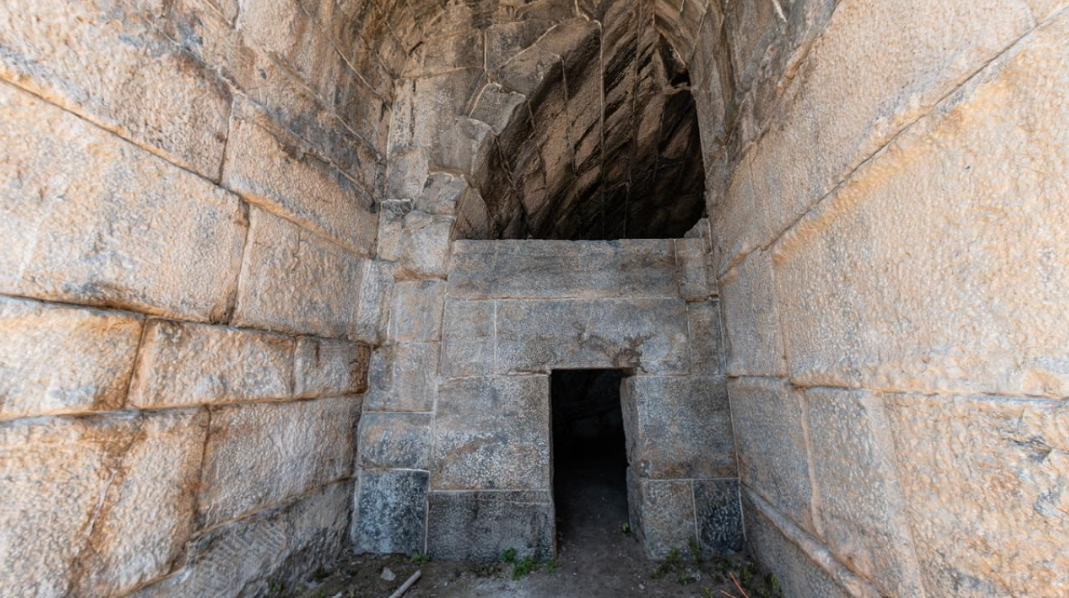
Vaulting of the Roman Theater at Nicaea
Annotations
With the permission of the Ministry of Culture and Tourism, excavations at the Roman Theater, where work first began in 1980, have been carried out since 2015 by a team led by the Department of Archaeology at Dokuz Eylül University, following the involvement of the Metropolitan Municipality. (TRTHABER)
Properties
Substructure of the Roman Theater at Nicaea
Annotations
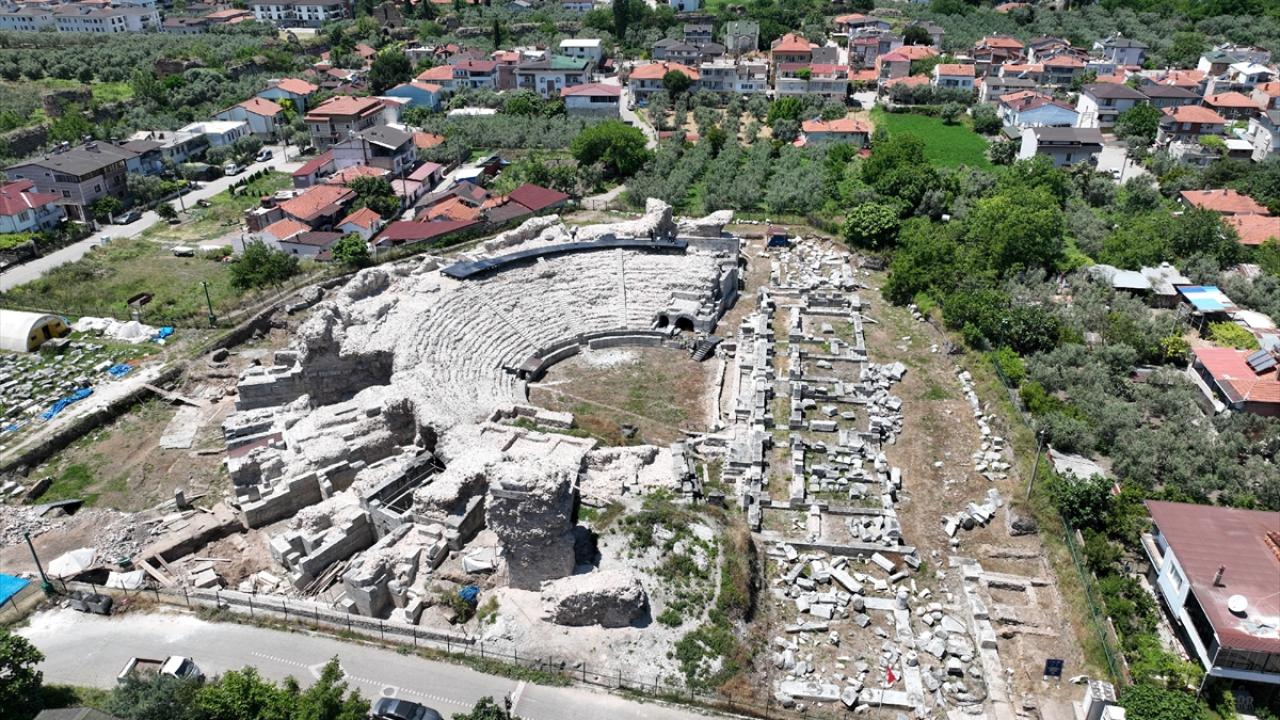
Its recognizable dimensions reach a maximum of 85 x 55 m, and only part of the cavea is conserved; the orchestra and the skene have been lost. Its plan must have been Hellenistic but has been repeatedly modified (Princeton Encyclopedia of Classical Sites, "Nicaea").
Properties
The Roman Theater at Nicaea
Annotations
The theater, which for a time also hosted gladiatorial combats, was used as a religious site after theatrical performances were banned following the advent of Christianity. Damaged and subsequently repaired after the major earthquakes of 358, 362, and 368, the structure was ultimately sacrificed for the defense of Nicaea, with materials dismantled from the theater being used to reinforce the city walls. (TRTHABER)
Properties
Nicomedia Aqueduct, Izmit, Turkey
Annotations
Photo first published on Flickr. Original image by Carole Raddato. Uploaded to World History Encyclopedia by Ibolya Horváth, published on 17 March 2025. The copyright holder has published this content under the following license: Creative Commons Attribution-ShareAlike. This license lets others remix, tweak, and build upon a work even for commercial reasons, as long as they credit the author and license their new creations under the identical terms. When republishing on the web a hyperlink back to the original content source URL must be included. Please note that content linked from this page may have different licensing terms.
Properties
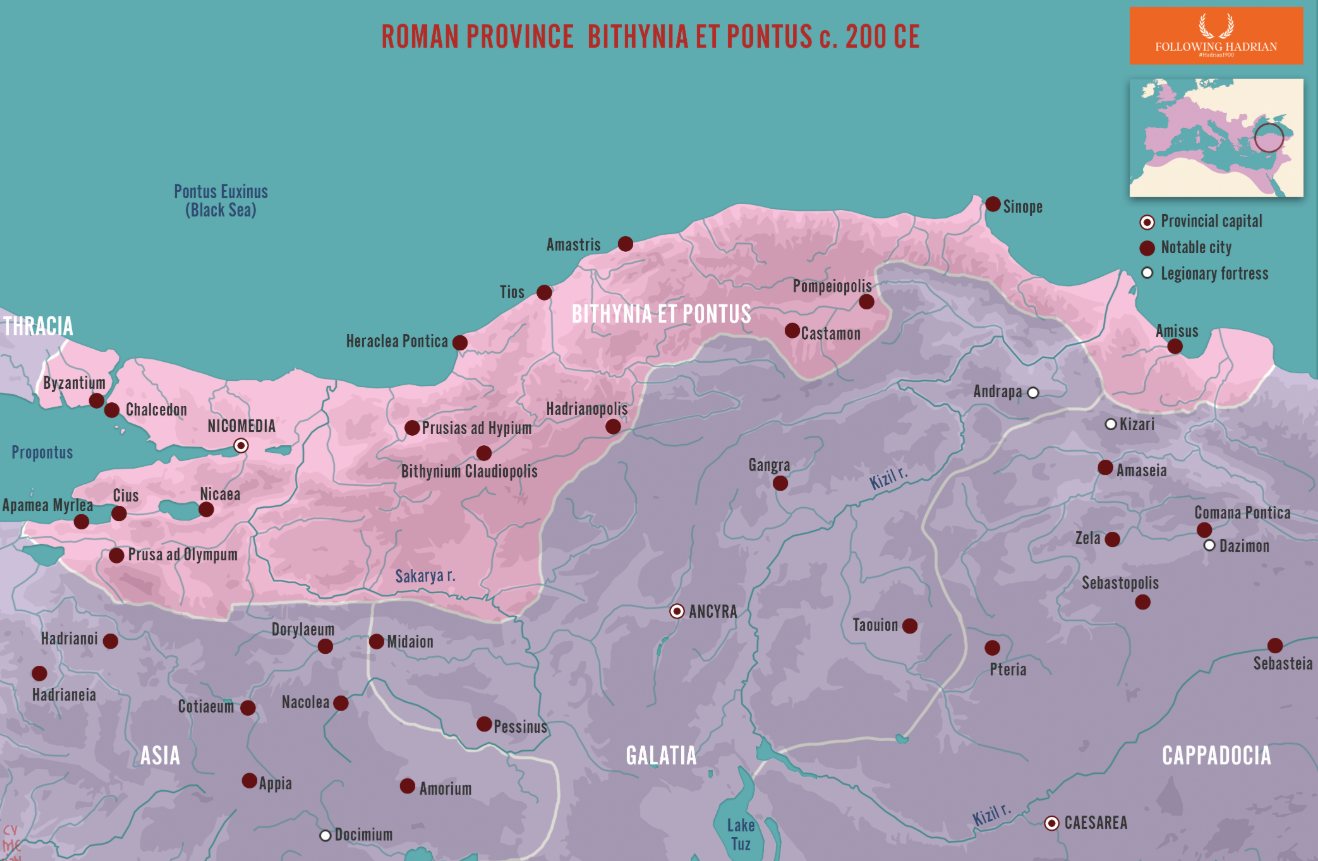
Roman Bithynia Map
Annotations
Roman Bithynia ca. AD 200.
Map created by Simeon Netchev for Following Hadrian (CC BY-NC-SA 4.0).
Properties
Panel with Painted Image of Isis
Annotations
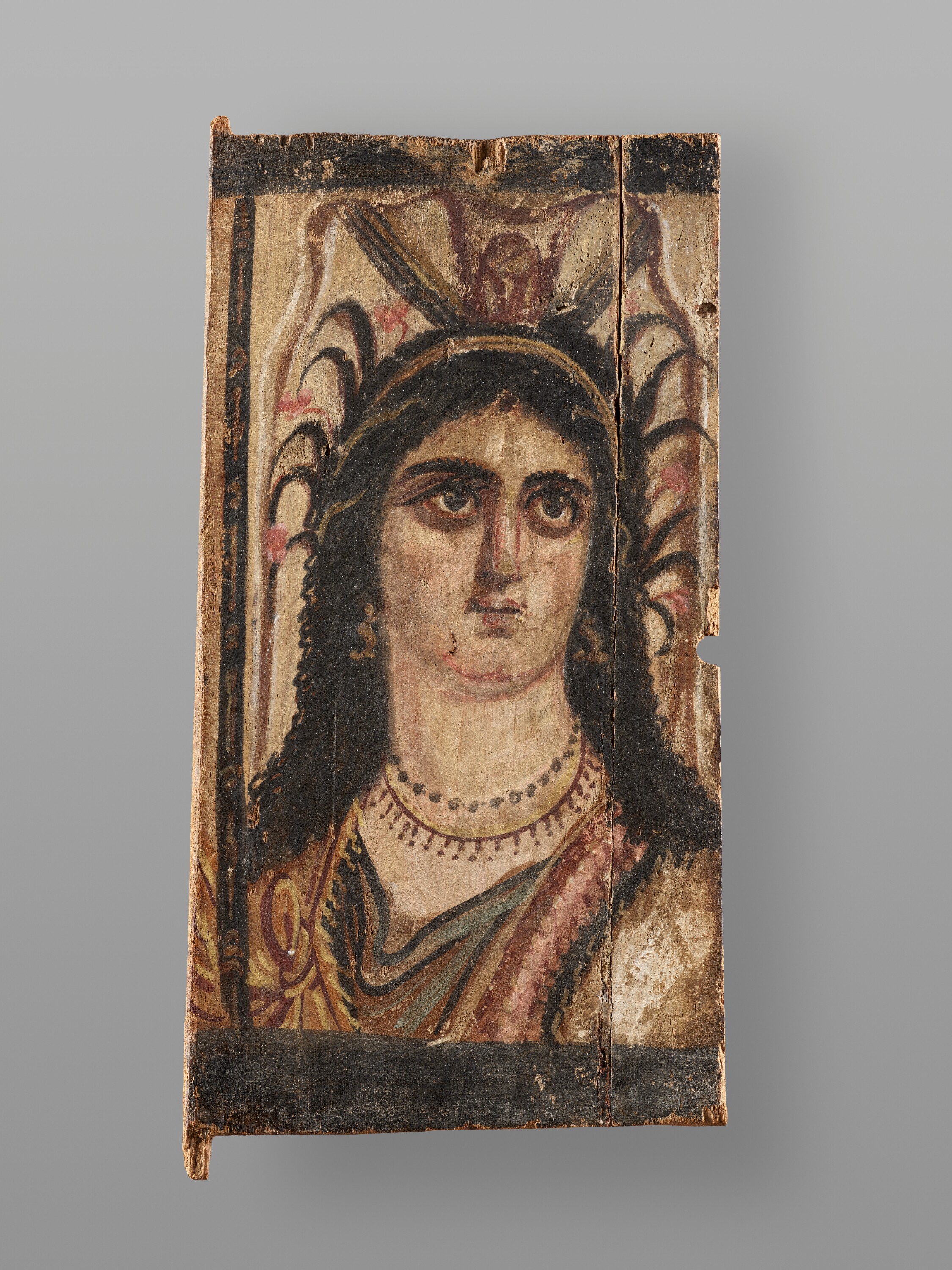
Romano-Egyptian painted panel of the Egyptian goddess Isis in tempera (animal glue) on a fig wood panel. This pairs with the Serapis panel (74.AP.21, with which it is currently displayed) having been cut from the same piece of wood and painted by the same hand. Together with that panel, it originally served as the right door (to Serapis’s left) of a small devotional shrine, the sides and back of which are now missing. The panel’s good surface condition indicates it must have been protected by its closed position facing inward. It has been Carbon 14 dated to the first century BC-AD, but its stylistic date of around 180-200 indicates a secondary use may be possible for the original wooden panel at the time it was fabricated into two doors.
Isis was a principal and original goddess of Egypt, wife/sister of Osiris and mother of Horus. Having resurrected Osiris and given birth to their son Horus, Isis was seen as a royal goddess possessing supernatural powers over motherhood, the land, and fertility in general. By the Hellenistic period, the worship of Isis had spread across the Mediterranean and after the annexation of Egypt by Rome following the battle of Actium in 31 BC, Isis was worshipped throughout the Roman Empire. When united with Serapis, as here, the divine couple reflected the religious needs of a combined Greek and Egyptian culture beginning in the Ptolemaic period (323-30 BC) and continuing into Roman Egypt (AD 30-330). Their worship was centered at the Serapeum in Alexandria, revered as the traditional home of Isis.
Isis is presented in three-quarter view, eyes upturned and gazing outward (in contrast to the direct gazes of contemporary human mummy portraits to which this is stylistically related). Isis’s many roles are communicated by insignia of identification and rank. She is crowned by a uraeus (sacred snake conferring royalty) supported by the horns of Hathor, a maternal goddess whose attributes are often taken over by Isis. In front of this is a diadem supporting olive leaves extending down each side of her head. The entirety is veiled by a transparent cloth outlined in white and ocher tempera. Framed by luxuriant black curls falling thickly to her shoulders, Isis’s pale complexion (in contrast to the ruddy complexion of Serapis) is highlighted by touches of pink and red on her cheeks and lips (Getty Museum).
Properties
Statuette of Isis-Fortuna
Annotations
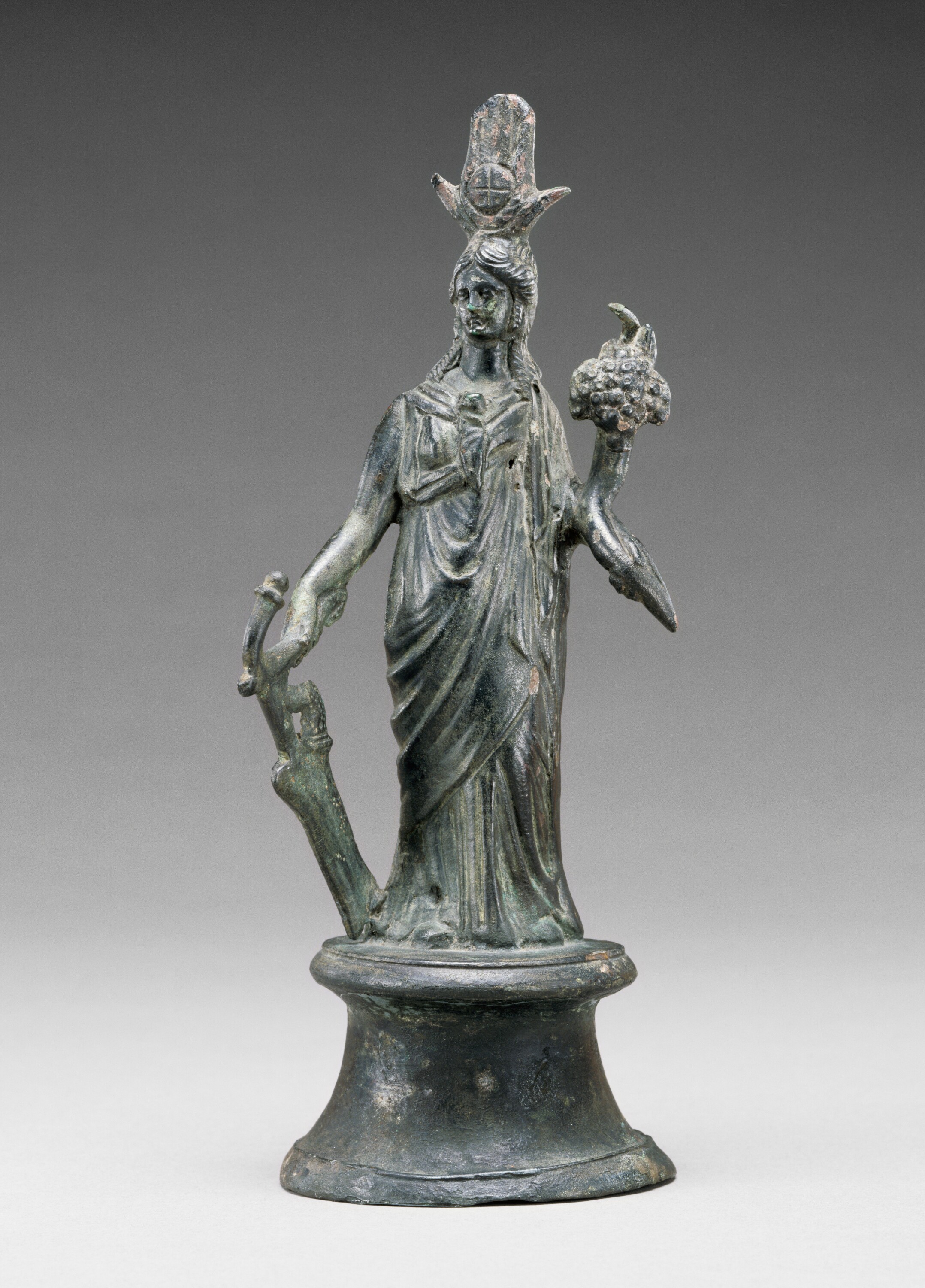
The Egyptian goddess Isis was adopted into Roman religion in the first century B.C. She possessed a wide range of powers, including the ability to offer her followers a better afterlife. In Roman religion, she was often merged with other Roman goddesses, creating new composite deities. This statuette portrays Isis combined with Fortuna, a fertility goddess who controlled the fate of both individuals and cities. This statuette has attributes of both goddesses: she wears the elaborate headdress of Isis, a lunar disk between horns or feathers, and the front of her long dress is tied in a knot on her chest, the so-called Isis knot. She also holds the usual attributes of Fortuna: the rudder in her right hand refers to her control over the course of human lives, and the cornucopia in her left arm is a symbol of abundance and prosperity (Getty Museum).
Properties
Chariot Race (Course de char) by Jean Léon Gérôme
Annotations
Jean-Léon Gérôme (French, 1824–1904) claimed that he based this almost cinematic depiction of a chariot race at the Circus Maximus stadium in Rome on archaeological research. The painting was first acquired by New York department store magnate A. T. Stewart, reflecting the popularity of Gérôme’s slickly finished and often dramatic work among wealthy American collectors in the 19th century. Its arrival in the United States made headlines and was reported by young writer Henry James, who described it as “a fierce mêlée of beasts, men, and wheels; the struggle and confusion are powerfully expressed, and the horses and chariots painted with that hard, consummate finish characteristic of the author.” (Art Institute of Chicago)
Properties
Ummidia Quadratilla inscription reconstruction drawing
Annotations
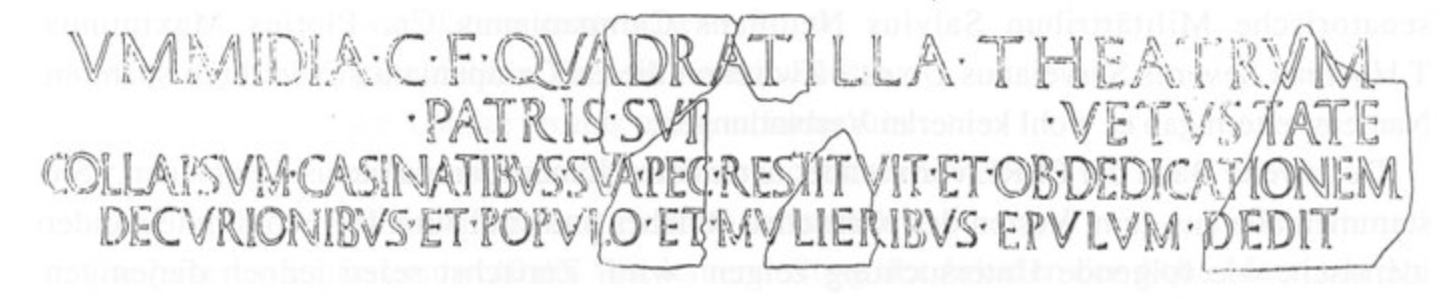
[Ummidia C(ai) f(ilia) Qu]adrati[lla theatr]um
[impensis(?) patri]s sui [exornatum(?) vetus]tate
[collapsum Casinatibus su]a pec(unia) [res]titu[it et ob dedica]tionem
[decurionibus et popu]lo et [m]ulier[ibus epulum] dedit
Ummidia Quadratilla, daughter of Gaius, restored for the people of Casinum with her own money the theater originally built at the expense of her father, but which had collapsed with age, and on the occasion of its dedication she provided a feast for the decurions, the people, and the women. (trans. Christopher Francese)