Fragmentary Amazonomachy Roman Mosaic
Annotations
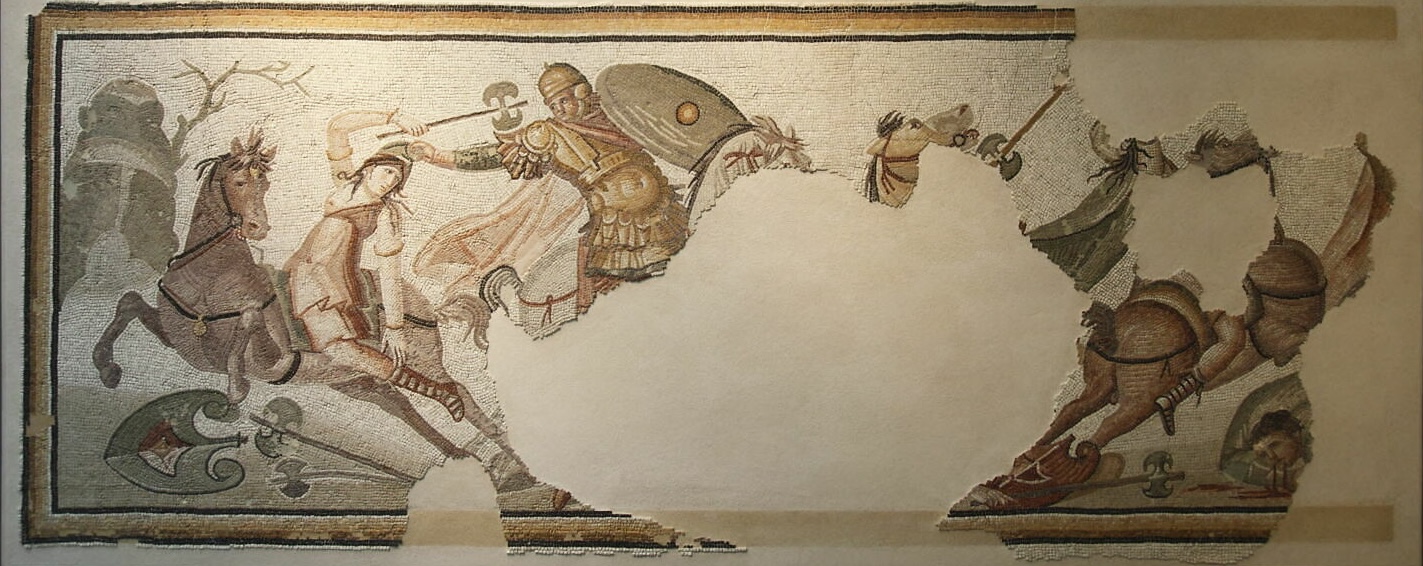
Detail of a fragmentary Roman mosaic depicting an Amazonomachy. Found in Antakya, Turkey. © 2012 Musée du Louvre, Dist. GrandPalaisRmn / Antoine Mongodin.
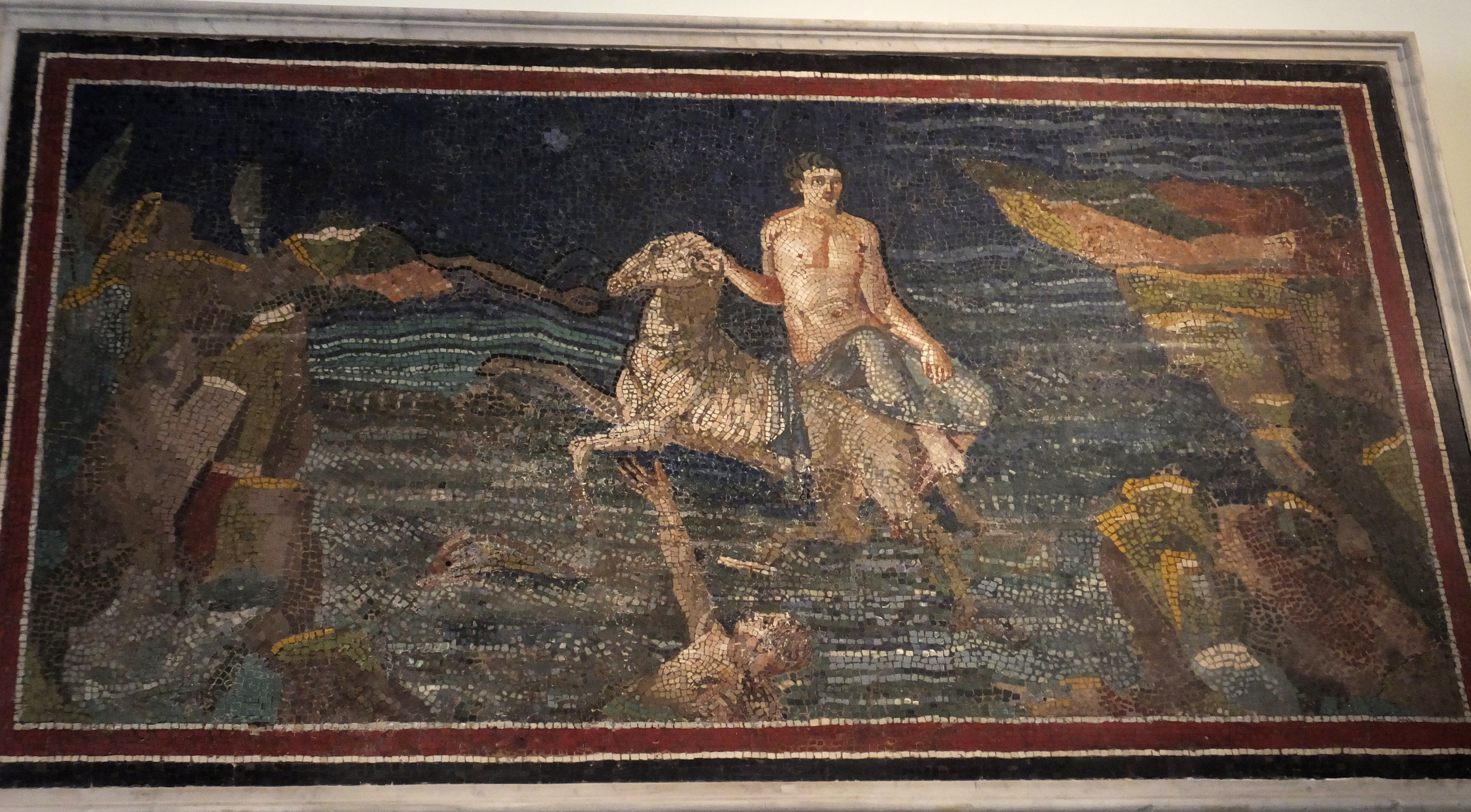
Phrixus being carried across the Hellespont on the ram from the Golden Fleece. Helle has fallen off the ram and is drowning. From the Nymphaeum of the Villa San Marco in Stabiae. Museo Archeologico Nazionale di Napoli 10005.
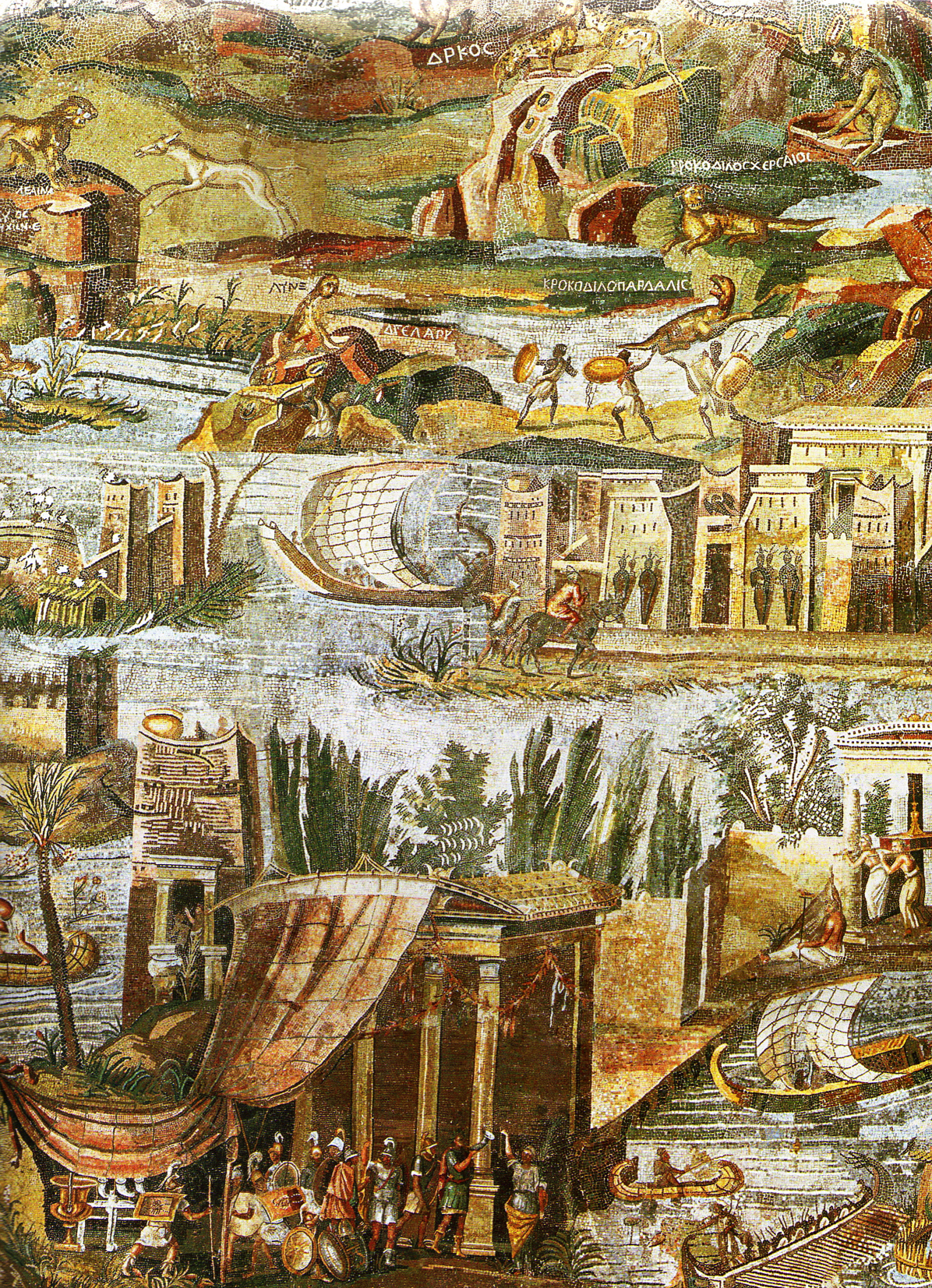
The Palestrina Mosaic or Nile mosaic of Palestrina is a late Hellenistic floor mosaic depicting the Nile in its passage from the Blue Nile to the Mediterranean. The mosaic was part of a Classical sanctuary-grotto in Palestrina, a town east of Ancient Rome, in central Italy. It has a width of 5.85 metres and a height of 4.31 metres and provides a glimpse into the Roman fascination with ancient Egyptian exoticism in the 1st century BC, both as an early manifestation of the role of Egypt in the Roman imagination and an example of the genre of "Nilotic landscape", with a long iconographic history in Egypt and the Aegean.
The mosaic, with an arch-headed framing that identifies its original location as flooring an apse in a grotto, features detailed depictions of Ptolemaic Greeks, Aethiopians in hunting scenes, and various animals of the Nile river. It is the earliest Roman depiction of Nilotic scenes, of which several more were uncovered at Pompeii. A consensus on the dating of the work is slowly emerging. Paul G. P. Meyboom suggests a date shortly before the reign of Sulla (ca. 100 BC) and treats the mosaic as an early evidence for the spread of Egyptian cults in Italy, where Isis was syncretised with Fortuna. He believes Nilotic scenes were introduced in Rome by Demetrius the Topographer, a Greek artist from Ptolemaic Egypt active ca. 165 BC. Claire Préaux emphasises the "escapist" nature of the fantastic scenery. (Wikipedia)
Orpheus charms the animals with his music. Detail of a Roman floor mosaic from Building A, Piazza della Vittoria, Palermo. Museo Archeologico Regionale Antonio Salinas NI 2287. Photo by Marie-Lan Nguyen via Wikimedia Commons, CC BY 2.5
Hercules dressed in women's clothes while serving as Omphale's slave. Museo Arqueológica Nacional, Madrid 38315BIS. Photo by Luis García via Wikimedia Commons, CC BY-SA 3.0.
Hercules cleans the Augean stables by rerouting the rivers Alpheus and Peneus. Museo Arqueológica Nacional, Madrid 38315BIS. Photo by Luis García via Wikimedia Commons, CC BY-SA 3.0.
Hercules hunts the Stymphalian Birds. Detail of The Twelve Labours Roman mosaic from Llíria, Spain. Museo Arqueológica Nacional, Madrid 38315BIS. Photo by Luis García via Wikimedia Commons. CC BY-SA 3.0
Hercules stealing the Golden Apples from the Hesperides. Detail of The Twelve Labours Roman mosaic from Llíria, Spain. Museo Arqueológica Nacional, Madrid 38315BIS. Photo by Luis García via Wikimedia Commons. CC BY-SA 3.0
Hercules subdues the man-eating Mares of Diomedes. Detail of a Roman mosaic from Llíria, Spain. Museo Arqueológica Nacional, Madrid, 38315BIS. Photo by Luis Garcia via Wikimedia Commons. CC BY-SA 3.0.
Memento Mori mosaic from excavations in the convent of San Gregorio, Via Appia, Rome, Italy. Now in the Museo Nazionale Romano Terme di Diocleziano, Rome, Italy. The Greek motto gnōthi sauton (know thyself, nosce te ipsum) combines with the image to convey the famous warning: Respice post te; hominem te esse memento; memento mori. (Look behind; remember that you are mortal; remember death.)