Brant: In the Underworld III
Annotations
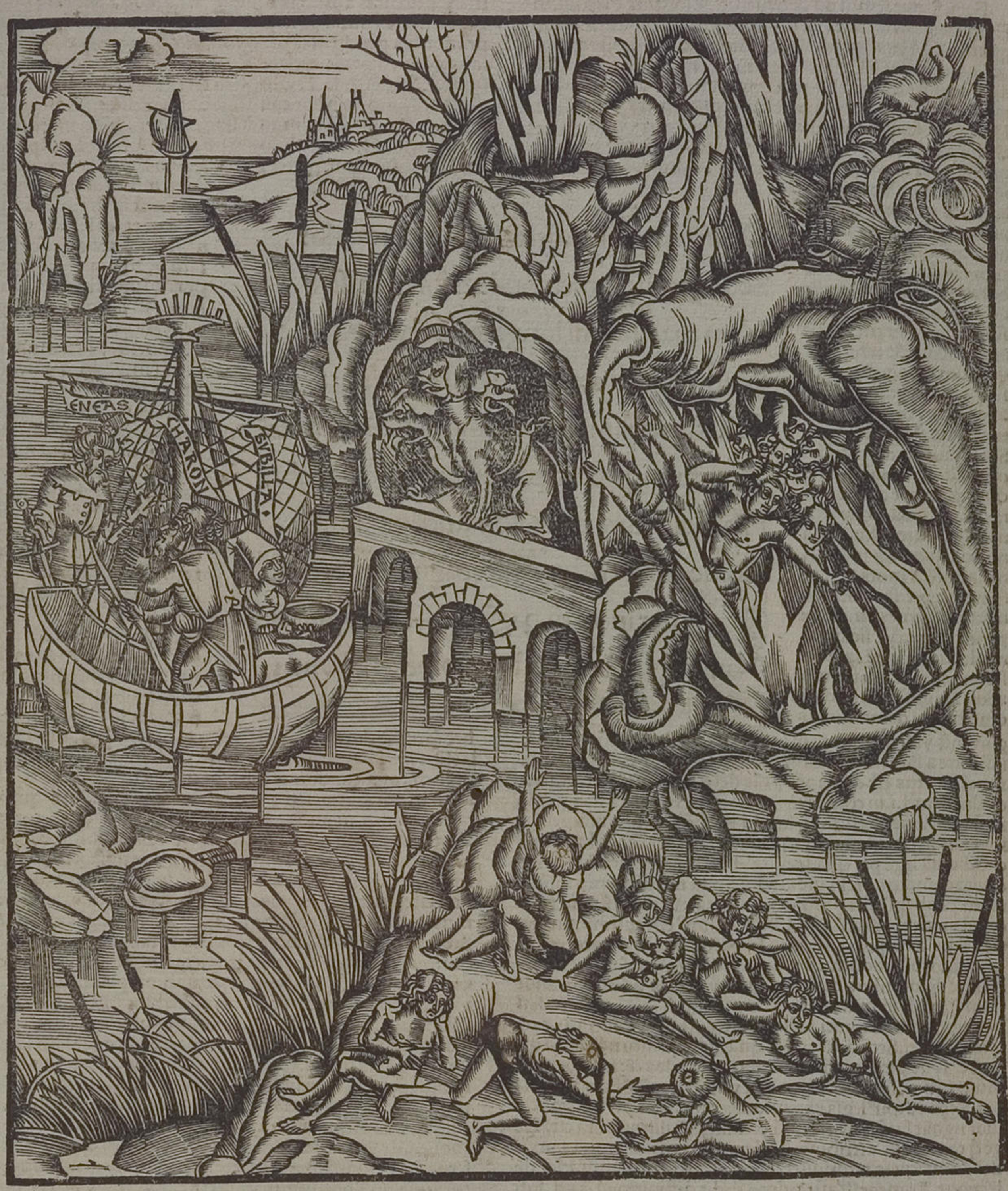
On the left, Aeneas, standing next to the ferry of Charon, shows the golden bough to the ferryman, as proof that he has permission to enter the depths of the underworld; in Vergil, the Sibyl holds the bough (406-10). Charon prepares to ferry Aeneas and the Sibyl across the Styx (407-16). The water is marshy (414-6), which is indicated by the cattails. In the middle of the image the three-headed dog Cerberus growls from its cave, where it guards the entrance to the deeper underworld (417-25). In the upper right, shades are crowded inside the fiery jaws of Hell, which is depicted as a monstrous head. It is interesting to note that the design of the monster is entirely different from the depiction of the same monster in the previous image. On a spit of land between the two primary rivers, more souls sit despairing; these may be the shades whom Charon displaced from his boat in order to carry Aeneas and the Sibyl (411-3).
Woodcut illustration from the “Strasbourg Vergil,” edited by Sebastian Brant: Publii Virgilii Maronis Opera cum quinque vulgatis commentariis expolitissimisque figuris atque imaginibus nuper per Sebastianum Brant superadditis (Strasbourg: Johannis Grieninger, 1502), fol. 268v, executed by an anonymous engraver under the direction of Brant.

Sebastian Brant (1458-1521) was a humanist scholar of many competencies. Trained in classics and law at the University of Basel, Brant later lectured in jurisprudence there and practiced law in his native city of Strasbourg. While his satirical poem Das Narrenschiff won him considerable standing as a writer, his role in the transmission of Virgil to the Renaissance was at least as important. In 1502 he and Strasbourg printer Johannes Grüninger produced a major edition of Virgil’s works, along with Donatus’ Life and the commentaries of Servius, Landino, and Calderini, with more than two hundred woodcut illustrations. (Annabel Patterson)
Properties
Brant: In the Underworld II
Annotations
Aeneas and the Sibyl, in the top right corner, approach the shores of the Cocytus river. The shades of the recently dead pour out from the jaws of a reptilian monster that signifies the entrance to the underworld. The right side of the monster is engulfed in flames. At the top center above and behind the head are two minute figures whose purpose is unclear, but the message seems sinister; a human figure in white is assaulted by a shadowy figure with a tail. Below the monster, a spring pouring out of a rocky cave is the source of the Acheron, Cocytus and Styx rivers (295-7); the latter two are split by a large delta. At the shores of the Cocytus, the river on the right, the shades wait to pass into the deeper realms of the underworld (305-16). In the lower left, Charon, with his garment knotted at his waist instead of his shoulder, ferries a handful of shades across the Styx (298-301). Palinurus, Aeneas' helmsman who fell to his death from the stern of the ship, approaches Aeneas and begs him to return to the shore where his body has washed up and give him a proper burial (337-83). The Sibyl promises him a proper tomb, but not by the men of Aeneas (377-81).
Woodcut illustration from the “Strasbourg Vergil,” edited by Sebastian Brant: Publii Virgilii Maronis Opera cum quinque vulgatis commentariis expolitissimisque figuris atque imaginibus nuper per Sebastianum Brant superadditis (Strasbourg: Johannis Grieninger, 1502), fol. 265v, executed by an anonymous engraver under the direction of Brant.
Sebastian Brant (1458-1521) was a humanist scholar of many competencies. Trained in classics and law at the University of Basel, Brant later lectured in jurisprudence there and practiced law in his native city of Strasbourg. While his satirical poem Das Narrenschiff won him considerable standing as a writer, his role in the transmission of Virgil to the Renaissance was at least as important. In 1502 he and Strasbourg printer Johannes Grüninger produced a major edition of Virgil’s works, along with Donatus’ Life and the commentaries of Servius, Landino, and Calderini, with more than two hundred woodcut illustrations. (Annabel Patterson)
Properties
Brant: In the Underworld I
Annotations
Sebastian Brant (1458-1521) was a humanist scholar of many competencies. Trained in classics and law at the University of Basel, Brant later lectured in jurisprudence there and practiced law in his native city of Strasbourg. While his satirical poem Das Narrenschiff won him considerable standing as a writer, his role in the transmission of Virgil to the Renaissance was at least as important. In 1502 he and Strasbourg printer Johannes Grüninger produced a major edition of Virgil’s works, along with Donatus’ Life and the commentaries of Servius, Landino, and Calderini, with more than two hundred woodcut illustrations. (Annabel Patterson)
Properties
Brant: Avernus
Annotations
Aeneas performs sacrifices at the entrance to the underworld at Lake Avernus, which is shown as a circular chasm, shaped a bit like a well, with flame-like vapor pouring out of it (237-42). The Sibyl pours wine on the head of one of two oxen, holding the head of a third; these oxen are a sacrifice to Hecate (243-9). Aeneas slits the throat of a sheep as an offering to Night (249-51); in the text, he sacrifices a barren heifer for Proserpine (251), but in the image, the task is given to Achates, who has shed his armor for the occasion. An altar burns with the leg of a bull for Hades (252-4). Aeneas performs these sacrifices in order to be allowed passage into the underworld. (Katy Purington)
Woodcut illustration from the “Strasbourg Vergil,” edited by Sebastian Brant: Publii Virgilii Maronis Opera cum quinque vulgatis commentariis expolitissimisque figuris atque imaginibus nuper per Sebastianum Brant superadditis (Strasbourg: Johannis Grieninger, 1502), fol. 262v, executed by an anonymous engraver under the direction of Brant.
Sebastian Brant (1458-1521) was a humanist scholar of many competencies. Trained in classics and law at the University of Basel, Brant later lectured in jurisprudence there and practiced law in his native city of Strasbourg. While his satirical poem Das Narrenschiff won him considerable standing as a writer, his role in the transmission of Virgil to the Renaissance was at least as important. In 1502 he and Strasbourg printer Johannes Grüninger produced a major edition of Virgil’s works, along with Donatus’ Life and the commentaries of Servius, Landino, and Calderini, with more than two hundred woodcut illustrations. (Annabel Patterson)
Properties
Brant: Preparation for the Funeral of Misenus
Annotations
The men of Aeneas prepare a funeral for Misenus (156-235), while in the upper right corner, Aeneas and Achates enter the grove to seek the golden bough that Aeneas needs in order to enter the underworld (183-211). Men cut down trees and chop logs to build a funeral pyre for the tomb of their comrade (176-84). Another digs a grave. There are multiple piles of chopped wood, so it is not immediately clear which one is intended as the funeral pyre. It would make sense that the lit fire would be the pyre, but the one next to it is surrounded by foliage, which is mentioned by Vergil in line 215. In the lower left, a cauldron of water is warmed in order to wash and anoint the body (218-9). Corynaeus [Chorineus] stands in the upper left corner, next to the grave, ready to collect the bones from the funeral pyre and place them in an urn (228). The oar and trumpet of Misenus lie on top of the tomb lid, ready to be placed in the tomb with the urn (232-6). (Katy Purington)
Woodcut illustration from the “Strasbourg Vergil,” edited by Sebastian Brant: Publii Virgilii Maronis Opera cum quinque vulgatis commentariis expolitissimisque figuris atque imaginibus nuper per Sebastianum Brant superadditis (Strasbourg: Johannis Grieninger, 1502), fol. 260r, executed by an anonymous engraver under the direction of Brant.
Sebastian Brant (1458-1521) was a humanist scholar of many competencies. Trained in classics and law at the University of Basel, Brant later lectured in jurisprudence there and practiced law in his native city of Strasbourg. While his satirical poem Das Narrenschiff won him considerable standing as a writer, his role in the transmission of Virgil to the Renaissance was at least as important. In 1502 he and Strasbourg printer Johannes Grüninger produced a major edition of Virgil’s works, along with Donatus’ Life and the commentaries of Servius, Landino, and Calderini, with more than two hundred woodcut illustrations. (Annabel Patterson)
Properties
Brant: Misenus
Annotations
Aeneas, accompanied by Achates, asks the Sibyl for help in reaching the underworld to visit his father (103-23). The Sibyl advises Aeneas of the steps he must take if he wishes to visit the underworld (124-55). She gestures toward a grove, at the right edge of the image, that contains a golden bough sacred to Proserpina, which a worthy man must break off to present to her when he reaches the underworld (136-48). To the left, the body of Misenus is carried in a ship toward the beach by a few of Aeneas's men (156-74). Aeneas must bury Misenus before he may descend to the underworld (149-53). (Katy Purington)
Woodcut illustration from the “Strasbourg Vergil,” edited by Sebastian Brant: Publii Virgilii Maronis Opera cum quinque vulgatis commentariis expolitissimisque figuris atque imaginibus nuper per Sebastianum Brant superadditis (Strasbourg: Johannis Grieninger, 1502), fol. 257v, executed by an anonymous engraver under the direction of Brant.
Sebastian Brant (1458-1521) was a humanist scholar of many competencies. Trained in classics and law at the University of Basel, Brant later lectured in jurisprudence there and practiced law in his native city of Strasbourg. While his satirical poem Das Narrenschiff won him considerable standing as a writer, his role in the transmission of Virgil to the Renaissance was at least as important. In 1502 he and Strasbourg printer Johannes Grüninger produced a major edition of Virgil’s works, along with Donatus’ Life and the commentaries of Servius, Landino, and Calderini, with more than two hundred woodcut illustrations. (Annabel Patterson)
Properties
Brant: The Temple of Apollo at Cumae
Annotations
Sebastian Brant (1458-1521) was a humanist scholar of many competencies. Trained in classics and law at the University of Basel, Brant later lectured in jurisprudence there and practiced law in his native city of Strasbourg. While his satirical poem Das Narrenschiff won him considerable standing as a writer, his role in the transmission of Virgil to the Renaissance was at least as important. In 1502 he and Strasbourg printer Johannes Grüninger produced a major edition of Virgil’s works, along with Donatus’ Life and the commentaries of Servius, Landino, and Calderini, with more than two hundred woodcut illustrations. (Annabel Patterson)
Properties
Brant: Farewell to Sicily
Annotations
Aeneas and the followers who have agreed to continue the journey to Latium with him bid farewell to those who have decided to stay behind in the newly founded city of Acesta (765-71). A ship on the left side of the image, with a gang-plank leading from it to the shore, indicates the imminent departure of the Trojans. On the right, Venus entreats Neptune to ensure the safe travels of Aeneas (779-98); Neptune assures Venus that he will protect Aeneas and his crew. Neptune stands facing Venus, with his back to the front of his chariot (799-815). Behind his chariot, near the shore, two sea creatures, perhaps the artist's attempt at depicting whales, make up his retinue of followers (816-26). (Katy Purington)
Woodcut illustration from the “Strasbourg Vergil,” edited by Sebastian Brant: Publii Virgilii Maronis Opera cum quinque vulgatis commentariis expolitissimisque figuris atque imaginibus nuper per Sebastianum Brant superadditis (Strasbourg: Johannis Grieninger, 1502), fol. 249v, executed by an anonymous engraver under the direction of Brant.
Sebastian Brant (1458-1521) was a humanist scholar of many competencies. Trained in classics and law at the University of Basel, Brant later lectured in jurisprudence there and practiced law in his native city of Strasbourg. While his satirical poem Das Narrenschiff won him considerable standing as a writer, his role in the transmission of Virgil to the Renaissance was at least as important. In 1502 he and Strasbourg printer Johannes Grüninger produced a major edition of Virgil’s works, along with Donatus’ Life and the commentaries of Servius, Landino, and Calderini, with more than two hundred woodcut illustrations. (Annabel Patterson)
Properties
Brant: Founding of Acesta
Annotations
In the upper right corner, Nautes [Nantes] advises Aeneas and Acestes about how to handle the dissent among Aeneas's followers. He advises Aeneas to allow any tired old men and women who are weary of traveling to stay behind in Sicily, and found a city under the protection of Acestes (704-18). In the upper left, sleeping Aeneas receives advice from a vision of his father Anchises. Anchises agrees with Nautes, and then advises Aeneas to stop at Avernus for a journey to the underworld before heading to Latium (721-40). The city of Acesta is shown to the left of the leaders, having been marked out, and apparently built, by Aeneas before he begins his preparations to continue to Latium (755-8). In the center of the image, a few women, some old men and an injured man represent the people who will stay behind in Acesta (750-1). In the lower right, a fully repaired ship represents the Trojan fleet, which Aeneas's remaining men have repaired (752-3). On the left, at the top of Mount Eryx, here no more than a hill, a new temple to Venus has been founded, labeled here as Veneris Erucine (759-60). (Katy Purington)
Woodcut illustration from the “Strasbourg Vergil,” edited by Sebastian Brant: Publii Virgilii Maronis Opera cum quinque vulgatis commentariis expolitissimisque figuris atque imaginibus nuper per Sebastianum Brant superadditis (Strasbourg: Johannis Grieninger, 1502), fol. 248r, executed by an anonymous engraver under the direction of Brant.
Sebastian Brant (1458-1521) was a humanist scholar of many competencies. Trained in classics and law at the University of Basel, Brant later lectured in jurisprudence there and practiced law in his native city of Strasbourg. While his satirical poem Das Narrenschiff won him considerable standing as a writer, his role in the transmission of Virgil to the Renaissance was at least as important. In 1502 he and Strasbourg printer Johannes Grüninger produced a major edition of Virgil’s works, along with Donatus’ Life and the commentaries of Servius, Landino, and Calderini, with more than two hundred woodcut illustrations. (Annabel Patterson)