Conticuēre omnēs intentīque ōra tenēbant;
inde torō pater Aenēās sīc ōrsus ab altō:
Īnfandum, rēgīna, iubēs renovāre dolōrem,
Trōiānās ut opēs et lāmentābile rēgnum
ēruerint Danaī, quaeque ipse miserrima vīdī5
et quōrum pars magna fuī. Quis tālia fandō
Myrmidonum Dolopumve aut dūrī mīles Ulixī
temperet ā lacrimīs? Et iam nox ūmida caelō
praecipitat suādentque cadentia sīdera somnōs.
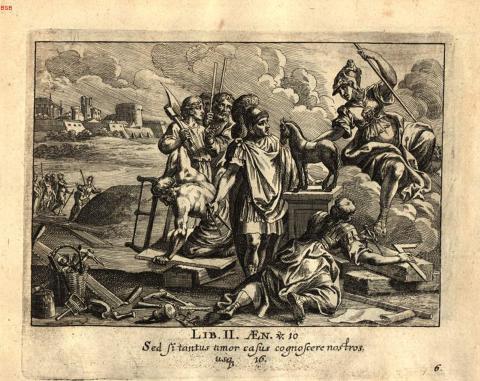
Sed sī tantus amor cāsūs cognōscere nostrōs10
et breviter Trōiae suprēmum audīre labōrem,
quamquam animus meminisse horret lūctūque refūgit,
incipiam. Frāctī bellō Fātīsque repulsī
ductōrēs Danaüm tot iam lābentibus annīs
īnstar montis equum dīvīnā Palladis arte15
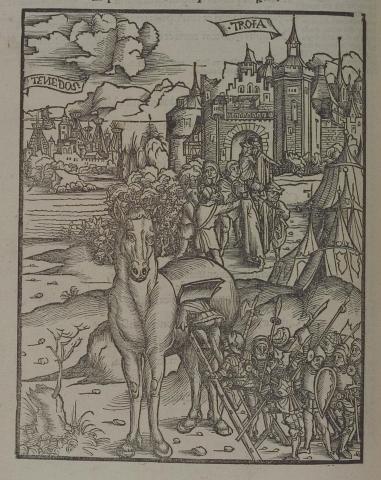
aedificant, sectāque intexunt abiete costās;
vōtum prō reditū simulant; ea fāma vagātur.
Hūc dēlēcta virum sortītī corpora fūrtim
inclūdunt caecō laterī penitusque cavernās
ingentēs uterumque armātō mīlite complent.20
notes
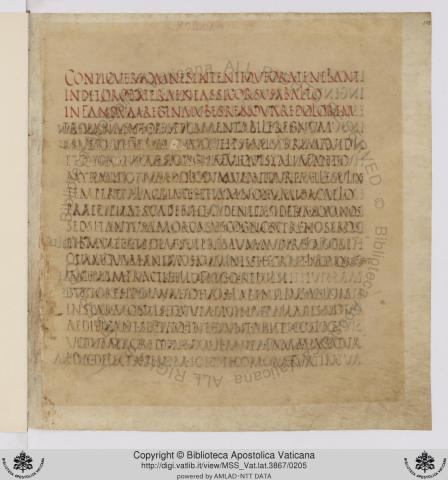
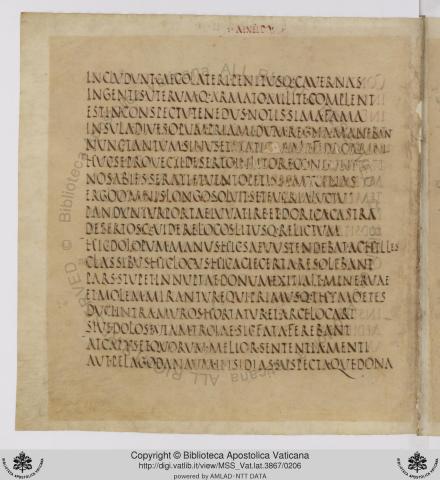
Manuscripts: M | P | R 1-18, 19-20
Aeneas undertakes to recount the story of his adventures (1–13); the stratagem of the wooden horse (13 ff.) (Bennett).
"The Aeneid obviously begins at the beginning of Book 1 with Arma virumque cano, but those words are introductory—they begin the poem, but not the story..."
- read full essay by Meghan Reedy
-
[click here to open in new tab]
The Aeneid obviously begins at the beginning of Book 1 with Arma virumque cano, but those words are introductory—they begin the poem, but not the story. The story begins in 1.34 with the huge storm Juno arranges. But then again, is this really the beginning of the story? The Trojans are in the middle of their journey already. The storm is just the first event we hear about. What kind of a beginning is that?
At the beginning of Book 2 everybody quiets down (1–2), and Aeneas begins to speak. The first thing he mentions is that the evening is at an end (8–9): iam nox umida praecipitat suadentque cadentia sidera somnos; the dew is falling already and the stars are setting—it is very late and time for sleep. The beginning and the middle of the evening happened at the very end of Book 1 (723–55). After a feast (723), Dido has sent around a libation cup to initiate the after-dinner drinking and conversation (724–40); a bard, Iolpas, has already sung a long song explaining the beginnings of many things (740–46): he tells the story of where the human race and animals come from, as well as rain and fire (unde hominum genus et pecudes, unde imber et ignes, 743).
Iolpas’ song cannot have been short, but even after this Dido draws the night out with conversation, vario noctem sermone trahebat … Dido (748–49). She asks Aeneas all sorts of things about Trojan war, and then she asks Aeneas for more: ‘Immo age, et a prima dic, hospes, origine nobis / insidias,' inquit, 'Danaum, casusque tuorum, …’ (753–54). Aeneas is right to mention that it’s bedtime already,but notice how Dido wants the story of their ending, casus tuorum … starting from the very beginning, a prima … origine.
So, to sum up: at the end of Book 1, at the end of the evening, Dido asks to hear the story of an ending told from the very first beginning. She asks this shortly after hearing a song about the beginning of humankind, which gently raises the question: how far back ought one go to start at the very beginning?
Thus, at the beginning of Book 2, when Aeneas gets around to saying he’s beginning—incipiam (13)—where does he start? At the end. The Trojan war has already worn everyone down, … fracti bello fatisque repulsi / ductores Danaum, tot iam labentibus annis … (13–14).
The first thing that happened was the building of the horse, instar montis equum … aedificant (15–16), and the rumor about it, votum pro reditu simulant (17), and its belly full of soldiers, uterumque armato milite complent (20). From here, the story moves quickly at first: the Greeks pretend to leave (21–24), and the Trojans really think they have left, nos abiisse rati (25), and this assumption alters the Trojans’ behavior: ergo omnis longo soluit se Teucria luctu (26). However, right away they are divided about the horse: the first opinion, primus (32), is that it should be taken inside the walls whatever it is; the better opinion, melior (35), is that it should be destroyed. They can’t agree: scinditur incertum studia in contraria vulgus (39). Then, a tiebreaker arrives: Laocoon, who is ‘first ahead of everyone,’ primus ante omnis (40). He is all fired up, ardens, and he runs down from the citadel, decurrit ab arce (41), and he sees that this is insanity: o miseri, quae tanta insania, ciues? (42). How, he asks over several lines (43–49), can they possibly believe that (a) the Greeks are really gone and (b) the horse is anything but a trick?! He goes to prove it by throwing his spear at the horse – and sure enough it makes a big, hollow sound … (52–53)
At this point, there is a pause in the swift-paced story. Aeneas says (54–56):
et, si fata deum, si mens non laeua fuisset,
impulerat ferro Argolicas foedare latebras,
Troiaque nunc staret, Priamique arx alta maneres.
If this situation—the trick-horse full of soldiers, the Greeks faking a departure, arguments among the gullible Trojan crowd, and an influential and charismatic Trojan leader with his head on his shoulders—had played out, Troy would still stand, Troia nunc staret. Laocoon would have set everybody straight in short order, and they would have destroyed the horse and its bellyful of soldiers one way or another. The Greeks’ big trick would have failed—and so these initial events are not really the beginning after all; they are groundwork, prelude, and setup.
When Aeneas begins the story again, it is with a bang: Ecce, Look. Some Trojan shepherds are dragging in a Greek they don’t know—a Greek who has let himself be caught, who has committed himself utterly to tricking the Trojans or dying: in utrumque paratus, / seu versare dolos seu certae occumbere morti (61–62). Then, after the flashy parts of the story are already told (the horse is already built, the Greeks have already pretended to leave), now that he is already 50 lines in to telling the story, he invites his listeners to pay attention: accipe nunc Danaum insidias et crimine ab uno disce omnis (65–66). Now learn about Greek treachery, he says, learn the whole range from this one crime. This is the real beginning of the treachery.
Thus, what we’re looking for the beginning of matters a great deal when we are looking for beginnings. Even then, it turns out that beginnings and endings remain intertwined, endings begin and beginnings end and then it all begins again…
Further Reading
Anderson, W.S. The Art of the Aeneid 2nd ed. (Wauconda, IL, 2005) 32-37
Gransden, K.W. ‘The Fall of Troy’ in Virgil. Greece & Rome Studies, eds I. McAuslan and P. Walcot (Oxford, 1990)
Harries, B. ‘Back to the horse: symbol and narrative in Aeneid 2’ Liverpool Classical Monthly 14 (1989) 136-41
Hexter, R. ‘What was the Trojan horse made of?: interpreting Vergil’s Aeneid’ The Yale Journal of Criticism 3 (1990) 109-31
Johnson, W.R. ‘Dis aliter visum: self-telling and theodicy in Aeneid 2’ in Reading Vergil’s Aeneid: An Interpretive Guide, ed. C. Perkell (Norman, OK, 1999) 50-63
Jones, J.W. ‘The Trojan horse: timeo Danaos et dona ferentis’ Classical Journal 65 (1970) 241-7
Lynch, J.P. ‘Laocoön and Sinon: Virgil, Aeneid 2.40-198’ Greece and Rome 27 (1980) 170-9
Nagle, B.R. ‘Open-ended closure in Aeneid 2’ Classical World 76 (1983) 257-63
Smith, R.M. ‘Deception and sacrifice in Aeneid 2.1-249’ American Journal of Philology 120 (1999) 503-23
The Aeneid obviously begins at the beginning of Book 1 with Arma virumque cano, but those words are introductory—they begin the poem, but not the story. The story begins in 1.34 with the huge storm Juno arranges. But then again, is this really the beginning of the story? The Trojans are in the middle of their journey already. The storm is just the first event we hear about. What kind of a beginning is that? (read full essay)
1: conticuēre: = conticuērunt. This ending is very rare in Caesar, but common in poetry, being often convenient for metrical purposes (C-R). The compound expresses the intensity of the silence, the tense marks the instantaneous check to the cheerful excitement of the company (Austin). The perf. describes a single completed act—”silence fell on all”: the imperf. tenēbant expresses duration—“turning their faces (towards Aeneas) they were keeping them (turned towards him)” (Page). The prefix in conticuēre has an intensive force (F-B). intentī: may be rendered adverbially “intently, earnestly” (Frieze). The whole expression is however perhaps only a variation for intenta ora tenēbant (Sidgwick).
2: torō: i.e., the banquet couch (Comstock). The Greeks and Romans did not sit, but reclined, at their meals (C-R). Torus is properly the cushioning of the couch, something that swells (Austin). orsus: sc. est (F-B). The omission of est or sunt is very common, especially with deponent verbs (Page). altō: higher than the others, as a mark of honour (Howson).
3–8: Notice how these lines are filled with expressions of sorrow: infandum...dolorem, lāmentābile (a most sonorous word), miserrima, quis...temperet ā lacrimīs. So Odysseus (Od. 9.12 f.) begins his story to Alcinous with emphasis on the sufferings, which he is asked to recall (Williams).
3: infandum: emphatic position, “Too sad for words (lit. ‘unspeakable’) is the tale of sorrow you bid me revive” (Comstock). renovāre: sc. mē (F-B).
4: ut: “how,” introducing an indirect question, which is dependent on the sense of “telling” implied in renovare dolorem (F-B). lāmentābile: adjs. in -bilis are usually passive as here (H-H) (AG 252).
5: Danaī: “the Greeks,” one of the Homeric names for the Greek host who attacked Troy. Danaus was the mythical king of Argos, and the name meant the Argives originally (Sidgwick). The name used most often by Virgil for the Greeks, and least often by Homer (Austin). quaeque: “and (the things) which”; the antecedent, ea understood, is in the same construction as dolōrem (Frieze). Quae and quōrum (line 6) are relative, not interrogative, pronouns, hence the change of mood. The relative sentences are in loose apposition to the previous lines, whose meaning they extend (C-R). ipse: This is strictly true, as the narrative is purely personal, and does not pretend to be a complete account of the capture of Troy (Howson).
6: fandō: “while uttering”; a gerund in the ablative expressing the relation of while and equivalent to a present participle. This usage also occurs occasionally in prose (Frieze) (AG 507). “In recounting such events”; fandō is ablative of attendant circumstance (Bennett).
7: Myrmidonum Dolopum: join with quis as a partitive (AG 346a). The Myrmidons and Dolopians were Thessalian soldiers, followers of Achilles, and, after his death, of his son Pyrrhus or Neoptolemus. They are specified here as being the most bloodthirsty enemies of Troy (Frieze). With mīles, quis is to be supplied as an adjective (Bennett). durī...Ulixī: “ruthless Odysseus.” The nature of the general gives a hint of that of his soldiers (Knapp). “The patient Ulysses,” one of the Homeric epithets for him: he bore ten years’ war and ten years’ wanderings. Observe the irregular gen. Ulixī from nom. Ulixēs (Sidgwick). Greek proper names in -ēs of the third declension have the genitive in both -is and -ī (C-R) (AG 83f).
8: temperet ā lacrimīs: Potential subj., in a question implying a negative answer (Chase) (AG 444). “Could refrain from tears…” the verb is more commonly followed in this sense by the abl. alone or by the dat. (G-K).
8–9: nox caelō praecipitat: intransitive, as in 9.670 nimbī in vāda praecipitant (Storr). The poet conceives darkness as descending upon the earth from the sky (Bennett). Nox is personified and represented as driving through the heaven in a chariot (Chase). Night, like the day (1.745), rises from the ocean, mounts the heavens, and descends into the ocean again (Knapp). caelō: in poetry the preposition is often omitted in phrases of motion from (C-R).
10: amor: sc. est. The word has here the sense of dēsīderium (F-B). cognōscere: complem. inf. with amor (est), which is equivalent to a verb of wishing (G-K) (AG 456). This use of an infinitive with a substantive is poetical. In prose it would be cognōscendī (F-B) (AG 504).
11: suprēmum...labōrem: “the final disaster” (Frieze); “the last agony” (G-K); “the death-struggle” (Storr). The day of a person’s death was called his diēs suprēmus (Knapp).
12: meminisse horret: “shudders to recall.” Verbs of fearing regularly take the infinitive in this sense, though usually only vereor is in fact so used (G-K) (AG 456). refūgit: Observe the quantity, indicating perfect tense (Page). The variation of tense is scarcely significant, since the feelings conveyed are concurrent and interchangeable (Horsfall).
13: incipiam: usually translated “I will begin,” but possibly “I will undertake, or attempt” (H-H).
14: ductōrēs: = ducēs. Archaic tone (F-B). Danaüm: = Danaōrum (F-B). lābentibus: abl. abs. (AG 466). “Seeing that now so many years were slipping away” (Howson).
15: īnstar: in apposition with equum, and governing the genitive. It may be translated “as large as” (Frieze). With one exception (6.865) īnstar is always used with a gen. (e.g. 3.637 Phoebēae lampadis īnstar, 7.707 magnī āgminis īnstar), and it is only found in nom. and acc. (Page) (AG 359b). Palladis: Pallas not only favoured the Greeks, but was also the patroness of all handicrafts (Page).
16: sectāque...costās: The process of placing the planks horizontally across the ribs is compared to the passing of the horizontal “threads” of the wood across the vertical threads of the warp in weaving (Page). abiete: is to be pronounced abyete, three syllables (Bennett). In 112 he speaks of the horse as made of “maple beams” and in 186 of oak: a natural poetic variation. He means “wood” (Sidgwick). The word rōbur, when used of the horse in 186, 230, 260, has the general sense of “wood” rather than its special meaning “oak” (Williams).
17: vōtum...simulant: “pretend it as an offering”; vōtum is predicate accusative. As direct object of simulant, eum referring to equum, is to be supplied in thought (Bennett). prō reditū: to ensure a favorable voyage, and perhaps as a thank-offering for getting safely away (C-R). ea fāma vagātur: “Such is the tale that spread” (Storr).
18: hūc: “in it,” literally, “hither,” and used because the verb implies motion (F-B). Hūc is equivalent to in equum (Frieze). dēlēcta vir(ōr)um corpora: a periphrasis for delēctōs virōs, the corpora, however, implying bodily vigor (F-B).
19–20: Note the development from caecō laterī to cavernās ingentēs and finally to uterum. Hard consonants are noticeably dominant in these lines, perhaps suggesting the clatter of the climbers into the Horse (Austin). cavernās...uterumque: hendiadys for “the hollow belly” (Bennett). -que here, as often, is used to give an explanation, not an additional detail (C-R).
19: caecō: here used in a passive sense (Howson). The epithet suggests the dark vastness of the hidden recesses in the Horse (Austin). laterī: explains hūc, and refers more definitely to the interior of the horse (Frieze). Dat., in a sort of apposition with hūc, but governed by inclūdunt (G-K) (AG 370).
20: mīlite: “with soldiery”; used collectively (Frieze). As is often the case in Virgil, the second part of the sentence explains the first, and the dēlēcta corpora (18) are identical with the armātō mīlite (F-B).
vocabulary
conticēscō, ticuī, 3, inc. n.: to become still; be still, hushed, silent, 2.253. (com- and taceō)
intentus, a, um: earnestly attentive, intent, 2.1; expectant, 5.137. (intendō)
torus, ī, m.: a bed, couch, 1.708; seat, 5.388; royal seat, throne, 8.177; bank, 6.674; the swelling part of flesh; a brawny muscle.
Aenēās, ae, m.: 1. A Trojan chief, son of Venus and Anchises, and hero of the Aeneid, 1.92. 2. Aenēās Silvius, one of the Alban kings, 6.769.
ōrdior, ōrsus sum, 4, dep. a. and n.: to weave, spin; to begin; begin to speak; begin, 1.325.
īnfandus, a, um: (adj.), not to be uttered; unutterable, inexpressible, unspeakable, 4.85; cruel, 1.525; dreadful, horrible, 10.673; accursed, perfidious, 4.613; fatal, 2.132; neut., in exclamations, īnfandum! O shame, O woe unutterable! 1.251; pl., īnfanda, as(adv.), 8.489.
rēgīna, ae, f.: a queen, 1.9; princess, 1.273. (rēx)
iubeō, iussī (fut. perf. iussō for iusserō, 11.467), iussus, 2, a.: to order, request, usually w. inf., freq.; bid, 2.3; ask, invite, 1.708; will, wish, desire, 3.261; direct, enjoin, admonish, 3.697; persuade, advise, 2.37; to clear by command, 10.444; w. subj., 10.53.
renovō, āvī, ātus, 1, a.: to renew; revive, suffer again, 2.3; brave, risk, dare again, 2.750.
Trōiānus, a, um: adj. (Trōia), Trojan, 1.19; subst., Trōiānus, ī, m., a Trojan, 1.286; pl., Trōiānī, ōrum, m., the Trojans, 5.688.
ut (utī): (adv., interrog.), in what manner, how? 1.466, et al.; sometimes with indic. in a dependent question, 6.855; how gladly, 8.154.
lāmentābilis, e: adj. (lāmentor, deplore), deplorable; pitiable; to be deplored, 2.4.
ēruō, ī, tus, 3, a.: to cast out or up; to overthrow, 2.5.
Danaī, ōrum, m.: the Greeks, 2.327.
Myrmidones, um, m.: the Myrmidons, Thessalian followers of Achilles, once dwelling in Aegina, where they had been transformed from ants to men in answer to the prayer of Aeacus, grandfather of Achilles, 2.7, et al.
Dolopes, um, m.: the Dolopians, a warlike tribe of Thessaly, followers of Pyrrhus at Troy, 2.7.
Ulixēs, is, eī or ī, m.: Ulysses, son of Laertes, king of Ithaca, and one of the Greek chiefs at Troy, distinguished for shrewdness and cunning, 2.44, et al.
temperō, āvī, ātus, 1, a. and n.: to attemper; combine in due proportions; with acc., regulate, adjust; refresh; allay, moderate, calm, 1.146; restrain, 1.57; with abl. or dat., abstain from, 2.8. (tempus)
ūmidus, a, um: adj. (ūmeō), moist, wet, damp, dewy, 2.8, et al.; liquid, 4.486.
praecipitō, āvī, ātus, 1, a. and n.: to cast headlong, hurl, plunge, 2.37; urge, hurry, hasten; impel, incite, 2.317; break off, end swiftly, 12.699; hasten away, 4.565; n. (sc. sē), fall headlong, 6.351; descend swiftly, 2.9; run down, 4.251. (praeceps)
suādeō, suāsī, suāsus, 2, n. and a.: to advise, warn, urge, exhort, 1.357, et al.; invite, 2.9; impel, prompt, 11.254; compel, force, 10.367.
Trōia, ae, f.: 1. Troy, the capital of the Troad, 2.625, et al. 2. A city built by Helenus in Epirus, 3.349. 3. A part of the city of Acesta in Sicily, 5.756. 4. The name of an equestrian game of Roman boys, 5.602.
meminī, isse, def. a. and n.: (w. acc., gen., or inf.), to have in mind; remember, be mindful, recollect, 1.203; distinguish, 3.202. (rel. to mēns)
horreō, 2, n. and a.: to bristle up or be bristling, 6.419; to bristle, 11.602; (fig.), to shudder, tremble, 2.12; shudder at, fear, dread, 4.209.
lūctus, ūs, m.: a mourning; sorrow, grief, woe, lamentation, 2.298, and freq.; personif., 6.274. (lūgeō)
refugiō, fūgī, 3, n. and a.: to fly, 3.258; flee away, 6.472; recede, stand distant, 3.536; shrink, 2.12; w. acc., start back from, 2.380; shrink from, refuse, 7.618; fugere, refugere, to fly to and fro, 12.753.
repellō, reppulī, repulsus, 3, a.: to push or drive back; repel, 2.13; reject, refuse, disdain, 4.214.
ductor, ōris, m.: a leader, 1.189; captain, commander, 5.133; prince, king, 9.691. (dūcō)
lābor, lapsus sum, 3, dep. n.: to slide, glide down, or slip, freq.; fall down, 2.465; ebb, 11.628; pass away, 2.14; descend, 2.262; glide, sail, skim along, 8.91; flow, 3.281; fall, perish, 2.430; decline, 4.318; faint, 3.309.
īnstar, indecl., n.: an image; figure; noble or majestic form, majesty, 6.865; w. gen., likeness; the size of, as large as, 2.15; like, 3.637. (1. in and stō)
dīvīnus, a, um: adj. (dīvus), relating to the gods; heaven-descended, divine, 5.47; heavenly, 1.403; inspired, prophetic, 3.373.
Pallas, adis, f.: Pallas Athena, identified by the Romans with Minerva, 1.39; rāmus Palladis, the bough sacred to Pallas, the olive, 7.154.
aedificō, āvī, ātus, 1, a.: to build; to construct, make, 2.16. (aedēs and faciō)
secō, secuī, sectus, 1, a.: to cut, freq.; cut off, 4.704; engrave, carve, 3.464; cut through, cleave, 5.218, et al.; of the channel of a river, 8.63; sail through, pass, 8.96; speed, 6.899; shape out mentally, form, 10.107.
intexō, uī, tus, 3, a.: to weave into or in; work in, inweave, 5.252; festoon, wreathe, entwine; cover, 6.216; frame, 2.16.
abies, etis (often trisyll. in the oblique cases), f.: a fir tree; fir wood or fir timber, 2.16; (meton.), a ship, 8.91; a lance, 11.667.
costa, ae, f.: a rib, 1.211; side.
reditus, ūs, m.: a return, 2.17. (redeō)
simulō, āvī, ātus, 1, a.: to make similar; imitate, 6.591; pretend, 2.17; to make a false show of, feign, 1.209; p., simulātus, a, um, made to imitate, counterfeiting, 4.512; dissembling, 4.105; imitating, resembling, 3.349. (similis)
vagor, ātus sum, 1, dep. n. and a.: to wander about, 6.886; ride to and fro, career about, 5.560; to be rumored round, spread, 2.17. (vagus, wandering)
dēligō, lēgī, lēctus, 3, a.: to choose from; choose, 2.18. (dē and legō)
sortior, ītus sum, 4, dep. n. and a.: to cast lots; obtain, get, take by lot, 3.634; share, 8.445; distribute, 3.510; assign, allot, appoint, 3.376; select, choose, 2.18; 12.920. (sors)
fūrtim: (adv.), by stealth, secretly, 2.18. (fūr)
inclūdō, clūsī, clūsus, 3, a.: to shut in, inclose, 6.680; secrete, 2.19; for interclūdō, stop, choke, 7.534; to mount, set, inlay, adorn, 12.211. (1. in and claudō)
penitus: adv. (cf. penes), inwardly, far within, deep, deeply, 1.200; wholly, entirely, 6.737; afar, 11.623; far away, 1.512.
caverna, ae, f.: a hollow; cavern, 2.53, et al. (cavus)
uterus, ī, m.: the womb, belly, 11.813; cavity, 2.38.
armātus, a, um: armed, charged, 12.857. (armō)
compleō, ēvī, ētus, 2, a.: to fill up; fill, 2.20; complete, 5.46; fulfill, 9.108.