Two satyrs and a faun seated to right watching two child satyrs

    Two satyrs and a faun seated to right watching two child satyrs and another satyr with an child on his shoulders dance to left, a round composition, from 'Six animal subjects' (Six sujets d'animaux). 
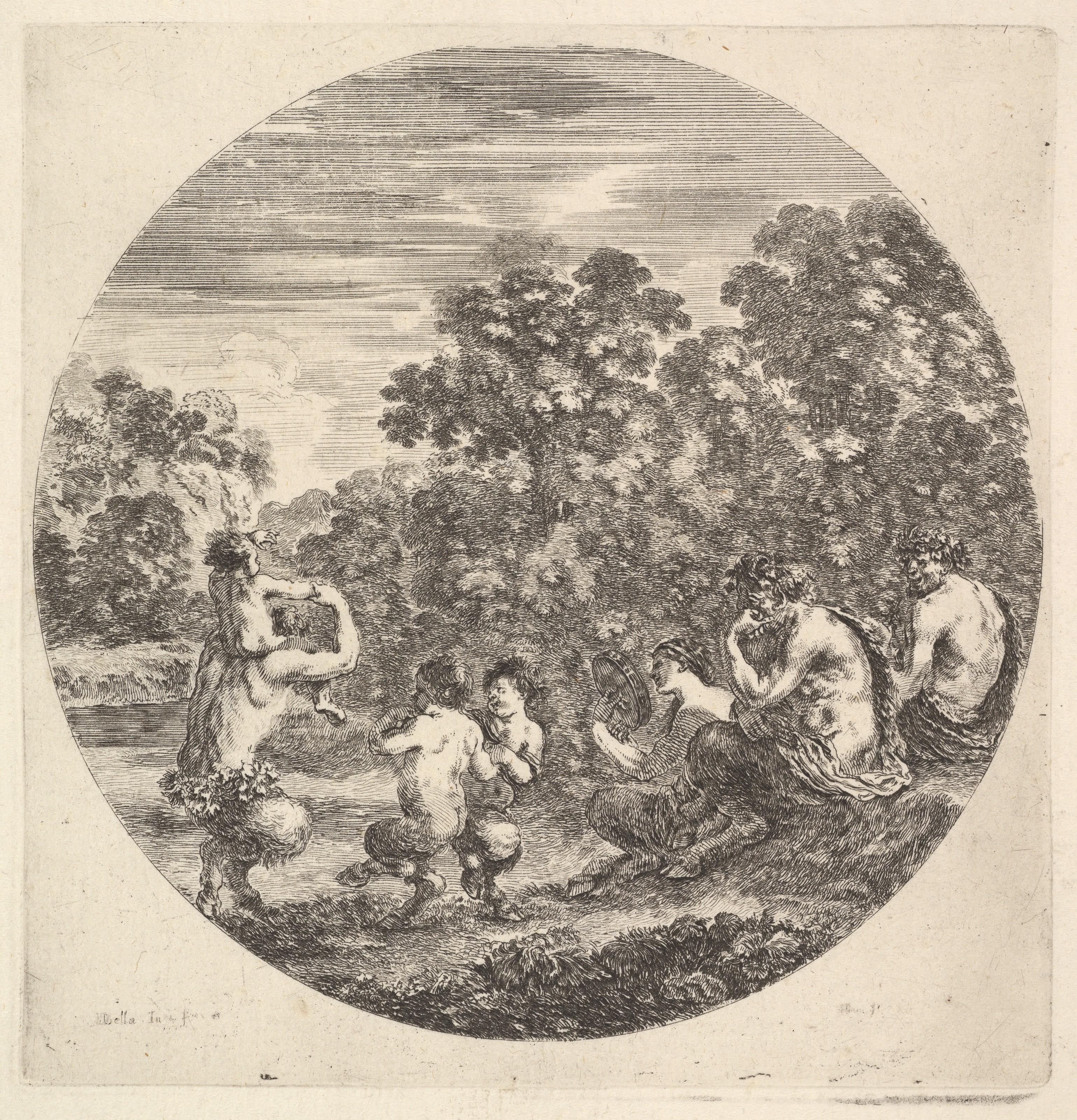
    Stefano della Bella (Italian, Florence 1610–1664 Florence)

    Etching

    Associated Passages
    Subjects
    Type
    Image
    License
    Creative Commons Attribution-ShareAlike
    Date
    ca. 1643–48

    Bronze statuette of a veiled and masked dancer

      "The complex motion of this dancer is conveyed exclusively through the interaction of the body with several layers of dress. Over an undergarment that falls in deep folds and trails heavily, the figure wears a lightweight mantle, drawn tautly over her head and body by the pressure applied to it by her right arm, left hand, and right leg. Its substance is conveyed by the alternation of the tubular folds pushing through from below and the freely curling softness of the fringe. The woman's face is covered by the sheerest of veils, discernible at its edge below her hairline and at the cutouts for the eyes," says the description on the Metropolitan Museum website but it does seem similar to have points of similarity with Apollonius' description of Medea's escape.

      Associated Passages
      Type
      Image
      License
      Creative Commons Attribution
      Date
      3rd–2nd century B.C.
      Location
      New York

      Bonasone: Neptune calming the Tempest

        Comments

        Attributed to Giulio Bonasone (Italian, active Rome and Bologna, 1531–after 1576) (in Bartsch, but questioned)

        Attributed to Girolamo Fagiuoli (Italian, active Bologna, by 1539, died 1574 Bologna) by S. Boorsch

        After Perino del Vaga (Pietro Buonaccorsi) (Italian, Florence 1501–1547 Rome) (Metropolitan Museum)

        Bartsch, although he lists this print under Bonasone, doubts that it was done by this artist. The editors of The Illustrated Bartsch concur in doubting the attribution. Massari accepts the attribution. (Museum of Fine Art, Boston)

        Associated Passages
        Type
        Image
        Date
        1531–76
        Culture
        Medium
        Location
        New York, Metropolitan Museum

        Tiepolo: Neptune and the Winds

          The sketch illustrates a celebrated passage from Virgil's Aeneid describing how Neptune calmed the winds to save Aeneas from shipwreck. Neptune, his arm raised, commands the winds to desist. Jupiter stands in front of the portico of a circular temple. In 1764–66 Tiepolo decorated a room in the Palacio Real, Madrid, with an apotheosis of Aeneas; the sketch may be related to this project. (Metropolitan Museum of Art)

          Subjects
          License
          Creative Commons Attribution-NonCommercial-ShareAlike
          Date
          1696–1770
          Culture
          Medium
          Dimensions
          24 1/2 x 24 1/2 in. (62.2 x 62.2 cm)
          Location
          The Metropolitan Museum of Art