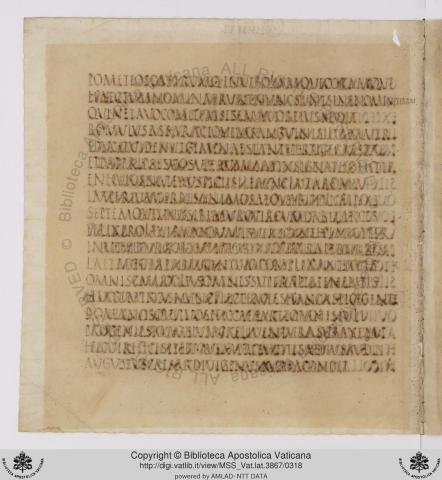
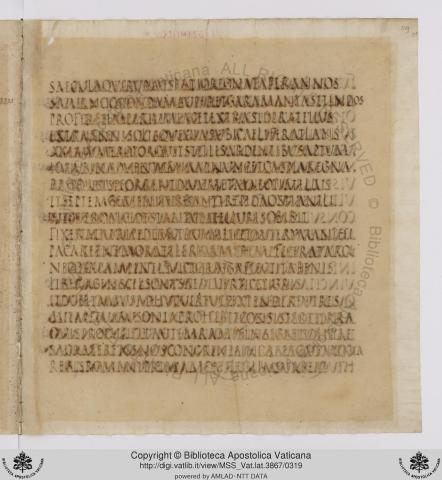
Hūc geminās nunc flecte aciēs, hanc aspice gentem
Rōmānōsque tuōs. hīc Caesar et omnis Iǖlī
prōgeniēs magnum caelī ventūra sub axem.790
Hīc vir, hic est, tibi quem prōmittī saepius audīs,
Augustus Caesar, dīvī genus, aurea condet
saecula quī rūrsus Latiō rēgnāta per arva
Sāturnō quondam, super et Garamantas et Indōs
prōferet imperium; iacet extrā sīdera tellūs,795
extrā annī sōlisque viās, ubi caelifer Atlās
axem umerō torquet stellīs ārdentibus aptum.
Huius in adventum iam nunc et Caspia rēgna
respōnsīs horrent dīvum et Maeōtia tellūs,
et septemgeminī turbant trepida ōstia Nīlī.800
notes
Manuscripts: M | P | R 788-792, 793-800
Anchises points out the Julian family, and especially Augustus, the destined conquerer of realms wider than were ever traversed by Hercules or Bacchus (Conington).
"When Aeneas reaches his father Anchises in the fields of Elysium, the area of the underworld that is bright and warm... he had arrived at his destination..."
- read full essay by Meghan Reedy
-
[click here to open in new tab]
When Aeneas reaches his father Anchises in the fields of Elysium, the area of the underworld that is bright and warm (like the sunny shore the migrating birds were arriving at in the simile at 6.311–12), he has arrived at his destination. As the Sibyl explained to Charon, seeing his father was the purpose of Aeneas’ visit: ad genitorem imas Erebi descendit ad umbras (404). However, once he gets there, and once his father begins to speak, it seems incidental—a formality—that Anchises and Aeneas are even related.
We jump right in in 788 when Anchises is already speaking. Sometimes we have been able to supplement our understanding of what people say by looking closely at what they do or how they are feeling before they begin or after they finish talking, but with Anchises we are given less extra information than usual. Vergil inserts tiny snippets around Anchises’ words, and they are often variations on ‘he started/stopped speaking’. We are told, for example, that he kept speaking, sic pater Anchises, atque haec mirantibus addit: …, (854), and that after he had been through the details (quae postquam Anchises natum per singula duxit, 888) he got Aeneas all fired up for the glory to come, incenditque animum famae veninetis (889)—a statement which is followed by more of Anchises’ words, only this time reported rather than quoted. The one time we hear of an expression of emotion by Anchises, he weeps over Marcellus—more on that in the next essay.
Therefore, when Anchises is describing the kings of Rome to come, it isn’t really personal. There is nothing we can do but listen to what he says, and this task, I think, is not an easy matter. As you will have noticed, everything Anchises says has some allusive tie to people and events in Rome’s history—events that are in the past from Vergil’s perspective (and of course from our own). Thus, one important way to listen to what Anchises says is to listen, as it were, from outside the story. When we do that, we can verify or interpret what Anchises ‘predicts’ according what we know (or what our commentators help us to know) about Rome’s history from other sources (some that were available to Vergil, like Livy or Caesar, and some that weren’t, like Arrian … or our Roman History textbook). From this perspective, this speech Anchises makes is a complex puzzle that there is satisfaction in solving, a maze full of little prizes.
Inside the story, however, Aeneas is the person Anchises is saying all of this to, and Aeneas has no way at all to recognize or verify the people or events that Anchises is talking about. So, for example, when Anchises comes to the Second Punic war, he has this to say: quo fessum rapitis, Fabii? tu Maximus ille es, unus qui nobis conctando restituis rem (845–46). There are a number of illustrious Fabii, but he points out one of them—Fabius Maximus, whose nickname after the war was Cunctator, the Delayer, because of his tactic of ‘delaying’ Hannibal in Italy through skirmishes and irritating attacks on supply stores rather than pitched battles. So there is a little joke when Anchises says, ‘you’re the best,’ tu maximus ille es, because Maximus was his name, and there is another little joke because cunctando is what he did, and also suggests his nickname. There is another little joke in his opening question, quo fessum rapitis, Fabii?, because not only does he imply that there are so many Fabii that they are tiring him out, but chasing and tiring was how Fabius Maximus helped to debilitate Hannibal.
To Aeneas, this is nothing but impenetrable paradox. The greatest of the Fabii restored the republic by delaying … delaying what? restored it how? For that matter, what does rem in this instance mean? There is no republic yet …
When we keep Aeneas in mind as we read, that is, Anchises’ speech becomes bewildering—and in a very particular way it turns out that it is personal after all.
At the start of this section, Anchises makes a nodding reference to Aeneas as he directs his son’s attention to a particular person in the (vast!) crowd of ghosts: huc geminas nunc flecte acies, he says, hanc aspice gentem Romanosque tuos (788–89). Look over here, and see your Romans. He links Aeneas to what he’s pointing out again as points out Augustus in particular, hic vir, hic est, tibi quem promitti saepius audis (791)—this man, this one, is the one you’ve heard most often promised to you.
After this, Aeneas fades from view, and the sense that Anchises is speaking to anyone in particular, let alone to his son, dissipates. He offers his own allusive interpretation of Augustus (who will be like Hercules against the myth-beasts, 801–3; like Liber on his tiger-pulled chariot, 804–5) in the form of an inclusive-seeming question: dubitamus adhuc virtutem …? (806–7). He asks more questions as the speech continues. Who is that?, quis procul ille …? (808–9), but of course he also answers: he recognizes people, knows them by their distinguishing features, nosco crinis incanque menta regis Romani primam … (809–10). Again and again he asks questions like these (in 817–18; 841; 842–44; 845)—questions that are really aimed at, and inclusive of, not Aeneas at all … but us, we who like Anchises can see the people he points out. We (sometimes with help) can recognize them by their most famous deeds or accoutrements (as at 808–9), we want (or don’t want) to see what Brutus does (as at 817–18), we might have opinions about who to include or exclude from the list of Great Romans (as we are asked to do in 841 and in 842–44).
Anchises, however, begins to ignore us too as he increasingly speaks directly to the people he is ostensibly pointing out in the distance. He speaks to them emphatically, as when he addresses Julius Caesar, tuque prior, tu parce … sanguis meus! (834–35)—the way one might accidentally speak out loud at the theatre, trying to tell a character in a film or a play not to go through that door! Even some of those questions that seem to include us are couched more deeply in an apparent relationship between Anchises and the people he sees, quis te, magne Cato, … aut te, Cosse, relinquat? (841). We might be able to have an opinion, but it is by report—Anchises seems to speak to them directly, in person, and not in fact to care about what we think about it.
Still less, it seems, is he concerned with what Aeneas can possibly comprehend. To Aeneas himself, besides this bewildering and incomprehensible slough of introductions to people Aeneas has never seen and will never see, Anchises offers so far only the broadest, blandest advice: tu …, Romane, memento … pacique imponere morem, parcere subiectis et debellare superbos (851–54). Actually, Aeneas may or may not even be explicitly included as the tu, Romane to whom Anchises speaks. He could as easily be speaking to his own internalized ideal, to any and every Roman, as to the flesh-and-blood son who has—at great cost—come to visit the ghost of his father.
Anchises, then, seems most invested, most personally committed, to these people-to-be. They are what is most vivid to him, most affecting, and for how vivid they seem to him, what is most striking is how opaque they are, not only to Aeneas, but to us. We who ostensibly are in the know still need to work it out—which Decii might he mean? Who took Corinth? How many Fabii is he talking about?
In the end, one might be left with a question that still needs answering by each of us, including Aeneas, including me, and including you: what use is all this talk of people we can’t really see or know, people gone before us and people yet to come? What use might it be for us to try to see them as they were or as they might one day be?
Further Reading
Clark, R.J. ‘How Vergil expanded the underworld in Aeneid 6’ Proceedings of the Cambridge Philological Society 47 (2001) 103-16
Feeney, D. ‘History and revelation in Vergil’s Underworld’ Proceedings of the Cambridge Philological Society 32 (1986) 1024
Galinsky, K. ‘Vergil’s uses of Libertas: Texts and Contexts’ Vergilius 52 (2006) 3-19
Goold, G.P. ‘The voice of Virgil: the pageant of Rome in Aeneid 6’ in Author and Audience in Latin Literature, eds. A.J. Woodman and J. Powell (Cambridge, 1992) 110-23, 241-5
Grebe, S. ‘Augustus’ divine authority and Vergil’s Aeneid’ Vergilius 50 (2004) 35-62
Habinek, T. ‘Science and tradition in Aeneid 6’ harvard Studies in Cassical Philology 92 (1989) 223-54
Leach, E.W. ‘Viewing the spectacula of Aeneid 6’ in Reading Virgil’s Aeneid, ed. C. Perkell (Norman, OK, 1999) 111-27
MacKay, L.A. ‘Three levels of meaning in Aeneid VI’ Transactions of the American Philological Association 86 (1955) 180-9
Segal, C. ‘Aeternum per saecula nomen: the golden bough and the tragedy of history. Part 2’ Arion 5 (1966) 34-72
788: geminās aciēs: = oculōs (Pharr): “both your eyes,” an expression in the “high style” and hence suited to Anchises’ prophetic enthusiasm (G-K). gentem: “family” (Bennett), the gēns Iūlia (Conington).
789: Rōmānōs tuōs: as being directly descended from you (Knapp); explanatory of hanc gentem (Bennett). Tuōs seems to be emphatic— Romans of your own stock (Conington). hīc: adverb (Comstock). Caesar: Julius (or possibly Augustus) (Pharr). Iūlī prōgeniēs: see 1.288: Iūlius, ā magnō dēmissum nōmen Iūlō (“Julius [Caesar], a name derived from the great Iulus”) (Knapp).
790: magnum caelī sub axem: “up to the vault / dome of heaven” (Knapp); “into the world above” (Bennett); “into the upper world,” i.e., into life (Carter). Caelī axem probably means, as Henry says, the rolling heaven or sky, the sky regarded as turning on its axis (Conington). But some refer it to Olympus itself, and the deification of the Caesars (Frieze). Iūlī: Iulus or Ascanius, son of Aeneas and Creusa (Carter).
791: saepius: “so often” (Comstock). hic: irregularly short in the second hic. This is the regular quantity in archaic Latin, but is rare in classical poetry (Bennett). quem…audīs: see, for example, 1.286: nāscētur pulchrā Troiānus orīgine Caesar (“the Trojan Caesar will be born of splendid origin”) (Knapp). These lines concerning the emperor Augustus are very famous (Carter).
792: Augustus: this title was bestowed upon Octavian by decree of the Senate in 27 B.C. (Frieze). Vergil here pays tribute to his great patron. According to one view of the Aeneid, which is more or less just, this name is the focus of the whole poem, that toward which all the rest points (H-M). dīvī genus: supply Caesaris, “son of him deified” (Bennettt); “son of the divine (Julius) Caesar” (F-B); “descendant of the god” (Carter); “son of the god,” i.e., of Julius Caesar, who after his death received divine honors and was called Dīvus (as were all emperors (Comstock)). So on coins Augustus Dīvī F(īlius) (Page). Augustus was the adopted son of Julius Caesar (Frieze).
792–794: aurea condet saecula quī…quondam: an unusual case of postponement of the relative pronoun; it throws great emphasis on the main idea (F-B): “who shall once more establish the Golden Age for Latium, amid the plough-lands where Saturn once held sway.” In the old national religion Saturnus (“the god of sowing”), the husband of Ops (“wealth”) (and predecessor of Jupiter (Carter)) is the type of prosperity and his reign was the golden age. It was in Latium that he ruled and disappeared (latēbat). Augustus is destined to restore this Golden Age (Frieze).
793: Latiō: supply in, ablative of place where (AG 421) (Pharr).
793-794: rēgnāta…Saturnō: the active rēgnāre, which is not properly transitive, is here felt to be so—and hence the perfect participle passive is used (Carter): “ruled over by Saturn” (Page). Saturnō is dative of agent (AG 375) (Bennett). per arva: Vergil seems to imply that the new Golden Age, like the first, shall be characterized by agricultural prosperity. It is well known that Augustus gave much attention to reviving farming, especially to the reestablishment of small farms, the number of which had been greatly reduced by the civil wars (Bennett).
794: super Garamantas: Greek form, 3rd declension (AG 81) (Comstock). The Garamantes were the most southern nation of Africa known, subdued by L. Cornelius Balbus in 19 B.C. (Page). The glory of Augustus is enhanced by representing him as having conquered nations beyond the farthest known (Conington). Alluding perhaps to the subjugation of the Ethiopians in 22 B.C. (Bennett). These people made overtures of peace to Augustus just before Vergil’s death; this allusion seems to be one of the last things introduced by Vergil into the Aeneid (Carter). Indōs: “the Indians,” i.e., Eastern races in general; the Romans had little to do with the Indī proper (F-B), and they were never subdued by Augustus. In 20 B.C., however, the Parthians restored to Augustus the standards captured from Crassus in 53 B.C., and an embassy came to Rome from India. Vergil may be exaggerating these incidents into a formal conquest of the remote East (Knapp). The meaning of verses 794–6 is, “beyond the Garamantes and Indians, and beyond the territory of Atlas” (Comstock).
795: tellūs: “the land” (beyond the Garamantes and Indians) (Chase), probably Ethiopia, overrun by C. Petronius in 22 B.C. (P-H); i.e., the land of the new dominions (Bennett). iacet extrā sīdera tellūs: “Earth (i.e., over which he shall extend his sway) lies beyond the stars” or “beyond the zodiac” (Chase). The land Augustus shall conquer beyond the Garamantes and the Indi is situated, according to the fancy of the poet, beyond the constellations (sīdera) south of the zodiac (Frieze), a poetic way of saying “beyond the Tropics” (Comstock). Sīdera (literally, “constellations”) designates first the constellations through which the sun passes in its annual course, i.e., the zodiac; then the part of the earth’s surface lying beneath this (Bennett).
796: annī sōlisque viās: “the path the sun follows in his yearly course.” Extrā sīdera…viās is really “beyond the world of civilization” (Knapp); this explains extrā sīdera (F-B). caelifer Atlās: Atlas is either a rebellious Titan condemned to support heaven, or Mt. Atlas in Mauretania, which is not unnaturally described as “heaven-supporting” (Page). Compare 4.247: Atlantis dūrī caelum quī vertice fulcit (“harsh Atlas who supports the sky on his summit / head” (G-K).
797: axem: the [vault of] heaven (Carter).
798: huius in adventum: “for (i.e., in expectation of) his coming” (Page); “at the prospect of his approach” (Chase); “in view of his coming”; join with horrent (Frieze). “Even now” (iam nunc), while Anchises is speaking, mysterious predictions heralding Augustus’ coming are perplexing the regions he will visit. The reference is to the emperor’s journey to the East (20 B.C.) for settling the provinces, which Vergil here represents as predicted long before, comparing it to the mythic travels of Hercules and Bacchus (P-H). Caspia regna: the regions of the Bactrians and Hyrcanians, who with the Parthians tried the power of Augustus (Frieze).
799: responsīs dīvum: dīvum = dīv(ōr)um; “by reason of divine oracles” (F-B). Responsīs is ablative of means (AG 410) (Conington) or ablative of cause (AG 404) with horrent (Frieze); i.e., oracles which are to be fulfilled by his coming (G-K). horrent: “shudder” at the prospect of his approach (Conington); “quake” (Comstock), “shiver,” used of the shivering fear caused by the oracles, but also suggesting skillfully the cold of the Caspian (Caspia rēgna) and the Crimea (Maeōtia tellūs). There is thus a contrast with trepida (800), which describes an excited state of fear, the hot haste of panic, and also suggests the warmth of Egypt (compare Georgics 1.296: trepidī aēnī, “a boiling caldron”) (Page). Maeotia: i.e., “Scythian” (Comstock); the region around the Sea of Azov (Carter).
800: septemgeminī: i.e., with seven mouths (Comstock); the Nile divides into a number of streams near its mouth, forming a delta (Pharr). trepida turbant: “tremble in terror” (F-B); “are all astir” (Knapp); “are troubled” (Frieze); “are in terror” (Comstock); “are in a panic” (Bennett). This intransitive use of turbō is very rare (Knapp).
vocabulary
flectō, flexī, flexus, 3, a. and n.: to bend; make by twisting, weave, 7.632; turn, guide, 1.156; rein, manage, 9.606; influence, sway, bend, move; retain, check, 12.46.
Rōmānus, ī, m.: a Roman, 1.234.
Caesar, aris, m.: a surname of the Julian gens, esp. Gaius Iulius Caesar, dictator and founder of the Roman Empire. His name was inherited by his nephew and adopted son Octavius and his successors; Augustus Caesar, 1.286; 6.792.
Iūlus, ī, m.: Iulus or Ascanius, son of Aeneas, 1.267, et freq.
prōgeniēs, ēī, f.: lineage, progeny, race, 1.19; offspring, 5.565; son, 7.97. (prōgignō)
veniō, vēnī, ventus: to come, freq.; come forth; approach, 6.755; rise, appear, 1.353; dawn, 10.241; to present one's self or itself, 5.344; descend, spring from, 5.373; impers., ventum est, we, they came or have come, 4.151.
axis, is, m.: an axle; synecdoche, car, chariot, 5.820; the axis of the heavens, the sky, the heavens, 4.482; the pole; the north pole, the north.
augustus, a, um: (adj.), venerable, 7.153; the surname given to Octavius Caesar by the senate, B.C. 27, and, after him, to the emperors generally, 6.792.
Latium, iī, n.: a country of ancient Italy, extending from the left bank of the lower Tiber to Campania, 1.6; (meton.), for Latīnī, the Latins, people of Latium, 10.365, et al. (2. latus; Virgil, 8.323, derives it from lateō)
Sāturnus, ī, m.: a deified king of Latium, whose reign was the “golden age"; identified by the Romans with the Greek Cronos, 8.319, et al.
Garamantes, um (acc. pl., -as), m.: the Garamantes, a barbarian tribe of Northern Africa, in the modern Fezzan, 6.794. (Γαράμαντες)
Indī: (adj.), belonging to India, Indian, 12.67; subst., Indus, ī, m., an Indian; pl., Indī, ōrum, the Indians, 7.605.
prōferō, tulī, lātus, ferre, irreg. a.: to carry forward or forth; extend, 6.795; postpone, delay, 12.395.
extrā, prep. w. acc.: outside of, beyond, 6.796; out of; from, 2.672. (exterā, abl. of exter)
caelifer, era, erum: adj. (caelum and ferō), heaven-bearing, sky-bearing, 6.796.
Atlās, antis, m.: Atlas, a king of Mauretania, famed for his knowledge of the stars, and hence said to have borne the heavens on his head and shoulders, transformed, according to mythology, by Perseus with the Gorgon’s head into the mountain that bears his name, 1.741, et al.
umerus, ī, m.: the upper bone of the arm; the shoulder, 1.501, and freq.
torqueō, torsī, tortus, 2, a.: to wind, turn, twist, 4.575; roll along, 6.551; whirl, hurl, 3.208; shoot, 5.497; cast, dash, 1.108; direct, 4.220; turn away, 6.547; turn, cause to revolve, 4.269; control, 12.180; p., tortus, a, um, whirled, whirling, impetuous, 7.567.
ārdēns, entis: burning, hot, sparkling, flaming, 5.637; bright, 4.482; impassioned, ardent, eager, 1.423; spirited, fiery, 1.472; glowing, lofty, 6.130; fierce, furious, 2.529; angry, 6.467. (ardeo)
adventus, ūs, m.: a coming, an arrival, 5.36; advance, 11.607. (advenio)
Caspius, a, um: (adj.), of the Caspian Sea, Caspian; Asiatic, 6.798.
respōnsum, ī, n.: an answer, reply, 2.376; oracular answer, response, 6.799. (respondeō)
horreō, 2, n. and a.: to bristle up or be bristling, 6.419; to bristle, 11.602; (fig.), to shudder, tremble, 2.12; shudder at, fear, dread, 4.209.
Maeōtius, a, um: adj. (Maeōtae), pertaining to the Maeotae, or Scythians on the Palus Maeotis, or Sea of Azof; Maeotian, 6.799.
septemgeminus, a, um: (adj.), sevenfold, said of the Nile on account of its seven mouths, 6.800.
trepidus, a, um: (adj.), agitated, uneasy, disturbed, trembling, affrighted, 2.380; excited, tumultuous, 11.300; confused, in disorder, 10.283; alarmed, fearful of, anxious for, w. gen., 12.589; panic-stricken, 12.583.
ōstium, iī, n.: a mouth; entrance, gate, door, 6.81; pl., ōstia, ōrum, harbor, port, 5.281; mouth of a river, 1.14. (1. ōs)
Nīlus, ī, m.: the Nile, 6.800.