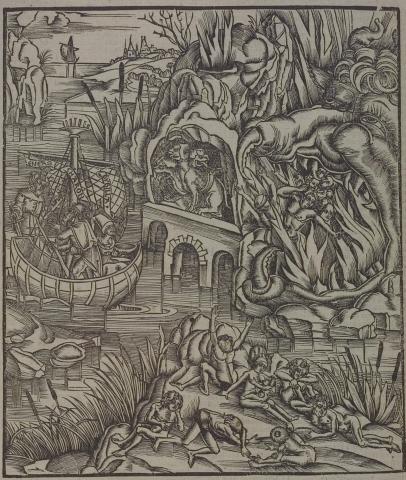
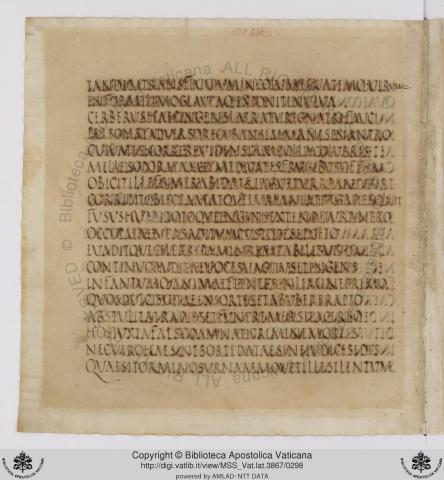
Cerberus haec ingēns lātrātū rēgna trifaucī
personat adversō recubāns immānis in antrō.
Cui vātēs horrēre vidēns iam colla colubrīs
melle sopōrātam et medicātīs frūgibus offam420
obicit. Ille famē rabidā tria guttura pandēns
corripit obiectam, atque immānia terga resolvit
fūsus humī tōtōque ingēns extenditur antrō.
Occupat Aenēās aditum custōde sepultō
ēvāditque celer rīpam inremeābilis undae.425
notes
Cerberus, who guards the entrance, is rendered harmless by a drugged cake (Page).
"Back when Charon stopped Aeneas and the Sibyl as they were approaching his shoreline (comprime gressum! 389) and told them it was illegal, improper, and unholy (nefas) for them to be taken across in his boat... he justified his statement by explaining that prior ‘guests’ of this kind had behaved badly..."
- read full essay by Meghan Reedy
-
[click here to open in new tab]
Back when Charon stopped Aeneas and the Sibyl as they were approaching his shoreline (comprime gressum! 389) and told them it was illegal, improper, and unholy (nefas) for them to be taken across in his boat (corpora viva nefas stygia vectare carina, 391), he justified his statement by explaining that prior ‘guests’ of this kind had behaved badly.
He hadn’t been happy that he’d taken them in, nec vero … me sum laetatus euntem accepisse lacu … (392–93). You see, Hercules chained up the guard-dog (manu custodem in vincla petivit, 394) and dragged him away from right next to the throne (ipsius a solio regis traxit, 396), and the dog was trembling (trementem, 396). Those other two, Theseus and Pirithous, tried to steal the wife of Dis right out his bed, hi domniam Ditis thalamo deducere adorti (398). This is the end of his speech to them; such bad behavior speaks for itself. Why would he take a risk on another of these thieving types, these live guests?
Of course, the Sibyl reassures him specifically on both counts when she replies. In 402 she politely expresses her hope that Proserpina stays where she is, but this is after the bit about the dog. ‘May your big guard-dog barking in his cave forever frighten the bloodless shadows,’ she says, licet ingens ianitor antro aeternam latrans exsanguis terreat umbras (401–2), which is on the one hand the dog’s job, frightening the shades, the ghosts, who really do have no blood … but on the other hand doesn’t it also sound like the dog is barking at harmless moving light?
But what is the very first thing they do when they are finally across? They drug the dog.
And did I mention that this is a big dog? He is huge: ingens ianitor (400), and then, in case we missed it that first time, again in 417, Cerberus haec ingens, and again in 423 once he’s spread out on the floor he takes up the whole cave, fusus humi totoque ingens extenditur antro. So is Aeneas, though—in 413, when Aeneas steps into the boat, we see that word again: ingentem Aenean. Perhaps there is a hint here that Aeneas is a match for Cerberus, at least that he might be big enough to handle him. In 424, he certainly springs out into the entrance with confidence once the dog is sleeping, occupat Aeneas aditum custode sepulto. Of course, it isn’t huge Aeneas but the little Sibyl who manages the dog, and not with force but with a little honey-cake she throws his way when he starts to bristle and bark with all three throats, melle soporatam et medicatis frugibus offam obicit (420–21).
This interaction is full of solid things right to the end. With his three ravenously hungry mouths Cerberus gobbles it down (how big was the cake? did they share it?), and then his enormous back gives way, immania terga resolvit, and he flops to the floor. Whump. Cerberus is so enormous, so loud, so hungry; even asleep he is so bulky … so alive. Even once he is asleep, custode sepulto (424), Aeneas doesn’t like to linger near him but scuttles away quickly, evaditque celer ripam (425).
It is worth really appreciating the physicality of Cerberus while we can because the next thing (is that too solid a word?) Aeneas encounters is ingens in a very different way: continuo auditae voces vagitus et ingens infantumque animae flentes … (426–27). Without bulk of any kind, there is a ‘huge’ wailing from the ghosts of infants … not just ghosts but tiny, tiny ghosts, crying hugely. They are so small they barely stepped into life at all before stepping into death; they died on the threshold, in limine primo (427), and are still on the threshold.
Once huge Aeneas is past the huge dog, and past this ‘huge’ wailing, he moves through three groups of shades, three classes of the dead—and finds Dido in the third, among those whom love has devoured (quos durus amor crudeli tabe peredit, 442). There are many famous ladies there, mentioned by name (Phaedra, Eriphyle, Evadne, Pasiphae, Laodamia, Caeneus); their run-ins with love (and political power) are idiosyncratic, each one has her own story. Each one is scarred by her particular betrayal or transgressive passion, and Dido, scarred by hers, is newly among them: inter quas Phoenissa recens a vulnere Dido (450).
And yet, looking back through the groups of shades Aeneas has passed on his way to these wounded lovers, one wonders whether Dido might not have belonged in any of them. There are the shades who died falsely accused of crimes they didn’t commit (hos iuxta falso damnati crimine mortis, 430). Might not Dido, who committed no crime, who did nothing wrong, be here?
Or why not in the next group? Surely Dido might also be among those who have taken their own lives (qui sibi letum insontes peperere manu lucemque perosi proiecere animas, 435–36); she took her own life so vividly, so purposefully, so conspicuously.
But no—it is among the wounded lovers that Aeneas sees Dido, and after she’s left him, we see one reason why she might prefer to be here rather than in either of the other two: her husband is here with her. He comes as a surprise, Sychaeus, not only because he is here at all but because we catch a glimpse of how he and Dido comfort each other, enjoying a well-matched, balanced love: coniunx … pristinus illi respondet curis aequatque Sychaeus amorem (473–74). We had been led to expect the most utter despair; we were told these were called the Mourning Fields, Lugentes Campi; sic illos nomine dicunt (441), but here is mutual solace.
So for Aeneas, when he sees her, there is nothing. He sees her only dimly (agnovitque per umbras obscuram, 452–53), the way you see—or think you see—the new moon behind a cloud (qualem primo qui surgere mense aut videt aut vidisse putat per nubila lunam, 454–55). He verifies the rumor that she has died (verus mihi nuntius … venerat exstinctam…, 456–57). He reiterates that he didn’t want to leave her (invitus, regina, tuo de litore cessi, 460), and that a god made him do it (me iuss deum …, 461). Think how that sounds, how little comfort there is in that … I didn’t want to, a god made me do it, I didn’t think it would hurt you (nec credere … hunc tantum tibi me discessu ferre dolorem, 463–64). Notice too where the focus of what he says to her falls—on Aeneas and his reasons, on how he had no idea what consequences his actions might have for her.
So she averts her eyes, illa solo fixos oculos aversa tenebat (469); exactly as Athena did when the Trojan women came streaming into her temple as the city was being overrun begging for help, diva solo fixos oculos aversa tenebat (1.482). The correspendence might lead us to wonder, is Aeneas begging here? What is he begging for? He doesn’t say, exactly, but it seems he wants to soothe her with his words, lenibat dictis animum (468); she is—or is it that he thinks she is? can he really see her that well?—burning and rolling her eyes, ardentem et torva tuentem (467). He wants to calm her down. Is it because if she were calm, he wouldn’t have to feel so badly? Aeneas is struck by the unfairness of accident, the inequality of this turn of events, Aeneas casu percussus iniquo (475). Is that if she could ratify his justifications, he wouldn’t have to weep for her, or feel the pain of pitying her as she walks away, prosequitur lacrimis longe et miseratur euntem (476)?
But her obscure, shadowy face is like a stone, nec … vultum … movetur, quam si dura silex (470–71).
Further Reading
Braund, S. ‘Virgil and the cosmos: Religious and philosophical ideas’ in The Cambridge Companion to Virgil, ed. C. Martindale (Cambridge, 1997) 204-21
Butler, H.E. The Sixth Book of the Aeneid (Oxford, 1920) 1-20
Camps, W.A. ‘The role of the sixth book in the Aeneid’ Proceedings of the Virgil Society 7 (1967-8) 22-30
Clark, R.J. ‘How Vergil expanded the underworld in Aeneid 6’ Proceedings of the Cambridge Philological Society 47 (2001) 103-16
Habinek, T. ‘Science and tradition in Aeneid 6’ Harvard Studies in Classical Philology 92 (1989) 223-54
Johnston, P.A. ‘Juno’s Anger and the Sibyl at Cumae’ Vergilius 44 (1998) 13-23
MacKay, L.A. ‘Three levels of meaning in Aeneid VI’ Transactions of the American Philological Association 86 (1955) 180-9
Panoussi, V. ‘Vergil’s Ajax: allusion, tragedy, and heroic identity in the Aeneid’ Classical Antiquity 21 (2002) 95-134
417: rēgna: accusative after personat (Frieze): “he makes the (whole) realm echo” (Comstock). latrātū trifaucī: “with triple-throated baying.” Cerberus was triceps (“three-headed”) and hence also trifaux (“triple-throated”) by analogy with triceps. In Dante, Cerberus is even more horrible than in Vergil, and rends the gluttonous in the third circle of Hell (Inferno, Canto 6) (F-B).
418: adversō: “fronting them, opposite” (F-B); i.e., facing the bank (Knapp). Fronting them as they came from the landing-place (Conington); “facing (the ferry)” (Comstock). recubāns immānis: “reclining in his huge bulk” (F-B).
419: horrēre…colubrīs: Cerberus has snakes for hair, so that when he is angry his snakes “bristle” (Conington).
420-421: melle…conicit: “flings to him a cake made drowsy with honey and drugged meal.” Vergil may be thinking of the “honey-cake” placed at the side of a corpse by the Greeks. Offa is, however, not so much a cake as a “scrap” (Comstock) or “morsel” (Carter) of anything like bread (or broken meat (G-K)); “a cake steeped in honey and in soporific drugs.” Soporātam cannot strictly apply to melle, and must be regarded here as joined with it by a kind of zeugma. In strictness the language would be melle imbūtam et frūgibus medicātīs soporātam (Frieze). In Dante, Vergil throws earth into the brute’s maws (Inferno, Canto 6.25–27) (F-B).
421: ille: “the monster” (F-B); “the beast” (Comstock). famē: this word has its final syllable long, as if from the 5th instead of the 3rd declension (F-B).
422: obiectam: supply offam (Pharr); “the proffered morsel” (Knapp). resolvit: “lowered” (Carter); “relaxes” (Comstock). The word marks a contrast with horrēre (419) (Knapp).
422-423: immānia terga resolvit fūsus humī: “unstiffens his monstrous back, sprawling on the ground.” Resolvit and fūsus vividly express the effect of the opiate; just before his back had been rigid and every muscle strained with excitement (Page).
423: fūsus humī: humī is locative case (AG 427) (Pharr): “stretched out on the ground.” tōtō antrō: (compare line 418). The repetition emphasizes the danger that confronted Aeneas until Cerberus was rendered powerless (Knapp).
424: occupat Aenēās aditum: occupāre often means “to do something before someone or something else can act.” In this case, Aeneas acts before Cerberus ceases to feel the effects of the drug (Knapp); “he gains” or “hastens through the entrance” (Frieze). Here it seems to mean little more than adit. There is doubtless a notion of a movement quickly executed, not unlike invade viam (“hit the road”) (Conington). custōde: = Cerberō. With sepultō forms an ablative absolute (AG 419) (Pharr). sepultō: = soporātō (Knapp); i.e. in somnō (Frieze). The context makes the sense clear: “its sentry [being] buried (in sleep)” (Chase). Compare 2.265: somnō vīnōque sepultum, “buried in wine and sleep” (Page).
425: ēvādit rīpam: ēvādit is here transitive (Bennett): “passes the bank [in safety]” (Comstock); “escaping from the bank;” ēvadit is used with reference to the threatened hindrance interposed by the watch-dog (Frieze); with accusative of the space passed over (Conington). inremeābilis: “not to be recrossed” (G-K); “renavigable never” (Rhoades), apparently coined by Vergil (F-B). Rightly taken by Heyne as an ordinary epithet of the Styx (Conington).
vocabulary
Cerberus, ī, m.: Cerberus, the three-headed watch-dog of Pluto, 6.417.
lātrātus, ūs, m.: a barking; baying, 5.257, et al. (lātrō)
trifaux, faucis: (adj.), found only once (trēs and faux), three-throated., three-voiced, triple, 6.417.
personō, sonuī, sonitus, 1, n. and a.: to sound loudly; sing, play, 1.741; cause to or make resound, 6.171.
recubō, 1, n.: to be lying back or down; recline; be extended; lie, 3.392.
immānis, e: (adj.), vast, huge, immense, 1.110; wild, savage, barbarous, 1.616; cruel, ruthless, 1.347; unnatural, monstrous, hideous, 6.624; (adv.), immāne, wildly, fiercely, 12.535.
antrum, ī, n.: a cave, cavern, grotto, 1.166.
horreō, 2, n. and a.: to bristle up or be bristling, 6.419; to bristle, 11.602; (fig.), to shudder, tremble, 2.12; shudder at, fear, dread, 4.209.
collum, ī, n.: the neck of men and animals, 1.654, et al.; of a plant, 9.436; pl., the neck, 11.692.
coluber, ubrī, m.: a snake, serpent, 2.471.
mel, mellis, n., pl., mella, abl., mellibus (no gen. or dat.): honey, 6.420.
sopōrō, no perf., ātus, 1, a.: to cause to sleep or to render sleepy; to make soporific; to drug, 5.855. (sopor)
medicō, āvī, ātus, 1, a., and medicor, ātus sum, 1, dep. a. and n.: to heal with drugs; heal, 7.756; mix with drugs or poisons; medicate, drug, 6.420. (medicus)
frūx, frūgis, f.: (found usually in the pl., frūgēs, um) fruit, of the ground and of trees; fruit of the ground; corn, 1.178; wheaten meal, sacrificial grits, cake, 2.133; herbs, 6.420. (fruor)
offa, ae, f.: a mouthful, a bit, lump, morsel, 6.420.
obiciō, iēcī, iectus, 3, a.: to throw against or towards; throw to, 6.421; present, oppose, 2.444; bar against, shut, 9.45; cast upon, 7.480; subject, expose, 4.549; (pass.), to be presented, appear, 5.522; p., obiectus, a, um, thrown towards or against; opposite, projecting, 3.534. (ob and iaciō)
rabidus, a, um: (adj.), raving, savage, mad, raging, 6.421; frenzied; frantic, raving, 6.80.
guttur, uris, n.: the throat, 6.421.
pandō, pandī, passus or pānsus, 3, a.: to spread out or open, 7.641; unfurl, 3.520; extend, expose, 6.740; break through, open, 2.234; unbind, dishevel, 1.480; (fig.), disclose, declare, explain, reveal, 3.179.
corripiō, ripuī, reptus, 3, a.: to take completely or eagerly; to grasp, snatch, seize, catch, 1.45; hurry away, 1.100; tear away; hasten on, take, 1.418; raise quickly, rouse, 4.572; sē corripere, to hasten away, 6.472. (com- and rapiō)
resolvō, solvī, solūtus, 3, a.: to untie, loosen, unbind, 3.370; break apart, 9.517; dispel, 8.591; of the lips, open, 3.457; of the body, relax, unbend, extend, 6.422; of separation of body and spirit, dissolve, separate, release, 4.695; unravel, disclose, 6.29; break, violate, 2.157.
extendō, tendī, tentus or tēnsus, 3, a.: to stretch forth; stretch, extend, 5.374; continue, 12.909; magnify, advance, 6.806.
Aenēās, ae, m.: 1. A Trojan chief, son of Venus and Anchises, and hero of the Aeneid, 1.92. 2. Aenēās Silvius, one of the Alban kings, 6.769.
aditus, ūs, m.: a going to; an approach, avenue, access, passage, entrance, 2.494; (fig.), approach, 4.423. (adeō)
sepeliō, pelīvī or peliī, pultus, 4, a.: to perform the rites of sepulture, whether by interring (humāre), or cremation (cremāre); to bury, 3.41; p., sepultus, a, um, buried, 4.34; of slumber, 6.424, et al.
ēvādō, vāsī, vāsus, 3, n. and a.: to go out, forth, or up; ascend, 2.458; come in flight, 2.531; come forth from, w. the idea of danger surmounted; (w. acc.), to escape the dangers of, 2.731; escape, 5.689; 6.425; w. dat., 11.702; 9.99.
inremeābilis, e: (adj.), that can not be gone over again; not to be repassed, or retraced, 6.425; inextricable, 5.591.