Tālibus ōrantem dictīs ārāsque tenentem
audiit omnipotēns, oculōsque ad moenia torsit220
rēgia et oblītōs fāmae meliōris amantēs.
Tum sīc Mercurium adloquitur ac tālia mandat:
'Vāde age, nāte, vocā Zephyrōs et lābere pennīs
Dardaniumque ducem, Tyriā Karthāgine quī nunc
exspectat fātīsque datās nōn respicit urbēs,225
adloquere et celerēs dēfer mea dicta per aurās.
Nōn illum nōbīs genetrīx pulcherrima tālem
prōmīsit Grāiumque ideō bis vindicat armīs;
sed fore quī gravidam imperiīs bellōque frementem
Ītaliam regeret, genus altō ā sanguine Teucrī230
prōderet, ac tōtum sub lēgēs mitteret orbem.
Sī nūlla accendit tantārum glōria rērum
nec super ipse suā mōlītur laude labōrem,
Ascaniōne pater Rōmānās invidet arcēs?
Quid struit? aut quā spē inimīcā in gente morātur235
nec prōlem Ausoniam et Lāvīnia respicit arva?
Nāviget! Haec summa est, hic nostrī nūntius estō.'
notes
Manuscripts: M 219-232, 233-237 | P 219-230, 230-237
In answer to this prayer Jupiter, summoning Mercury, bids him go and remind Aeneas of his high mission, and that if his own ambition is dead, he has no right thus to ruin his son’s hopes (Page).
"Since their ‘wedding’ in the cave... we have been watching stories about Aeneas’ and Dido’s relationship travel throughout Libya, to Iarbas, and then to Jupiter..."
- read full essay by Meghan Reedy
-
[click here to open in new tab]
Since their ‘wedding’ in the cave—when Dido was not moved by rumor or appearances, neque enim specie famave movetur (170)—we have been watching stories about Aeneas’ and Dido’s relationship travel throughout Libya, to Iarbas, and then to Jupiter. Next, we will see Jupiter (who seems irritated by what Iarbas tells him) give a message to Mercury to give to Aeneas, who will try to tell Dido.
After hearing Iarbas’ pointed complaint (audiit Omnipotens, 220), Jupiter wrenches his eyes to the relevant kingdom’s walls, and to the ‘lovers forgetful of the better story,’ oblitos famae melioris amantis (221), and then he immediately calls up Mercury and gives him a message for Aeneas to the effect that Aeneas isn’t doing what he is supposed to be doing, and he’d better get back on task (222–37).
Then, for 27 lines (238–65), we hear details about how Mercury prepared for his journey, and how it was to pass Atlas on the way, and how he touched down. All of a sudden, we are called upon to pay careful attention to how this messenger crosses space, and what that space is like. Watching the way space is handled as a message is carried through it from Jupiter will in turn invite us to look back at how the story traveled through space on its way towards him.
So, how does Mercury cross space?
First, he has to strap golden wings onto his feet, primum pedibus talaria nectit aurea (239–40), which transport him as fast as the wind, quae … rapido pariter cum flamine portant (240–41). Then, he has to pick up his wand, tum virgam capit (242), and with this wand he drives the winds and swims through the clouds, illa fretus agit ventos et turbida tranat nubila (245–46).
So, Mercury requires tools in order to travel from Olympus to earth on his errand: one tool to enable him to fly at all, his winged sandals, and another to help him push the weather in the direction he needs to go. He flies, we are told later, like a bird, avi similis (254).
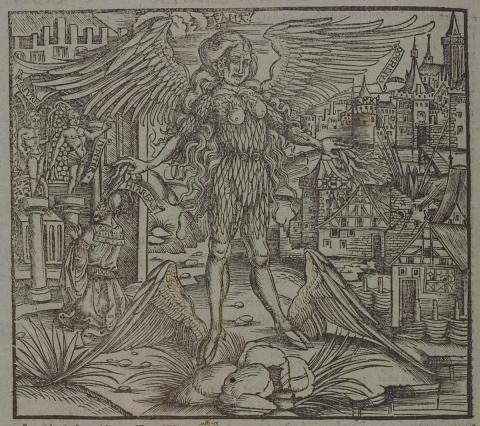
Compared with how Fama travels back in 175–87, this looks like a cumbersome hassle. Fama doesn’t need to strap wings on because she has feathers herself, sunt corpore plumae (181), and so she simply flies as she pleases between the sky and the earth, volat caeli medio terraequ (184). Moreover, whereas Mercury needs his wand to help him move, Fama expends no effort at all––quite the opposite; rather than using strength, moving provides it, making Fama stronger and bigger the more she moves: mobilitate viget viresque adquirit eundo, parva metu primo, mox sese attollit in auras ingrediturque solo et caput inter nubila condit (175–77).
And what is the space like?
Mostly it is mountainous. As he flies, Mercury sees first the peak and then the sides of Mount Atlas: volans apicem et latera ardua cernit Atlantis (246–47). The mountain has pines and snow at the top and is lashed with wind and rain, piniferum caput et vento pulsatur et imbri, nix umeros infusa tegit (249–50), … and he has a beard bristling with ice, et glacie riget horrida barba (251). Mercury flies down the side of this personified mountain (with its head and its beard), then onward to the sandy shore of Libya, litus harenosum ad Libyae (257).
Again, it seems much easier for Fama altogether. She did not have to navigate her way down that wintery mountainside at all—in fact, she made it to all the major cities of Libya instantly. As soon as the ‘marriage’ in the cave has happened, the very next moment the news is everywhere, extemplo Libyae magnas it Fama per urbes (173).
Which prompts a question of a different order, about messengers and messages. In 173, it Fama per urbes, the message and the messenger are uneasily the same. Fama moves messages around, swiftly and broadly, with her umpteen mouths and ears and eyes and tongues (182–83), but fama, rumor, is also the message she moves. Tricky.
What about Mercury in this regard? Unlike Fama/fama, Mercury is only the messenger, and he carries one distinct message from one person (Jupiter) to another (Aeneas). Thus we might also reasonably ask—and expect a slightly different answer to—the question ‘how does Jupiter’s message cross space?’
It turns out that for Jupiter, unlike for Fama who is the message she carries, getting a message out takes some work. There is the logistical matter of him needing Mercury to take the message on his behalf (just as Iarbas did the job of bringing news to him earlier), but Mercury’s encounter with Atlas on his way down from Jupiter also demonstrates how removed Jupiter is from the place where the action he so strongly influences is happening.
It leads one to wonder what Jupiter really saw when he looked down at them after Iarbas told him Dido and Aeneas were together. Or rather, to wonder whether what he saw was what was really happening, or if it was a reflection of what he’d heard. The story Fama told was that they were forgetting their kingdoms and spending all their time this winter on each other (hiemem inter se luxu … fovere regnorum immemores, 193–94), and the brief mention we get of what Jupiter looks at is an echo of that report filtered through his own interests: oblitos famae melioris amantis (221). He sees lovers forgetful of the better fama, the better story––which seems to be the fata, the ‘things told,’ in his conversation with Venus back in Book 1 (fatur: ‘…Cytherea: … hic tibi fabor enim …, 1.256-96).
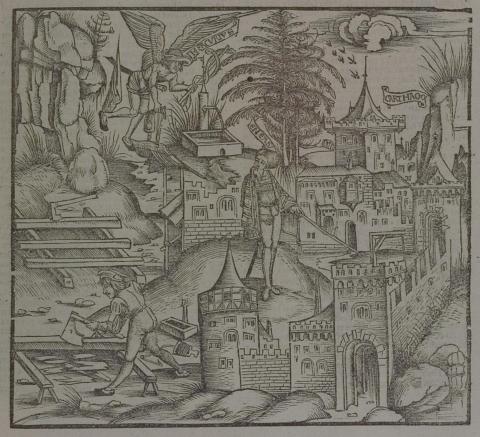
Lovers forgetful of their kingdoms isn’t what Mercury sees when he gets there, actually. When Mercury touches down, he sees Aeneas hard at work, building a city: ut primum alatis tetigit magalia plantis, Aenean fundantem arces ac tecta novantem conspicit (259-61). Which are we to believe? The report of Fama, which we know is equal parts fact and poison (pariter facta atque infecta, 190), or what Mercury sees with his own eyes?
Of course, from Jupiter’s point of view (which we see now as lofty and distant), whatever Aeneas is doing in Carthage will count as ‘forgetful’ because this isn’t the city Jupiter said Aeneas would build. Carthage isn’t in Jupiter’s story.
Further Reading
Estevez, V.A. ‘Oculos ad moenia torsit: On Aeneid 4.220’ Classical Philology 77 (1982) 22-34
Feeney, D.C. ‘The Taciturnity of Aeneas’ Classical Quarterly 33 (1983) 204-29, reprinted in Oxford Readings in Virgil’s Aeneid, ed. S.J. Harrison (Oxford, 1990) 167-90
Feeney, D. The Gods in Epic: Poets and Critics of the Classical tradition (Oxford, 1991) 241-8
Gibson, R.K. ‘Aeneas as Hospes in Virgil, Aeneid 1 and 4’ Classical Quarterly 49 (1999) 184-202
Hardie, P.R. Virgil’s Aeneid: Cosmos and Imperium (Oxford, 1986) 373-81
Hardie, P.R. Rumour and Renown: Representations of Fama in Western Literature (Cambridge, 2012) 78-149
Harrison, E.L. ‘Vergil’s Mercury’ in Vergilian Bimillenary Lectures, ed. A.G. McKay and A. Gordon, Vergilius supplementary volume (College Park, MD, 1985) 1-47
Hejduk, J. ‘Jupiter’s Aeneid: Fama and Imperium’ Classical Antiquity 28 (2009) 279-327 (esp. 292-5)
Horsfall, N. ‘Virgil and the Conquest of Chaos’ Antichthon 15 (1981) 141-50
219: ōrantem, tenentem: supply Iarban (acc.); object of audiit (Pharr). ārās tenentem: thus adding solemnity to his appeal (F-B). To be taken literally; worshipers laid hold upon the altars as if thus to come into close contact with the god of the altar (Frieze).
220: Omnipotēns: = Iuppiter (Carter).
220–221: moenia rēgia: of Carthage (Pharr). Rēgia = “of the queen” (F-B).
221: oblītōs fāmae meliōris amantēs: “the lovers forgetful of their nobler fame.” fāmae meliōris = all larger considerations of their personal reputation; fāmae is genitive with a verb of forgetting (oblītōs) (AG 350) (Carter). This is the poet’s first admission that Aeneas, as well as Dido, was doing wrong (F-B).
222: Mercurium: Mercury, the Italian god of merchandise (merx), was identified because of this function with the Greek Hermes, the messenger of the gods, protector of heralds, and divinity of persuasion and intercourse between man and man (G-K). So Mercury is sent by Jupiter to Carthage (1.297–303), as Hermes had been sent to escort Priam (Iliad 24.333–348), or, again, to free Odysseus from the charms of Calypso (Odyssey 5.28–54); cf. Silius 3.163–171, where Jupiter sends him to Hannibal; also the mission of Raphael to Adam (Milton, Paradise Lost 5.224–297). The present theophany seems to have been by day, while the corroborative dream (4.554–570) was at night (Pease). adloquitur: with final syllable irregularly long, due to the caesura and the verse accent (Pharr).
223: vocā Zephyrōs…lābere pennīs: Mercury is to sail on the winds (Zephyrōs), using his winged shoes (the talāria with its pennīs) as sails (Carter) to aid his flight and make it easier, so that he may go rapidly (Page): “glide on your wings”; cf. volat rēmigiō ālārum (1.300–301) (F-B).
224: Dardanium ducem: = Aenēās; object of the imperative adloquere (226) (Pharr).
225: exspectat: “dallies” (F-B), “delays” or “lingers” (Carter). Exspectō elsewhere always has an object (= “wait for”), or a dependent clause (= “wait until”) equivalent to an object. Here it is used quite absolutely: he is not waiting for anything or until anything happens, but simply “waiting” without object or aim (Page). fātīs datās: “assigned by the fates” (Chase). nōn respicit urbēs: “pays no regard to” (G-K), “regards not” (F-B) or “regardless of the cities” (Page); urbēs refers to the city he is to found in Italy. The plural is an exaggeration (F-B).
226: celerēs per aurās: i.e., swiftly through the air. The idea is something like “on the wings of the wind” (G-K). mea dicta: Jupiter in the Aeneid never speaks directly to mortals but through gods as mouthpieces, as befits his dignity; in Apollonius’ Agonautica he is entirely silent.
227–230: nōn illum…regeret: “not such did his beauteous mother promise him to us—therefore twice rescuing him from Grecian arms—but (promised) that he should be one to rule…” The change in tense from prōmīsit to vindicat seems allowable, because the clause Graium…armīs is parenthetical, and the present vindicat may be explained either because the effect of his rescue is regarded as still continuing, or, more probably, because the present is often used even of past events (historical present, AG 485e), where the event itself rather than the time at which it takes place is dwelt upon (Page). The present tense of vindicat implies “she has saved and is still saving” (Frieze). genetrīx pulcherrima: = Venus (Carter).
227: nōn tālem: supply virum fore (Pharr); “that he would not be such a man as this” (G-K), such as he is now showing himself to be (Carter). Graium: = Graiōrum (Page).
228: ideō: “for this purpose”; that he might dally at ease in Carthage (Pharr) and forget his true mission (H-M): “on the strength of her promise was able to rescue him” (Frieze). bis vindicat: once when she rescued him from the hand of Diomedes, the second time at the fall of Troy (Page). armīs: ablative of separation (AG 401) (Pharr).
229: sed fore…: supply genetrīx prōmīsit illum tālem (Pharr): “but [his mother promised] that he should be one who…” (G-K). Fore (= futūrum esse) is the future infinitive of sum (AG 170) (Pharr); it is dependent upon prōmīsit and is the verb in indirect discourse (AG 577) (Frieze). gravidam imperiīs: “teeming with (future) empire” (Pharr), i.e., the mother of empires (Frieze); destined to give birth to powerful races (Carter); “pregnant with empire” (Sedgwick). bellō frementem: “clamorous with war” (Sedgwick); with reference to the conflicts which Aeneas and his followers must undergo in order to obtain the rule (Carter).
229–231: quī regeret…prōderet…mitteret: subjunctives in a relative clause of purpose (AG 531) or characteristic (AG 535) (Pharr).
230: genus prōderet: “should hand down a line” (Chase); “would hand on a race” (F-B); “should propagate” a race (Frieze); “would beget”; it is his descendants who ultimately are to subdue the world (Carter);
231: tōtum…orbem: with reference to his latest descendant Augustus, whose wide conquests Vergil wishes to celebrate (Carter); through the latter development of the Roman Empire, especially under Augustus, who is here thus complimented by the poet (Pharr). Aeneas was never himself “to make the whole earth pass beneath his laws,” but he was to do so by “handing down a race from Teucer’s lofty line” (Page). It was Rome’s boast, in the time of the empire, that she was absolute mistress of the world. Here, as in many other places, we see a delicate compliment to Augustus, the poet’s great patron (H-M). sub lēgēs mitteret: Aeneas was destined to subjugate the world through his representatives, the Romans (Frieze). Cf. sub iūgum mittere, “to send under the yoke” (Page), an act of submission that a conquered enemy was compelled to undergo.
232: accendit: supply illum (Pharr).
233: nec super ipse suā mōlītur laude labōrem: “nor for his own fame’s sake he essays the task.” Ipse is put between super and its own case because ipse and suus have such strong attraction for one another (Page). ipse: in contrast with Ascanius (Frieze). super: = pro; In order super…sua…laude is interlocked with ipse…molitur…laborem; the juxtaposition of ipse and sua adds to the emphasis on the former word (Pease).
234: Ascaniō pater: Ascaniō is the indirect object of the special verb invidet (AG 367), while arcēs is its direct object: “does he begrudge Ascanius his citadels?” (Pharr). In 1.267–277 Jupiter had foretold to Venus that Ascanius was destined to found Alba Longa, whence would arise Romulus, the founder of Rome (Pease). Pater is added to emphasize the argument—not “does he,” but “does he as a father grudge his son?” (Page). Could a father do this, and have so little true paternal feeling? (Pharr).
235: spē inimīcā: hiatus, in which a word ending in a vowel, diphthong, or –m is followed by a word beginning with a vowel or h- and elision does not take place (Pharr). inimīcā gente: Vergil is thinking of later times when Rome and Carthage were such bitter foes (Pharr).
236: prōlem Ausoniam: the offspring which he will beget in Italy (Carter). et: = nec (Carter). Lāvīnia…arva: an anachronism; a reference to the town of Lavinium, the city which Aeneas will found in Italy and name after the bride whom he will take there.
237: nāviget!: jussive subjunctive (AG 439) (Pharr). Note its emphatic position at the beginning of the line (Carter) and before the pause (F-B). This one word of command contains the substance of the whole matter (summa) (G-K). The getting away is the main point, the other things will attend to themselves (Carter). summa: a substantive; the “sum total,” which is contained in nāviget!: this is my command in brief (Stephenson). The “main thing” is for Aeneas to leave Carthage. The injunction is peremptory (F-B). haec, hic: with adverbial force, = dē hāc rē (Stephenson); referring to the command preceding (nāviget), but agreeing as usual with the predicate (G-K). hic nostrī nuntius estō: nuntius is “messenger, herald” or “message”: Either “be thou this messenger of ours,” i.e., our messenger of this, or, more simply, “be this our message,” though perhaps Vergil does not elsewhere use nuntius as “a message” (Page). Nostrī is genitive plural of the personal pronoun nōs, but with a singular force (the “royal we”) (F-B). We should instead expect noster, as the genitive nostrī is subjective. Perhaps Vergil uses the form merely because it is less common (G-K).
vocabulary
dictum, ī, n.: a thing said; word, 1.197; command, precept, injunction, 1.695; promise, 8.643. (dīcō)
omnipotēns, entis: adj. (omnis and potēns), all-powerful, almighty, 1.60; supreme, sovereign, 10.1; subst., The Almighty, 4.220.
torqueō, torsī, tortus, 2, a.: to wind, turn, twist, 4.575; roll along, 6.551; whirl, hurl, 3.208; shoot, 5.497; cast, dash, 1.108; direct, 4.220; turn away, 6.547; turn, cause to revolve, 4.269; control, 12.180; p., tortus, a, um, whirled, whirling, impetuous, 7.567.
oblīvīscor, oblītus sum, 3, dep. n. and a.: to forget, w. acc. or gen. of object, 2.148; to be heedless, unmindful, forgetful of, 5.174; p., oblītus, a, um, having forgotten; forgetful, 4.528.
amāns, antis: (subst.) a lover; loving, fond wife, 1.352.
Mercurius, iī, m.: Mercury, an Italian god, identified with the Greek Hermes, son of Jupiter and Maia, and messenger of the gods, 4.222, et al.
adloquor, locūtus sum, 3, dep. a.: to address, 1, 229.
atque, or ac: (conj.), and in addition, or and besides; and, as well, and indeed, and, 1.575; freq.; even, 2.626; in comparisons, as, 4.90; than, 3.561.
mandō, āvī, ātus, 1, a.: to give in hand or consign; w. acc. alone, or acc. and dat., or inf.; to commission, charge, bid, command, 4.222; place, deposit; commit, consign, confide, intrust, 3.50; of burial, to inter; order, w. inf. (manus and dō)
vādō, 3, n.: to go, walk, advance, go on, 2.396, et al.; rush, 2.359; move, speed on, 8.702; imperat., vāde, away, go on! 3.462.
age, agite: (imperat. of ago), onward! away! come on!
Zephyrus, ī, m.: Zephyrus or Favonius, the god of the west wind, 2.417, et al.; west wind, 4.562; wind, 10.103.
lābor, lapsus sum, 3, dep. n.: to slide, glide down, or slip, freq.; fall down, 2.465; ebb, 11.628; pass away, 2.14; descend, 2.262; glide, sail, skim along, 8.91; flow, 3.281; fall, perish, 2.430; decline, 4.318; faint, 3.309.
penna (pinna), ae, f.: a feather, 12.750; wing, pinion, 3.258; in the form pinna, a pinnacle, battlement, palisade, 7.159.
Dardanius, a, um: adj. (Dardanus), Dardanian, Trojan, 5.711; subst., Dardanius, iī, m., the Dardanian; the Trojan, 12.14.
Tyrius, a, um: adj. (Tyrus), of Tyre; Tyrian or Phoenician, 1.12; subst., Tyrius, iī, m., a Tyrian, 1.574; pl., 1.747.
Karthāgō, inis, f.: a city built by Phoenician adventurers on the northern coast of Africa, opposite Sicily, a short distance N.E. of the modern Tunis, 1.13, et al. (Καρχηδών, new city)
genetrīx, īcis, f.: she who brings forth; mother, 1.590, et al. (gignō)
Grāī (Grāiī) (dissyll.), ōrum, m.: the Greeks, 1.467, et al.
bis: (adv.), twice, 1.381. (in composition bi-)
vindicō, āvī, ātus, 1, a.: to claim or get by legal process; claim; rescue, save, 4.228. (vindex, defender)
gravidus, a, um: adj. (gravis), heavy, 7.507, et al.; with young, pregnant; (fig.), pregnant, teeming with, 4.229.
fremō, uī, itus, 3, n. and a.: to make a murmuring noise; to roar, 1.56; whinny, neigh, 12.82; raise lamentations, 6.175; whiz, 12.922; resound, 4.668; rage, 5.19; to be fierce, furious, 4.229; fume, rave, 12.535; shout and sing, 4.146; a., rage, rave for, clamor for, 11.453, et al.; ore fremere, applaud, shout applause, 5.385; p., fremēns, entis, raging, 4.229.
Ītalia, ae (Ī by poetic (epic) license), f.: Italy, 1.2, et al.
Teucer (Teucrus), crī, m.: 1. Teucer, first king of Troy, son of the river-god Scamander, and father-in-law of Dardanus, 1.235. 2. Teucer, son of Telamon and Hesione, half-brother of Ajax, and founder of Salamis in Cyprus, 1.619.
accendō, ī, cēnsus, 3, a.: to set fire to, light up, enkindle, 5.4; enrage, exasperate, incense, 1.29; incite, rouse, 4.232. (ad and candō, rel. to candeō)
nec or neque: (adv. and conj.), and not; neither, nor, 1.643, et al.; in prohibition, 3.394, et al.; neque (nec) — neque (nec), neither — nor, 5.21, et al.; nec — et, or -que, may be rendered neither — nor, 12.801; 2.534; nec nōn, and also, nor less, 6.183; nec nōn et, and also, 1.707.
mōlior, ītus sum, 4, dep. a. and n.: to pile up; build, erect, construct, 1.424; plan, undertake, attempt, 2.109; pursue, 6.477; cleave, 10.477; contrive, devise, 1.564; occasion, 1.414; prepare, equip, 4.309; arrange, adjust, 12.327; of missiles, discharge, hurl, 10.131. (mōlēs)
Ascanius, iī, m.: Ascanius, son of Aeneas, and traditional founder of Alba Longa, 1.267.
Rōmānus, a, um: adj. (Rōma), belonging to Rome; Roman, 1.33; subst., Rōmānus, ī, m., a Roman, 1.234.
invideō, vīdī, vīsus, 2, n. and a.: to look into; to look at with dislike; begrudge, envy, 4.234, et al.; withhold, deny.
struō, strūxī, strūctus, 3, a.: to place side by side or upon; to pile up; build, erect, 3.84; cover, load, 5.54; arrange, 1.704; like īnstruō, to form or draw out a line of battle, 9.42; (fig.), to plan, purpose, intend, 4.271; bring about, effect, 2.60. (rel. to sternō)
prōlēs, is, f.: that which springs forth; offspring, race, progeny, 1.75; lineage, 3.180.
Ausonius, a, um: adj. (Auson), Ausonian; Italian, 4.349; subst., Ausoniī, ōrum, m., the Ausonians; Italians, 11.253.
Lāvīnius, a, um: and Lāvīnus, a, um, adj. (Lāvīnium), of or belonging to Lavinium, 4.236.
nāvigō, āvī, ātus, 1, n. and a.: to sail; set sail, 4.237; w. acc., sail over, sail upon, 1.67. (nāvis and agō)
summa, ae, f.: the chief thing; chief point, 12.572; the sum and substance; all, the whole, 4.237; summa bellī, the command or direction of the war, 10.70. (f. of summus, sc. rēs)