MELIBOEUS TITYRUS
M. Tītyre, tū patulae recubāns sub tegmine fāgī
silvestrem tenuī Mūsam meditāris avēnā;
nōs patriae fīnīs et dulcia linquimus arva.
nōs patriam fugimus; tū, Tītyre, lentus in umbrā
fōrmōsam resonāre docēs Amaryllida silvās. 5
T. Ō Meliboee, deus nōbīs haec ōtia fēcit.
namque erit ille mihi semper deus, illius āram
saepe tener nostrīs ab ovīlibus imbuet agnus.
ille meās errāre bovēs, ut cernis, et ipsum
lūdere quae vellem calamō permīsit agrestī.10
notes
Eclogue 1 is a dialogue between two shepherds, Meliboeus and Tityrus.
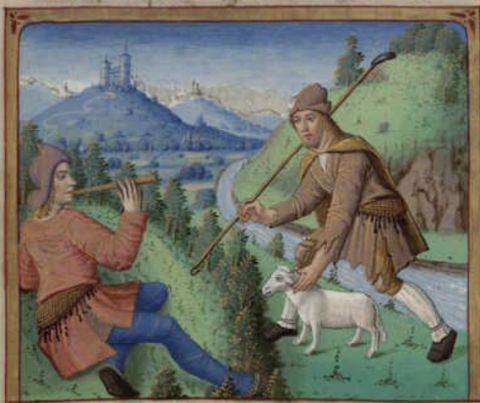
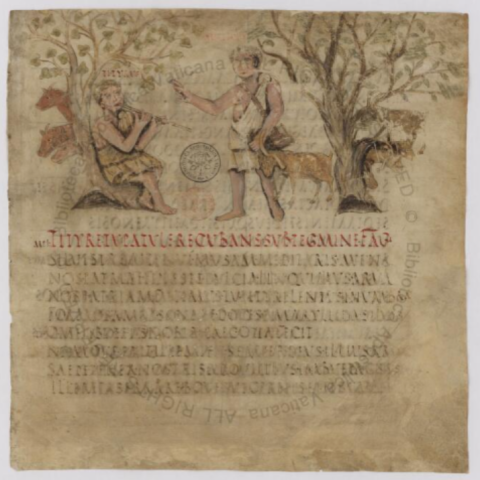
1–10 M: Tityrus, you are sitting under a tree playing your shepherd's pipe, but I am fleeing from my homeland. T: Meliboeus, the man who granted me the security I enjoy is like a god to me. He has allowed me to pasture this herd of cattle and play my music.
1–4 tū … nōs pătriae … nōs pătriam … tū: Tityrus’s and Meliboeus’s strikingly different circumstances are compared through the antithesis between tū and nōs and the repetition (anaphora) in inverse order (chiasmus) of the pronouns tū … nōs … nōs … tū. The repetition of patriae and patriam signals Meliboeus’s deep sense of loss.
1 Tītyre: Vergil takes the name from the pastoral poetry of the Greek poet Theocritus, who lived in Sicily during the 3rd century BCE. A variety of original meanings for tītyrus have been put forth: “reed” or “pipe,” “satyr,” “he-goat,” among others. Tityrus also appears in Eclogues 3, 5, 6, 8, and 9.
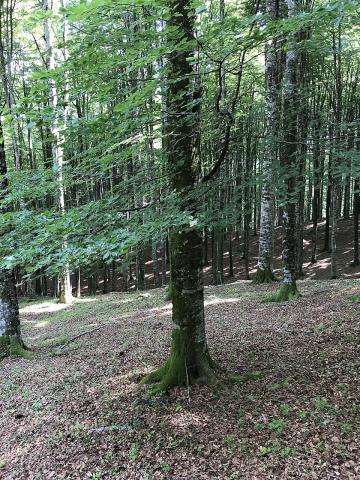
1 Patulae … fāgī: fāgus is feminine, as is the case with trees and plants (AG 32). Shady trees are often places for reflection in classical poetry.
2 silvestram … Mūsam: “woodsy song,” direct object of the deponent meditāris; Meliboeus’s description of Tityrus’s song as silvestram reveals the interdependent relationship between setting and song.
2 tenuī … avēnā: ablative of means with meditāris (AG 409). Avēna is literally an “oat-straw” and is used, like calamus and harūndō (both of which mean “reed, cane”), for the shepherd’s reed pipe or pan-pipe. The placement of tenuī between silvestram … Mūsam connects the “woodsy song” to the “delicate reed pipe” on which it is composed.
3 fīnīs: third declension i-stem nouns often show accusative plural -īs in place of -ēs (AG 74.c), especially in Vergil. Its political sense contrasts Meliboeus’s situation with that of Tityrus, who remains in a pastoral world removed from the politics and upheaval of the land confiscations.
4 fugimus: scansion shows that this is a present tense verb because fu- scans short, indicating the root is from the first principal part and thus present tense.
5 Amaryllida: -ida accusative ending borrowed from Greek (AG 81–82); direct object of resonāre. Like Tityrus, the name Amaryllis is taken from Theocritus’s Idylls.
5 docēs: governs two accusatives: the person receiving instruction and the thing taught (AG 396). Tityrus teaches the personified woods (silvās) the infinitive phrase formōsam resonāre … Amaryllida.
6 Meliboee: vocative (AG 340); oe forms a diphthong, so the name scans as four syllables: Me-li-boe-e. Meliboeus is a Greek name like those of Tityrus and Amaryllis, but is not attested in pastoral before Vergil.
6 deus: this “god” is widely believed to stand in for the young triumvir Octavian, whom Tityrus credits with allowing him to retain his farm, despite the ongoing land confiscations under the Second Triumvirate.
- read more
-
The attribution of divinity by an Italian herdsman to his benefactor, which is all that we are explicitly required to accept here, is no more than the characteristic gesture of gratitude from a simple and superstitious rustic. Nevertheless, the reference is certainly to Octavian. At the time when the poem first appeared he must still have been very much the junior partner to Antony; and so there may be here be evidence of a second edition of the Eclogue, dating from the early years of the principate, when popular versions of the emperor cult were already becoming established. However, even in the mid 30s, “the cities joined in placing [Octavian] among their tutelary gods” (Appian, Civil Wars 5.132) (Coleman).
7–8 illius … agnus: Tityrus honors his benefactor, Octavian, through the highest honor of ritual sacrifice, as though he were a god. Though formal emperor worship was not established in Rome until after Octavian/Augustus’s death in 14 CE, Octavian had already adopted the title divi filius, “son of the divine,” for propagandistic uses.
7 ille: refers to Octavian. His prominence in Tityrus’s world is marked by the emphatic repetition ille … illius/ … /ille.
The repetition suggests ritual speech (Clausen).
7 mihī: dative of reference (AG 378) or possession (AG 373); the second syllable of this word scans long, an archaic form.
7 illĭus: refers to his godlike benefactor, Octavian. The second syllable of this word scans short.
9–10 ille … / … permīsit: a verb of permitting using the infinitive in place of the usual ut clause with the subjunctive (AG 563c).
9 meās … bovēs: accusative subject of errāre; ipsum [mē] is the accusative subject of lūdere.
10 lūdere [ea] quae vellem: the neuter plural relative pronoun quae refers to an implied antecedent “things” [ea]; relative clause of characteristic (AG 534).
vocabulary
Meliboeus -ī m.: Meliboeus, a shepherd
Tityrus –ī m.: Tityrus, a shepherd
patulus –a –um: broad, spreading
recubō recubāre recubāvī recubātus: to be lying back, recline
tegmen (tegumen) –inis n.: covering, shade
fāgus –ī f.: beech-tree
silvestris silvestre: pertaining to the woods, pastoral
tenuis tenue: thin, fine
Mūsa –ae f.: a Muse; song
meditor meditārī meditātus sum: practice, rehearse; ponder
avēna –ae f.: a hollow stalk used as a wind instrument; pan-pipes
linquō linquere līquī: to leave behind, abandon
lentus –a –um: untroubled, at ease
fōrmōsus –a –um: beautiful, fair 5
resonō resonāre resonāvī resonātus: to sound again, echo
Amaryllis –idis or –idos f.: Amaryllis, a woman's name
ō: O
ovīle –is n.: sheepfold
imbuō –ere –uī –ūtus: stain
agnus agnī m.: lamb
lūdō lūdere lūsī lūsus: play 10
calamus –ī m.: a reed pipe
agrestis agrestis agreste: rural, rustic