MELIBOEUS TITYRUS
M. Tītyre, tū patulae recubāns sub tegmine fāgī
silvestrem tenuī Mūsam meditāris avēnā;
nōs patriae fīnīs et dulcia linquimus arva.
nōs patriam fugimus; tū, Tītyre, lentus in umbrā
fōrmōsam resonāre docēs Amaryllida silvās. 5
T. Ō Meliboee, deus nōbīs haec ōtia fēcit.
namque erit ille mihi semper deus, illius āram
saepe tener nostrīs ab ovīlibus imbuet agnus.
ille meās errāre bovēs, ut cernis, et ipsum
lūdere quae vellem calamō permīsit agrestī.10
notes
Eclogue 1 is a dialogue between two shepherds, Meliboeus and Tityrus.
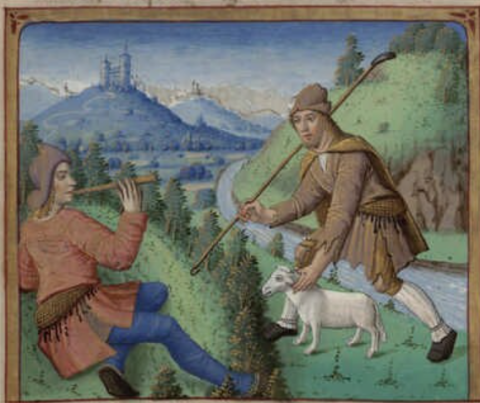
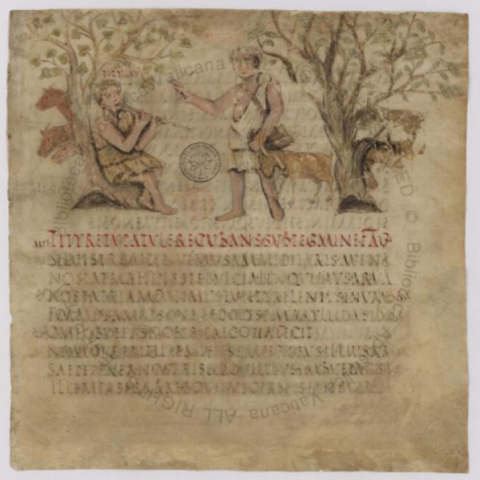
1–10 M: Tityrus, you are sitting under a tree playing your shepherd's pipe, but I am fleeing from my homeland. T: Meliboeus, the man who granted me the security I enjoy is like a god to me. He has allowed me to pasture this herd of cattle and play my music.
Pastoral poetry existed before Vergil’s first Eclogue, but no other poem so successfully defined the genre for future generations. After Vergil, pastoral poetry became largely a poetry of shepherds in an idyllic landscape, singing about their rustic lives while showing off their poetic skill, often with a tone of melancholy or longing. The first Eclogue became the paradigm for pastoral because it masterfully weaves evocative, playful descriptions of the countryside with melancholic meditations on loss and longing.
- read full essay
-
In the opening verses the goatherd Meliboeus longingly describes the lovely scene: a fellow goatherd, Tityrus, relaxes under a beech tree, playing a song on his reed pipe. This longing immediately takes a surprisingly melancholic turn when Meliboeus recounts his own circumstances to Tityrus—he is a refugee aimlessly searching for a new home, driven into exile because the government in Rome gave his land to military veterans from the recent civil wars. These contrasting circumstances bring into sharp focus the creative potential of the pastoral landscape and the destructive power of political instability. Meliboeus’s dialogue with Tityrus illustrates the deep gulf between those who lost everything in the civil wars and those who benefitted from a benevolent autocrat. Meliboeus can no longer participate in the activities that occupy Tityrus: composing song, pasturing flocks, and pursuing a lover or meditating on love lost.
Meliboeus lost his land because of the traditional Roman practice of granting land to military veterans. Normally colonies of retired soldiers were established in newly conquered territories, and the newly resettled veterans helped expand the zone of Roman influence, or else established a base in a still hostile territory. Meliboeus, however, lives in Italy. By Vergil’s time (mid-1st century BCE) the practice of colonization and land distribution had become more political in nature, a way for cash-strapped generals to reward loyal veterans, or for politicians to appeal to the urban poor. During the 40s BCE, for the first time veterans were allotted land in Italy, rather than newly acquired foreign territory, as had been the traditional practice. As the veterans of the recent civil wars clamored for their promised land, the newly established governing triumvirate redistributed public land in Italy (ager publicus), forcing out current occupants, often Roman citizens whose families had occupied that land for generations.
In the opening lines of Eclogue 1, Meliboeus reveals that the rustic landscape is the source of creative expression. Hemarvels aloud to Tityrus: Tityre, tu patulae recubans sub tegmine fagi / silvestrem tenui Musam meditaris avena; / nos patriae finis et dulcia linquimus arva (“Tityrus, you, reclining und the cover of a shady beech, play the woodsy muse on your flute; we leave the borders of our fatherland and our sweet fields,” 1.1–3). These opening verses reveal a tension between those pastoral inhabitants composing song and those driven from their lands because of political turmoil, who can no longer participate in the pastoral way of life. The two speakers, Tityrus and Meliboeus, represent these two perspectives, respectively. Their conversation reveals the gulf between them. The opening lines draw attention to the landscape, the shade and the tree under which Tityrus reclines. And it is in this space that Tityrus sings his song. The leisure for song is also a space for song – not only having the time to make song but having a particular space to foster the creative production of the song.
Although the poem is set in the countryside, the city of Rome is central to it. From the exchange between Meliboeus and Tityrus, the reader learns that Tityrus has the leisure to sing and the freedom to pasture his flock because of his trip to Rome, where he sought libertas (“freedom,” 1.26–27). Tityrus’s first words tell us that he owes everything to a “god” (deus, line 6, presumably Octavian, one of the governing triumvirate and the future emperor Augustus) whom he petitioned for his freedom: O Meliboee, deus nobis haec otia fecit. / . . . / ille meas errare boves, ut cernis, et ipsum / ludere quae vellem calamo permisit agresti (“O Meliboeus, a god has made leisure for us. / . . . / He allowed my cattle to roam, as you see, and me myself to play the things that I wanted on my rustic reed pipe.” 1.6, 9–10). Tityrus’s trip to Rome enabled him to have the pastoral lifestyle, the key features of which are leisure, shepherding, and composing songs.
When asked by Meliboeus a little later in the poem why he went to Rome, Tityrus exclaims “libertas” (1.27). In the context, Tityrus celebrates the fact that he was able to purchase his freedom from slavery, but the word libertas itself was an important cultural value for Romans and a politically charged term in Vergil’s time. Caesar’s assassins had used the language and imagery of freedom to justify their actions. By using this language of freedom, Tityrus links his ability to produce pastoral song with political freedom and the historical reality of the moment
Tityrus’ freedom to pursue his pastoral lifestyle granted to him by a godlike young Octavian is contrasted with Meliboeus’s despair, not only at having to leave his home, but worse, having a veteran take his land. His exile and loss of land is a product of of civil wars: impius haec tam culta novalia miles habebit, / barbarus has segetes. en quo discordia civis / produxit miseros: his nos consevimus agros! (“a disloyal soldier will have these such well-tilled fields, a barbarian these wheatfields. Look how discord has produced wretched citizens; we sowed our fields for these men!” 1.71–72). The land is the source of his livelihood and pleasure; without it the two most important things to both him and Tityrus (agricultural pursuits and singing) cannot happen. As Meliboeus’s last words make clear, these are both lost to him now: carmina nulla canam; non me pascente, capellae, / florentem cytisum et salices carpetis amaras (“I will sing no songs; not while I pasture them will my little she-goats pluck at the blooming clover and bitter willow” 1.77-78).
This is a poem of longing, longing for the connection between land and creative production and the longing for connection through song and shared experience. Tityrus’s joy in his own freedom to fully inhabit and participate in the pastoral world is tempered with his sympathy for Meliboeus’s suffering. As the shadows descend, all Tityrus can offer Meliboeus is a night’s respite from his hardship: Hic tamen hanc mecum poteras requiescere noctem / fronde super viridi (“All the same, you could rest here with me this night upon a green bed of leaves,” 1.79–80). The poem ends with an acknowledgement that much has been lost to the darkness of war and the hope that, despite what has been lost, solace can be found in the collective acceptance of this loss, expressed through the offer of quiet companionship for a night.
1–4 tū … nōs pătriae … nōs pătriam … tū: Tityrus’s and Meliboeus’s strikingly different circumstances are compared through the antithesis between tū and nōs and the repetition (anaphora) in inverse order (chiasmus) of the pronouns tū … nōs … nōs … tū. The repetition of patriae and patriam signals Meliboeus’s deep sense of loss.
1 Tītyre: Vergil takes the name from the pastoral poetry of the Greek poet Theocritus, who lived in Sicily during the 3rd century BCE. A variety of original meanings for tītyrus have been put forth: “reed” or “pipe,” “satyr,” “he-goat,” among others. Tityrus also appears in Eclogues 3, 5, 6, 8, and 9.
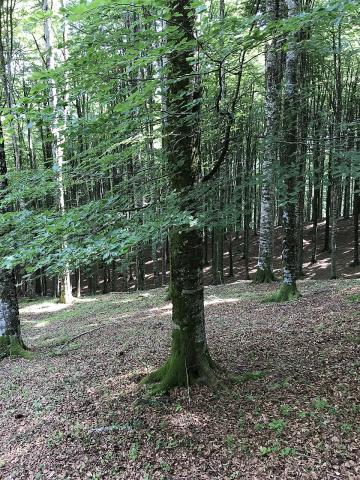
1 Patulae … fāgī: fāgus is feminine, as is the case with trees and plants (AG 32). Shady trees are often places for reflection in classical poetry.
2 silvestram … Mūsam: “woodsy song,” direct object of the deponent meditāris; Meliboeus’s description of Tityrus’s song as silvestram reveals the interdependent relationship between setting and song.
2 tenuī … avēnā: ablative of means with meditāris (AG 409). Avēna is literally an “oat-straw” and is used, like calamus and harūndō (both of which mean “reed, cane”), for the shepherd’s reed pipe or pan-pipe. The placement of tenuī between silvestram … Mūsam connects the “woodsy song” to the “delicate reed pipe” on which it is composed.
3 fīnīs: third declension i-stem nouns often show accusative plural -īs in place of -ēs (AG 74.c), especially in Vergil. Its political sense contrasts Meliboeus’s situation with that of Tityrus, who remains in a pastoral world removed from the politics and upheaval of the land confiscations.
4 fugimus: scansion shows that this is a present tense verb because fu- scans short, indicating the root is from the first principal part and thus present tense.
5 Amaryllida: -ida accusative ending borrowed from Greek (AG 81–82); direct object of resonāre. Like Tityrus, the name Amaryllis is taken from Theocritus’s Idylls.
5 docēs: governs two accusatives: the person receiving instruction and the thing taught (AG 396). Tityrus teaches the personified woods (silvās) the infinitive phrase formōsam resonāre … Amaryllida.
6 Meliboee: vocative (AG 340); oe forms a diphthong, so the name scans as four syllables: Me-li-boe-e. Meliboeus is a Greek name like those of Tityrus and Amaryllis, but is not attested in pastoral before Vergil.
6 deus: this “god” is widely believed to stand in for the young triumvir Octavian, whom Tityrus credits with allowing him to retain his farm, despite the ongoing land confiscations under the Second Triumvirate.
- read more
-
The attribution of divinity by an Italian herdsman to his benefactor, which is all that we are explicitly required to accept here, is no more than the characteristic gesture of gratitude from a simple and superstitious rustic. Nevertheless, the reference is certainly to Octavian. At the time when the poem first appeared he must still have been very much the junior partner to Antony; and so there may be here be evidence of a second edition of the Eclogue, dating from the early years of the principate, when popular versions of the emperor cult were already becoming established. However, even in the mid 30s, “the cities joined in placing [Octavian] among their tutelary gods” (Appian, Civil Wars 5.132) (Coleman).
7–8 illius … agnus: Tityrus honors his benefactor, Octavian, through the highest honor of ritual sacrifice, as though he were a god. Though formal emperor worship was not established in Rome until after Octavian/Augustus’s death in 14 CE, Octavian had already adopted the title divi filius, “son of the divine,” for propagandistic uses.
7 ille: refers to Octavian. His prominence in Tityrus’s world is marked by the emphatic repetition ille … illius/ … /ille.
The repetition suggests ritual speech (Clausen).
7 mihī: dative of reference (AG 378) or possession (AG 373); the second syllable of this word scans long, an archaic form.
7 illĭus: refers to his godlike benefactor, Octavian. The second syllable of this word scans short.
9–10 ille … / … permīsit: a verb of permitting using the infinitive in place of the usual ut clause with the subjunctive (AG 563c).
9 meās … bovēs: accusative subject of errāre; ipsum [mē] is the accusative subject of lūdere.
10 lūdere [ea] quae vellem: the neuter plural relative pronoun quae refers to an implied antecedent “things” [ea]; relative clause of characteristic (AG 534).
vocabulary
Meliboeus -ī m.: Meliboeus, a shepherd
Tityrus –ī m.: Tityrus, a shepherd
patulus –a –um: broad, spreading
recubō recubāre recubāvī recubātus: to be lying back, recline
tegmen (tegumen) –inis n.: covering, shade
fāgus –ī f.: beech-tree
silvestris silvestre: pertaining to the woods, pastoral
tenuis tenue: thin, fine
Mūsa –ae f.: a Muse; song
meditor meditārī meditātus sum: practice, rehearse; ponder
avēna –ae f.: a hollow stalk used as a wind instrument; pan-pipes
linquō linquere līquī: to leave behind, abandon
lentus –a –um: untroubled, at ease
fōrmōsus –a –um: beautiful, fair 5
resonō resonāre resonāvī resonātus: to sound again, echo
Amaryllis –idis or –idos f.: Amaryllis, a woman's name
ō: O
ovīle –is n.: sheepfold
imbuō –ere –uī –ūtus: stain
agnus agnī m.: lamb
lūdō lūdere lūsī lūsus: play 10
calamus –ī m.: a reed pipe
agrestis agrestis agreste: rural, rustic