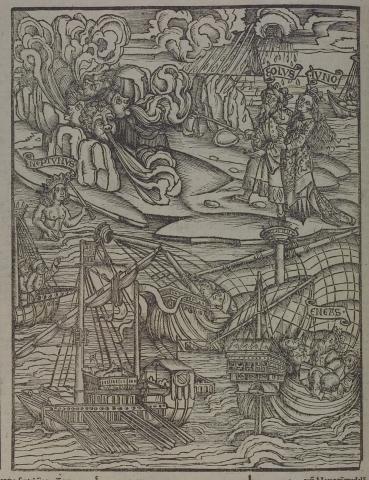
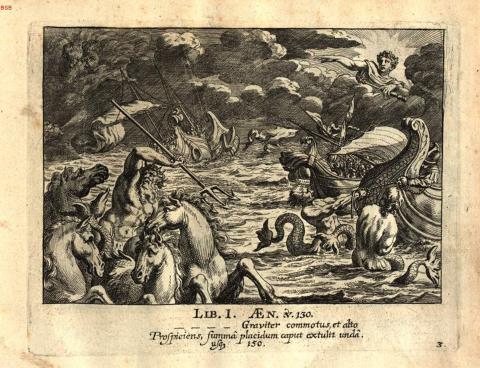
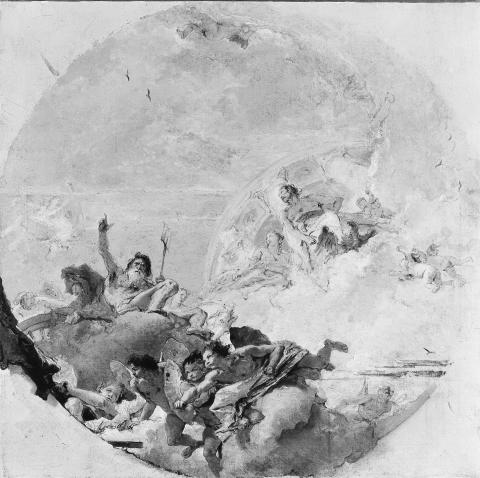
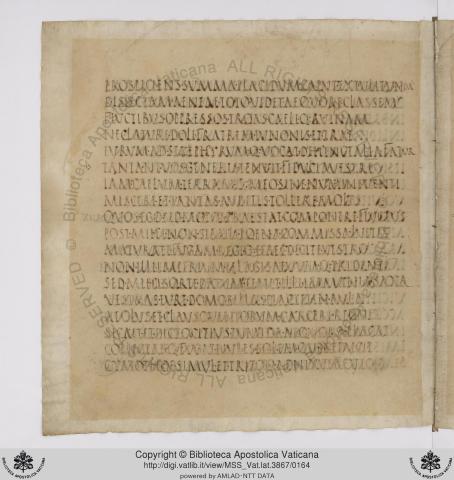
Intereā magnō miscērī murmure pontum
ēmissamque hiemem sēnsit Neptūnus et īmīs125
stāgna refūsa vadīs, graviter commōtus, et altō
prōspiciēns summā placidum caput extulit undā.
Disiectam Aenēae tōtō videt aequore classem,
flūctibus oppressōs Trōas caelīque ruīnā;
nec latuēre dolī frātrem Iūnōnis et īrae.130
Eurum ad sē Zephyrumque vocat, dehinc tālia fātur:
notes
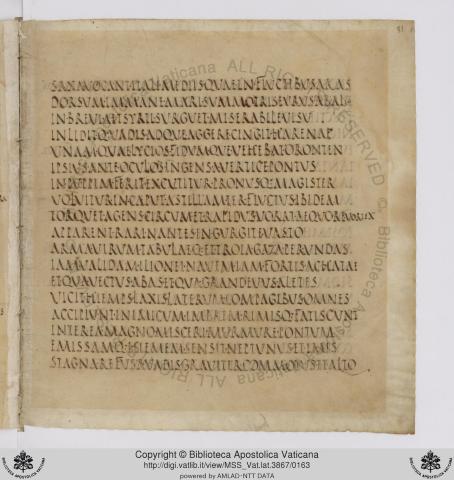
Manuscripts: M | R 124-126, 127-131
Neptune notices that an unauthorized storm has arisen (Austin).
By line 123, the storm invited by Juno has reached its height. Ships and people are scattered and shattered all over the place. However, starting in line 124, it turns out that another god is not pleased by the winds’ rampage...
- read full essay by Meghan Reedy
-
By line 123, the storm invited by Juno has reached its height. Ships and people are scattered and shattered all over the place. However, starting in line 124, it turns out that another god is not pleased by the winds’ rampage: Neptune, deep down, has felt the disturbance, emissam hiemem sensit Neptunus (125), and lifted his head out of the sea to have a look, alto prospiciens summa placidum caput extulit unda (126–27). Throughout the scene that follows, we are shown more about how the gods interrelate. Neptune knows, for example, that his sister Juno’s anger is what caused the storm, nec latuere doli fratrem Iunonis irae (130). Yet it is not Juno he confronts about the incident, nor is it Aeolus, whom Juno persuaded to let the winds go. No, he calls two of the winds by name and brings them to heel with a talking to: Eurum ad se Zephyrumque vocat, dehinc talia fertur… (131).
Thus, we learn that the winds themselves are also people, so to speak, and can be held accountable for their behavior. When Neptune asks, Tantane vos generis tenuit fiducia vestri? (132), his question about the overweening confidence of the winds mirrors the poet’s concern about the extent of Juno’s anger in line 11: Tantaene animis caelestibus irae? And so, we have another opportunity to consider the nature and the limits of deities. The winds are gods, too, but cannot, Neptune suggests, just raise a ruckus however and whenever they choose; there are limits. Looking back in the light of this to line 11, we might read that question anew: Juno is queen of the gods, and her anger is terrible—but is she not also ultimately bound to modulate her behavior and accept the limits the Fates set?
In 133–34, Neptune asks how they can dare to raise up “such a gigantic mass (of water)”: Iam caelum terramque meo sine numine, venti, miscere et tantas audetis tollere moles? With meo sine numine, he highlights his own control over his own domain as one of the limits the winds ought to observe. But the question also echoes the poet’s statement in 33, which concludes the explanation of Juno’s anger: “such great effort was involved in founding the Roman people,” (Tantae molis erat Romanam condere gentem). It seems that when Neptune asks, “who are you, minor winds, to dare lift such weight?” he might be questioning not just their overreaching their own status, not just their straying into his own territory and lifting huge “weights” of water as waves, but also their overstretching with regard to the central Fate of the Aeneid, the founding of the Roman people. How could these wind-godlings think they could meddle with that fate?
Neptune packs Eurus and Zephyr off to go tell their king Aeolus to mind that he stays within the limits of his power (non illi imperium pelagi … sed mihi sorte datum, 138–39), and he puts everything to rights (142–47). The manner in which he does this is illuminated in one of the Aeneid’s many striking similes: the waves and winds quiet down in Neptune’s presence just as, veluti (148), a rioting mob stops to listen when they catch sight of a dignified man who calms them with his speech (148–53). Many people have thought a great deal about this simile, and about the striking way Vergil uses a human event (calming a riot) to augment our understanding of a natural event (calming a storm), when the reverse happens so much more often, especially in Homer. In the light of what has just been said about excess and limits in the behavior of the gods, we should notice the way this “storm” has been consistently described as a series of deliberate acts by deities. The unleashed winds stir up huge waves (vastos volvunt ad litora fluctus, 86), and later Neptune calms the water (tumida aequora placat, 142); clouds steal the day away (eripiunt subito nubes caelumque diemque … ex oculis, 88–9), and Neptune shoos them off and brings back the sun (collectasque fugat nubes solemque reducit, 143); the wind Notus hurls three ships onto rocks (tres Notus … in saxa … torquet, 108) while Eurus grounds another three (tres Eurus… in brevia… urget, 110–11), and Neptune and the nymphs lever them off (Cymothoe simul et Triton adnixus acuto detrudunt naves scopulo; levat ipse tridenti et vastas aperit syrtes, 144–46). We have also witnessed Neptune’s verbal rebuke of Eurus and Zephyr.
We have thus been encouraged throughout the description of the storm not to think of it primarily as weather arising through impersonal natural forces, but as a conflict among characters, as personal. Thus when the simile comes it feels surprisingly natural. The comparison it offers readily provides a frame of reference, a name, for the behavior of the winds that has been described so far: seditio saevitque animis ignobile vulgus (149). The troop of winds is rowdy, trashy mob, ignobile vulgus, and their overreach is fueled by the desire for insurrection, mutiny (seditio saevit). Yes, we can easily think Notus and Eurus and Zephyr and their low-born colleagues have been rioting. Similarly, the behavior of Neptune, is easily compared to that of an upstanding, dignified man, peitate gravem ac meritis… virum (151). Indeed, we can easily agree. He looked out from the deep and the rioters paused; he spoke sternly to them and they were chastened.
The result of describing the storm in such person-like terms, and then using a simile that directly compares the person-like storm-actors to people, is two-fold. As has often been remarked, the vir is described in such a way that we can’t help but think of Aeneas—already in line 10 he was called insignem pietate virum, and the man in the simile is pietate gravem… vir—so here we are being nudged toward thinking of Aeneas as being a little bit like Neptune, a little bit godlike. However, I think something larger is also happening here. We are being allowed to think, to feel, that the whole universe, including the most extravagant weather, behaves like people do and can therefore be thought of in terms of us. The god of the sea, when acting at his best and fairest, acts as a good person does, and bad weather acts as rowdy people do.
Both ways—Aeneas elevated to the divine, and cosmic forces reduced to human, or perhaps rather to Roman, scale—the human players in the Aeneid are linked in with, blurred into, the workings and the motivations of the cosmos at every level, all the way to the uppermost deities. Might we not ask, is there such confidence in humankind? Isn’t this, too, overreaching?
Further Reading
Anderson, W.S. 2005. The Art of the Aeneid, 24–26. 2nd ed. Wauconda, IL: Bolchazy-Carducci.
Hardie, P.R. 1986. Virgil’s Aeneid: Cosmos and Imperium, 90–97, 103–10, 180–3. Oxford: Oxford University Press.
Harrison, S.J. 1988. “Vergil on kingship: the first simile of the Aeneid.” In Proceedings of the Cambridge Philological Society n.s. 34: 55–9.
McKay, A.G. 1989. “Vergil’s Aeolus episode.” In Daidalion: Studies in Memory of Raymond Schroder, ed. R.F. Sutton 249–56. Wauconda, IL: Bolchazy-Carducci, 1989.
Phillips, O. 1980. “Aeole, namque tibi.” Vergilius 26: 18–26.
Smith, R.A. 2005. The Primacy of Vision in the Aeneid, 12–20. Austin: University of Texas Press.
West, David. 1969. “Multiple-correspondence similes in the Aeneid.” Journal of Roman Studies 59: 40–49.
124–126: the order is: —Interea Neptunus, graviter commotus, sensit pontum misceri magno murmure, hiememque emissam (esse), et stagna refusa (esse) imis vadis (Robertson).
124: magno misceri murmure: “is in the turmoil of a loud uproar”; murmure is abl. of manner (Wetherell) (AG 412). misceri: “to be agitated” (Frieze).
125: emissam: sc. esse (F-B).
126: stagna: the waters near the bottom of the sea are supposed not to be disturbed by ordinary winds; hence, they are called here “standing” or “still waters” (Frieze). refusa: sc. esse, “upheaved” (F-B). vadis: ablative of separation (F-B) (AG 401). graviter commotus: “deeply indignant” or “with deep displeasure,” not vehementer concitatus, “violently agitated,” or “roused to fury”; it is the stern displeasure of a god, conscious of his supreme power, and calmly exercising his authority to restrain or punish without any external excitement. Hence placidum caput, in the next verse, is not inconsistent (Frieze). 126–127: alto prospiciens: “gazing out over the deep.” alto is most naturally taken as ablative of the place where. prospiciens is not a verb of motion, and the dative would mean, “caring for the deep” (F-B). Locative abl. or possible abl. of separation (G-K). Dat. = in altum “over the sea” (Page).
127: placidum caput: however angry, the god is outwardly serene (F-B). In contrast with the angry storm and also to express his dignity...and dignified self-control in spite of his anger (Page). unda: abl. of separation (Wetherell).
129: caelique ruina: “by the destructive force of the air”; literally, “by the rushing down of the sky”; referring to the furious descent of the winds (Frieze). The phrase is here opposed to fluctibus: the sea and sky conspire to destroy the Trojans (Page). “The wreck of heaven,” a fine poetic audacity for “the storm” (Sidgwick).
130: latuere… fratrem: the verb is transitive (“be unknown to, escape the notice of”), and hence takes the accusative, fratrem (Bennett). Neptune was a son of Saturn, and therefore brother of Juno (Frieze). irae: “passions,” plural with reference to their repeated display (Walpole).
131: Eurum, Zephyrumque: all the winds are implied, though only two are mentioned (Frieze). dehinc: one syllable, by synizesis (F-B) (AG 603 note).
vocabulary
intereā: (adv.), amid these things; meanwhile, in the meantime, 1.418, et al.
murmur, uris, n.: a murmur, 6.709; uproar, 1.124; roaring, reverberation, 1.55; acclamation, applause, 5.369; thunder, 4.160.
ēmittō, mīsī, missus, 3, a.: to send forth, 6.898; hurl, throw, shoot, 11.676.
Neptūnus, ī, m.: Neptune, one of the sons of Saturn, and brother of Jupiter, Juno, and Pluto; identified by the Romans, as god of the sea, with the Greek Poseidon, 1.125.
stāgnum, ī, n.: a collection of standing water; a pond, pool, lake; sluggish water or stream, 6.323; pl., stāgna, ōrum, deep waters of the sea, 1.126; waters, 6.330. (stō)
refundō, fūdī, fūsus, 3, a.: to pour back or up; cast, throw up, 7.590; boil up, 1.126; flow back, overflow, 6.107; p., refūsus, a, um, thrown back, beaten back; poured back, flowing back upon itself, encircling, 7.225.
vadum, ī, n.: a ford; a shallow, shoal, 1.112; sand-bank, 10.303; shallow water, 11.628; bottom, depth, 1.126; water, tide, stream, 6.320; water of the sea, 5.158; wave, sea, 7.198.
graviter: (adv.), heavily; deadly, 7.753; greatly, deeply, 1.126; heavily, mournfully, 2.288. (gravis)
commoveō, mōvī, mōtus, 2, a.: to move completely; move rapidly in procession, 4.301; rouse, start from cover, 7.494; shake, stir, 5.217; disturb, move, 1.126; agitate, terrify 1.360.
altum, ī, n.: the deep; the lofty; the deep sea, the main, the deep, 1.3; the sky, heaven, air, 1.297; from far, far-fetched, remote, 8.395. (altus)
prōspiciō, spexī, spectus, 3, n. and a.: to look forth, forward; to see afar, in the distance, descry, see, 3.648; to look forth or out upon, w. dat., 1.127. (prō and speciō, look)
placidus, a, um: adj. (placeō), gentle, calm, tranquil, peaceful, serene, 5.848; inactive, idle, 9.187; friendly, propitious, 3.266; (adv.), placidē, gently, softly, quietly, calmly, 5.86.
extollō, 3, a.: to lift up; (fig.), laud, extol, 11.401.
dīsiciō, iēcī, iectus, 3, a.: to throw, cast asunder; overthrow, demolish, 8.355; scatter, disperse, 1.70; cleave, 12.308. (dis- and iaciō)
Aenēās, ae, m.: 1. A Trojan chief, son of Venus and Anchises, and hero of the Aeneid, 1.92. 2. Aenēās Silvius, one of the Alban kings, 6.769.
opprimō, pressī, pressus, 3, a.: to press against; press down, overpower, overwhelm, 1.129; come upon suddenly; surprise, 9.398. (ob and premō)
Trōes, m.: (subst.), the Trojans, 1.30, et al. (Tros, one of the kings of Troy)
ruīna, ae, f.: a falling down; fall, overthrow; convulsion, commotion, destructive force, 1.129; onset, shock, 11.613; pl., ruin, overthrow, destruction, 1.238; dare, trahere ruīnam, to fall in ruins, 2.310; bring destruction, 12.454. (ruō)
nec or neque: (adv. and conj.), and not; neither, nor, 1.643, et al.; in prohibition, 3.394, et al.; neque (nec) — neque (nec), neither — nor, 5.21, et al.; nec — et, or -que, may be rendered neither — nor, 12.801; 2.534; nec nōn, and also, nor less, 6.183; nec nōn et, and also, 1.707.
Iūnō, ōnis, f.: Juno, the Sabine and Roman name for the wife and sister of Jupiter, daughter of Saturn, 1.4, et al.; Iūnō īnferna, the Juno of the lower world, Proserpine, 6.138.
Eurus, ī, m.: the southeast wind, 1.85, et al.; wind, 1.383, et al.
Zephyrus, ī, m.: Zephyrus or Favonius, the god of the west wind, 2.417, et al.; west wind, 4.562; wind, 10.103.
dehinc (often monosyll.): (adv.), from this place; from this time; thereupon, then, 1.131.