Dēfessī Aeneadae quae proxima lītora cursū
contendunt petere, et Libyae vertuntur ad ōrās.
Est in sēcessū longō locus: īnsula portum
efficit obiectū laterum, quibus omnis ab altō160
frangitur inque sinūs scindit sēsē unda reductōs.
Hinc atque hinc vāstae rūpēs geminīque minantur
in caelum scopulī, quōrum sub vertice lātē
aequora tūta silent; tum silvīs scaena coruscīs
dēsuper, horrentīque ātrum nemus imminet umbrā.165
Fronte sub adversā scopulīs pendentibus antrum;
intus aquae dulcēs vīvōque sedīlia saxō,
nymphārum domus. Hīc fessās nōn vincula nāvēs
ūlla tenent, uncō nōn alligat ancora morsū.
Hūc septem Aenēās collēctīs nāvibus omnī170
ex numerō subit, ac magnō tellūris amōre
ēgressī optātā potiuntur Trōës harēnā
et sale tābentēs artūs in lītore pōnunt.
Ac prīmum silicī scintillam excūdit Achātēs
succēpitque ignem foliīs atque ārida circum175
nūtrīmenta dedit rapuitque in fōmite flammam.
Tum Cererem corruptam undīs Cereāliaque arma
expediunt fessī rērum, frūgēsque receptās
et torrēre parant flammīs et frangere saxō.
notes
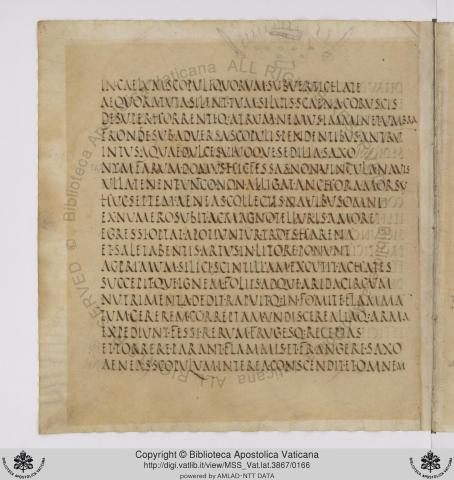
Manuscripts: M 157-175, 176-179 | R 157-162, 163-179
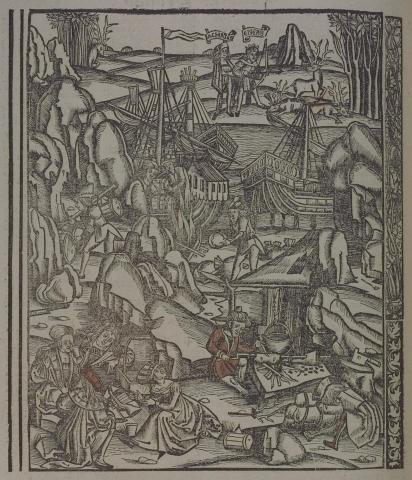
The Trojans land in a sheltered spot and prepare a meal (Walpole).
"In the simile that compares Neptune calming the storm to a worthy and respected man calming a riot (1.148–53), the man is described using terms that have already been used of Aeneas..."
- read full essay by Meghan Reedy
-
[click here to open in new tab]
In the simile that compares Neptune calming the storm to a worthy and respected man calming a riot (1.148–53), the man is described using terms that have already been used of Aeneas: peitate gravem … virum in 151 recalls insignem pietate virum in 10. As discussed in an earlier essay, the simile picks up elements of what has come before and shows them to us in a new light.
The scene following the storm does something similar. The simile had compared Neptune calming the winds to a man who “soothes the hearts” of rioters: ille regit dictis animos et pectora mulcet (153). After the storm, the exhausted Trojans come to shore in Libya (defessi Aeneadae … Libyae vertuntur ad oras 157–58). Aeneas hunts venison for everyone (180–96), and then, in line 197, addresses his men: dictis maerentia pectora mulcet. What Aeneas is doing here is similar in important ways to what the vir in that simile did: using words, dictis, and soothing hearts. However, what he is doing is also different. In the simile the vir “governs their minds” with his words, regit dictis animos (153); but here Aeneas uses words only to allay distress, dictis … pectora mulcet (197). Also, the pectora being soothed need soothing for different reasons. In the simile they are raging and intent on mutiny, seditio saevitque animis … vulgus (149); but Aeneas’ men are grieving, maerentia pectora (197).
A look at what Aeneas actually says shows that he is far from identical with the pius vir of the simile. How does Aeneas soothe his men’s hearts? He uses two main strategies: reminding them that they have successfully endured hardships before and encouraging them to remember that a peaceful outcome is promised by fate. He provides them two tools for overcoming their distress, two ways of shifting perspective so that the current distress can be seen as finite and manageable: compare this with what has gone before, so you’ll see it will pass like your other troubles did; compare this with the future, it will be better then. Nonetheless, his instructions also make it clear that this is all he can do. He does not indicate that he or they have any say in when or how the hardships will end: a god will end them, dabit deus his quoque finem (199). Moreover, he instructs them to take control of their own minds and soothe their own sadness and fear: revocate animos maestumque timorem mittite (202–3). Similarly, though fate has shown them their destination, they need to keep themselves going in order to get there: durate, et vosmet rebus rebus servate secundis (206–7). It is in this context that he offers the poignant, heartening, melancholy thought that even this might be good to think back on someday, forsan et haec olim meminisse iuvabit (203).
Thus, Aeneas’ power over his people in these words is tightly constrained. He cannot, this speech suggests, actually ease their grief, or end their difficulties, or get them to their fated destination. It turns out that they must each do it for themselves.
Aeneas’ all too human limitations are also clear when we compare him to Neptune, as the text asks us to do in some ways. After they come ashore Aeneas men’ find a protected place where the water is calm (aequora tuta silent, 164) and drag their salt-drenched limbs ashore (sale tabentes artus in litore ponunt). Achates starts a fire (Achates succepitque ignem foliis, 174–75). Then they make food (177–79), and while they do that Aeneas climbs a cliff, hoping to get a good view, but finding good venison instead (180–96). Here, surprisingly, are echoes of the storm itself, and of Neptune’s response to it. Aeneas’ men treat their grain in much the same way the storm treated their boats. It gets drenched in water (Cererem corruptam undis, 177), then pulled out (fruges receptas, 178) and broken on a rock (frangere saxo, 179). They also get ready to subject it to fire (torrere parant flammis, 179). Meanwhile, interea (180), Aeneas climbs the cliff (Aeneas scopulum … conscendit, 180), and he is described doing so in terms that remind us of Neptune when he first felt that his domain was being disturbed. Neptune:
… graviter commotus, et alto
prospiciens summa placidum caput extulit unda (126–27),
and again at the close of the scene,
… aequore postquam
prospiciens genitor … (154–55).
Of Aeneas we hear:
… omnem
prospectum late pelago petit (180–81),
and again just a few lines later,
Navem in conspectu nullam, tres litore cervos
prospicit errantes … (184–85).
In every case a form of prospicio starts a line. Neptune sees Aeneas’ wrecked ships, disiectam Aeneae toto videt aequore classem (128). He also sees that it was Juno’s doing (nec latuere doli fratrem Iunonis et irae, 130). Later (154–55), after taking a series of direct and effective steps to calm the storm (sic cunctus pelagi cecidit fragor, 154), he takes a last look at the water, now calm, before he rides off. Aeneas, on the other hand, doesn’t see anything. He is hoping that he can see even a little of what Neptune saw, Anthea si quem iactatum vento videat Phrygiasque biremes, aut Capyn aut celsis in puppibus arma Caici (181–83). That’s what he would like to see. But he doesn’t: Navem in conspectu nullam (184). Instead, he sees, and is fruitfully distracted by, three deer and then by their herd, tres litore cervos prospicit errantes … (184–85).
The vir in the simile takes charge, stops a riot; Neptune has a clear view of the situation and can act. But Aeneas can only tell his dejected comrades that this too shall pass and tell them to keep their spirits up. How can anyone be that ideal vir after all? In 208–9, we see him struggle to take his own advice. As he gives his people what lukewarm encouragement he can, Aeneas is sick with worry, curisque ingentibus aeger; he puts on a brave face, and pushes down the pain, spem vultu simulat, premit altum corde dolorem.
This subtle characterization of Aeneas as a compassionate leader, and the proposing of ideals against which his hero (or any real person) falls short is in sharp contrast to the tenor and context of speech of Odysseus to his men in Odyssey Book 12, on which Aeneas’ speech is ostensibly modeled. Here, Odysseus is trying to motivate his men, who have dropped their oars in terror at the sound of Charybdis in the distance (trans. Fagles):
But I strode down the decks to rouse my crewmen,
halting beside each one with a bracing, winning word:
‘Friends, we’re hardly strangers at meeting danger—
and this danger is no worse than what we faced
when Cyclops penned us up in his vaulted cave
with crushing force! But even from there my courage,
my presence of mind and tactics saved us all,
and we will live to remember this someday,
I have no doubt. Up now, follow my orders,
all of us work as one! You men at the thwarts—
lay on with your oars and strike the heaving swells,
trusting that Zeus will pull us through these straits alive.
You, helmsman, here’s your order—burn it in your mind—
the steering oar of our rolling ship is in your hands.
Keep her clear of that smoke and surging breakers,
head for those crags or she’ll catch you off guard,
she’ll yaw over there—you’ll plunge us all in ruin!’
So I shouted. They snapped to each command.
No mention of Scylla—how to fight that nightmare?
Odysseus’ relationship to his men is very different than that of Aeneas to his, and the two speeches repay much closer comparison than we have time to pursue here.
Further Reading
Johnson, W.R. 1976. Darkness Visible: A Study of Vergil’s Aeneid, 32–6. Berkeley: University of California Press. Compares Odysseus in Odyssey 10.156–184 to Aeneas in 1.180–197.
Leach, E.W. 1988. The Rhetoric of Space: Literary and Artistic Representations of Landscape in Republican and Augustan Rome, 27–42. Princeton: Princeton University Press.
Nelis, D. 2001. Vergil’s Aeneid and Apollonius’ Argonautica, 73–5. Leeds: Francis Cairns.
Reed, J.D. 2007. Vergil’s Gaze, 175–6. Princeton: Princeton University Press. Discusses Aeneas’ “characteristically incomplete vision” in 1.180–189.
Sider, Aaron M. 2013. Memory in Vergil’s Aeneid, 78–80. Cambridge: Cambridge University Press. Discusses the O socii speech with relation to Roman ideas about cultural memory.
Staley, G.A. 1990. “Aeneas’ first act: 1.180–194.” Classical World 84: 25–38. Discusses Aeneas’ shooting of the stags.
157: defessi: de as a prefix is intensive (F-B). Aeneadae: “followers of Aeneas.” The patronymic is used in an extended sense (F-B). quae… petere: contendunt petere litora, quae (sunt) proxima (in) cursu (Cooper). quae proxima litora: sc. sunt. litora is a nominative case attracted into the relative clause (F-B) (AG 307b). “Strive to reach in their course the shores that are nearest” (Anthon). cursu: = rapidē, “quickly” as in 2.321 (Conington).
159: est: “there is.” The substantive verb often stands first in descriptions (F-B). secessu longo: “in a deep inlet.” portum efficit: “makes a perfect harbor.” efficit is stronger than facit. The island lies across the entrance of the inlet (F-B). As object of efficit understand eum referring to secessu or locus; portum is predicate accusative (Bennett).
160: quibus: the ablative, means of frangitur and scindit; “by which every wave from the deep is broken, and divides itself into the deep windings of the bay” (Frieze). ab alto: = veniens ab alto (Walpole).
161: sinus: may have two meanings: (1) a horizontal curve, and so a bay or indentation of the shore; (2) a vertical curve, and so an undulation, billow, or ripple (Page).
162: hinc atque hinc: “on this side and on this”; “on either side”; not hinc atque illinc, because the two points are conceived to be equally near to the spectator (Frieze). rupes: sc. sunt. minantur in caelum: “loom up toward heaven” (F-B).
164: tuta: seems to include the two notions, protected from the wind, and safe for ships (Conington). tum: “then too,” or “further,” introducing a fresh point in the description (F-B). silvis scaena coruscis: “a scene of shimmering woods.” silvis is an ablative of quality (AG 415). The scaena is properly the “scene” or back wall of a Roman stage, the rupes corresponding to the side walls of the theater. coruscis is used of the waving tree-tops gleaming in the sunlight (F-B). silvis curuscis is an ablative of quality or description (Frieze).
165: horrentique…: “and a grove overhangs, dark with gloomy shade.” Vergil carefully contrasts the dark grove with the sunny tree-tops. (F-B). “Bristling and quivering,” a typical example of the Vergilian economy of saying one thing by a word which itself suggests another thing also ... here the effect upon the spectator, who cannot help trembling too (Conway). nemus: added to scaena by way of epexegesis (Frieze).
166: fronte sub adversa: “under the brow (of the cliffs) facing one,” i.e., as one enters the harbor (F-B).
167: dulces: “fresh” (F-B). vivo sedilia saxo: “seats of living rock,” contrasted with artificial benches (Conway).
168: Nympharum domus: may be in either vague apposition to the two preceding lines, or in strict apposition to antrum (Conington). The Nymphs were often associated with grottoes and most frequently with springs of fresh water (Page). hīc: “here” (Carter). fessas navēs: by a natural personification the ships are regarded as living things (F-B).
169: non: = nulla (Comstock). morsu: the “toothed” anchor is thought of as biting into the ground (Carter).
170: collectis navibus: abl. abs. (Comstock).
172: optata: = quem optaverant, “which they had prayed for” (F-B).
173: sale tabentes: “drenched with brine”; tabentes is a strong word, suggesting defilement or pollution (F-B).
174: silici: dat. of separation (Comstock) (AG 381).
175: succepit: an archaic form for suscepit.The metaphor from infancy (“conceive, beget”) is continued in nutrimenta (“nourishment”), used of leaves, twigs, etc. (F-B). rapuit: used of rapid motion to and fro (F-B). circum: belongs with dedit in the next verse. Tmesis (Walpole).
177: Cererem: by metonymy for frumentum, the goddess of grain for the grain itself (F-B). Cerealia arma: the implements for preparing the grain for eating (Bennett).
178: fessi rerum: “weary of trial.” Poetic use of the genitive (F-B). receptas: “rescued” (F-B).
179: torrere et frangere: in preparing meal, the grain was commonly steeped, then parched, then crushed. Here the grain needed no steeping, being wet already (F-B). They roast their grain before they reduce it to meal, because it was usual to do so (see Georgics 1.267 nunc torrete igni fruges: nunc frangite saxo); and it was usual to do so because roast grain is less tough, more friable, more easily reduced into meal, that raw. It was not unusual to wet grain (perfusio, perfundere) before roasting, in order to increase the effect of the roasting. See Pliny, Natural History 18.98.1. (Henry)
vocabulary
defessus, -a, -um: wearied, tired, fatigued, 1.157. (dēfetīscō)
Aeneadēs, ae, m.: a son of Aeneas; pl., Aeneadae, ārum, followers of Aeneas, the Trojans, 1.565; Aeneadae, 3.18.
contendō, ī, tentus, 3, a.: to stretch completely; stretch, strain; strain the bow, 12.815; level the arrow, 5.513; shoot, 5.520; endeavor, strive, 1.158; contend, 4.108; hold, steer, 5.834; contend in skill of any kind.
Libya, ae, f.: Libya; northern Africa; by poetic license, Africa, 1.22, et al.
ōra, ae, f.: a margin, border, 12.924; coast, shore, 3.396; region, 2.91; rim, extremity, 10.477; pl., outline, compass, 9.528.
sēcessus, ūs, m.: a going apart; a retreat, retirement; a recess, 1.159. (sēcēdō)
portus, ūs, m.: a port, harbor, haven, 1.159, et al; (fig.), 7.598.
obiectus, ūs, m.: a throwing against; projection, opposition, 1.160. (obiciō)
altum, ī, n.: the deep; the lofty; the deep sea, the main, the deep, 1.3; the sky, heaven, air, 1.297; from far, far-fetched, remote, 8.395. (altus)
scindō, scidī, scissus, 3, a.: to cut asunder; split, 6.182; part, separate, divide, 1.161; tear, 9.478; (fig.), divide, 2.39.
reductus, a, um: reductus, a, um, retired, remote, solitary, 6.703; receding, 1.161. (redūcō)
vāstus, a, um: (adj.), empty, void, wild, waste, 9.323; vast, unbounded, 1.118; huge, enormous, immense, 3.647; deep-, vast-, sounding, 1.245.
rūpēs, is, f.: a rock, cliff, crag, ledge, freq.; quarry, 1.429. (rumpō)
geminus, a, um: (adj.), twin, 1.274, et al.; twofold, 6.203; double, two, 4.470; pl., geminī, ae, a, twin, 2.500; two, 1.162.
minor, ātus sum, 1, dep. n. and a.: to jut out, project; ascend, tower, 1.162; threaten, menace, 3.540. (minae)
scopulus, ī, m.: a projecting ledge of rock; a high cliff or rock, 1.180; crag, 1.45; ledge, reef, 1.145; detached rock, fragment of rock, 12.531.
vertex, icis, m.: a whirl; whirlpool, 7.567; vortex, 1.117; whirling column of flame, 12.673; the top, crown of the head, the head, 1.403; summit, top, 1.163; mountain summit, height, 3.679; ā vertice, from on high, from above, 1.114. (vertō)
lātē: (adv.), widely; far and wide, 1.21; on all sides, far around, 1.163; all over, 12.308. (lātus)
sileō, uī, 2, n. and a.: to be, keep, remain silent, 2.126; be hushed, calm, still, 1.164; w. acc., to pass over in silence; leave unmentioned, unsung, 10.793.
scaena, ae, f.: the stage of a theatre, 4.471; a sylvan scene, view, 1.164.
coruscus, a, um: adj. (coruscō), vibrating, tremulous, waving, 12.701; flashing, 1.164; gleaming, 2.172.
dēsuper: (adv.), from above; above, 1.165.
horrēns, entis: bristling, bristly, 1.634; rough, roughening, 1.165; fierce, 10.237. (horreō)
āter, tra, trum: (adj.), black; dark, gloomy, 1.60, et al.; smoky, lurid, 7.456; 4.384; clotted, dark, 3.622; soiled, blackened, 2.272; (fig.), sad, fatal, 6.429; venomous, deadly; of the odor of smoke, 12.591.
immineō, 2, n.: to rest over; overhang, 1.165; to be at hand; approach, 9.515.
pendeō, pependī, 2, n.: to hang, foll. by abl. alone or w. prep., 2.546, et al.; 5.511; be suspended, 1.106; cling, 9.562; bend, stoop forward, 5.147; (meton.), linger, delay, 6.151; listen, hang upon, 4.79.
antrum, ī, n.: a cave, cavern, grotto, 1.166.
intus: (adv.), within, 1.294, et al. (in)
vīvus, a, um: adj. (vīvō), alive, living, 6.531; lifelike, 6.848; immortal, 12.235; of water, living, running, pure, 2.719; of rock, natural, unquarried, living, 1.167.
sedīle, is, n.: a bench, seat, 1.167. (sedeō)
nympha, ae, f.: a bride, a maiden; a nymph, one of the inferior deities, presiding over fountains, woods, etc., 1.71, et al.
uncus, a, um: (adj.), hooked, crooked, 1.169; talon-shaped, hooked, 3.217.
adligō, āvī, ātus, 1, a.: to tie or bind to; hold fast, hold, 1, 169; constrain, confine, 6, 439.
ancora, ae, f.: an anchor, 1.169.
morsus, ūs, m.: a biting; eating, 3.394; tooth, 7.112; fang, 2.215; gripe, hold, 12.782; fluke, 1.169. (mordeō)
septem: (num. adj.), seven, freq.
Aenēās, ae, m.: 1. A Trojan chief, son of Venus and Anchises, and hero of the Aeneid, 1.92. 2. Aenēās Silvius, one of the Alban kings, 6.769.
subeō, iī, itus (p. subiēns, euntis), 4, n. and a.: to go or come under, into, or up to; alone, or with acc. and prep., or with dat.; without a case, come up, 2.216; go under, bend, stoop down under, 10.522; come after; follow, 2.725; take one's place, 12.471; enter, 1.171; come into or upon the mind, suggest itself, occur, 2.560; with acc. and prep., go, advance towards, 8.359; with dat., come or go up to, down to, into, 5.203; succeed to, 5.176; come after, follow, 10.371; with acc., approach, enter, 1.400; go under a burden, bear, with abl. of instrument, 2.708; go under the yoke, draw, 3.113; enter the mind of, strike, occur to, 9.757; approach, reach, 3.512; approach, 7.22; meet, encounter, 10.798; attack, 9.344.
atque, or ac: (conj.), and in addition, or and besides; and, as well, and indeed, and, 1.575; freq.; even, 2.626; in comparisons, as, 4.90; than, 3.561.
optātus, a, um: desired, longed for, much desired, 1.172; (adv.), optātō, according to one's wish; in good time, 10.405.
potior, ītus sum, 4, dep. n.: to become master or possessor of; get, take possession, w. abl., 3.56; enjoy, 4.217; seize, 12.642; win, 9.363; achieve, execute, 6.624; gain, reach, 1.172. (potitur, 3.56; 4.217) (potis)
Trōes, m.: (subst.), the Trojans, 1.30, et al. (Tros, one of the kings of Troy)
harēna, ae, f.: sand, 1.112; sandy shore, strand, 1.540; sandy ground, arena; space for races; an arena, 5.336.
sāl, salis, m.: salt; brine, salt water, 1.173; (meton.), the sea, 1.35.
tābeō, 2, n.: to melt; drip, be drenched, 1.173; to waste away, be wan, 12.221.
artus, ūs, m.: a joint of the body of man or beast, 5.422; a limb, 2.173, et al.; part, member, 6.726; frame, body, 9.490. (generally in the pl., except in later writers)
silex, icis, m. and f.: a hard stone, flint, 1.174; rock, 6.602; crag, 6.471.
scintilla, ae, f.: a spark, 1.174.
excūdō, cūdī, cūsus, 3, a.: to strike out, 1.174; beat out, mold, 6.847.
Achātēs, ae, m.: Achates, a companion of Aeneas, 1.174, et al.
suscipiō, cēpī (succēpī, 1.175), ceptus, 3, a.: to take up, 4.391; receive, catch, 1.175; conceive, beget, 4.327; undertake, 6.629; reply, 6.723; to take up the new-born child; (pass.), to be born, 4.327. (sub and capiō)
folium, iī, n.: a leaf, 1.175.
āridus, a, um: adj. (āreō), dry, parched, 5.200; thirsty.
circum: (adv.), about, around; (prep. with acc.), around, about.
nūtrīmentum, ī, n.: nourishment; fuel, 1.176. (nūtriō)
fōmes, itis, m.: kindling stuff; fuel, 1.176. (foveō)
Cerēs, eris, f.: daughter of Saturn and Ops, and goddess of agriculture; (meton.), corn, grain, 1.177; bread, 1.701; cake, loaf, 7.113; Cerēs labōrāta, bread, 8.181.
Cereālis, e: adj. (Cerēs), of Ceres; pertaining to Ceres or to grain; Cereālia arma, utensils for preparing grain or making bread; instruments of Ceres, 1.177.
expediō, īvī or iī, ītus, 4, a.: to make the foot free; to extricate, disentangle; bring forth, get ready, 1.178; seize, use, 5.209; serve, 1.702; unfold, describe, disclose, 3.379, 460; declare, 11.315; pass. in middle sig., make one’s way out, escape, 2.633. (ex and pēs)
frūx, frūgis, f.: (found usually in the pl., frūgēs, um) fruit, of the ground and of trees; fruit of the ground; corn, 1.178; wheaten meal, sacrificial grits, cake, 2.133; herbs, 6.420. (fruor)
torreō, uī, tostus, 2, a. and n.: to burn, scorch, roast, parch, 1.179; rush, roll, 6.550; of a river bank, 9.105; p., torrēns, entis, subst., a torrent, 7.567.