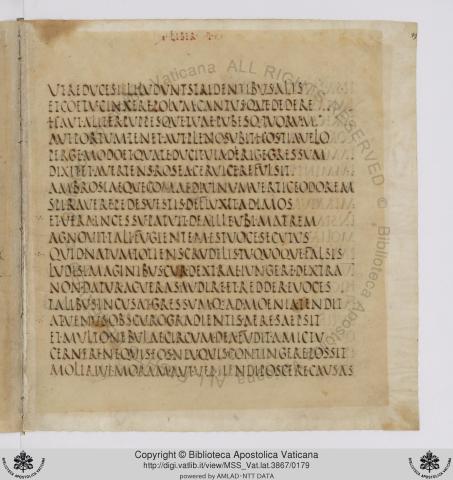
Dīxit et āvertēns roseā cervīce refulsit,
ambrosiaeque comae dīvīnum vertice odōrem
spīrāvēre; pedēs vestis dēflūxit ad īmōs,
et vēra incessū patuit dea. Ille ubi mātrem405
agnōvit tālī fugientem est vōce secūtus:
'Quid nātum totiēns, crūdēlis tū quoque, falsīs
lūdis imāginibus? Cūr dextrae iungere dextram
nōn datur ac vērās audīre et reddere vōcēs?'
Tālibus incūsat gressumque ad moenia tendit.410
At Venus obscūrō gradientēs āëre saepsit,
et multō nebulae circum dea fūdit amictū,
cernere nē quis eōs neu quis contingere posset
mōlīrīve moram aut veniendī poscere causās.
Ipsa Paphum sublīmis abit sēdēsque revīsit415
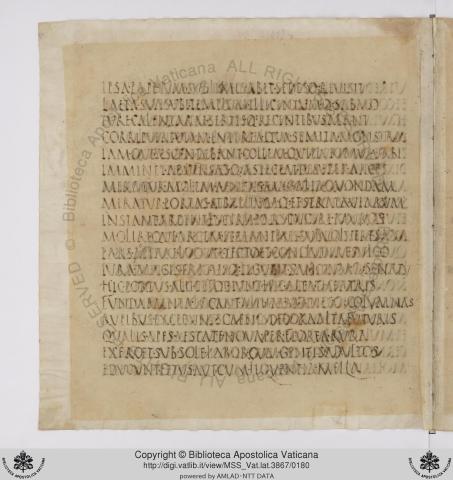
laeta suās, ubi templum illī, centumque Sabaeō
tūre calent ārae sertīsque recentibus hālant.
notes
Manuscripts: M 402-407, 408-417 | P 402-414, 415-417 | R 402-414, 415-417 | G
Venus reveals herself in all her beauty and majesty: she hides Aeneas and Achates in a cloud of mist, and floats away to Paphos, happily (Austin).
"In the previous scene, Aeneas met and talked with Venus, who was disguised as a huntress, in a grove outside Carthage (media … silva, 314), in territory Aeneas had thought entirely uninhabited..."
- read full essay by Meghan Reedy
-
[click here to open in new tab]
In the previous scene, Aeneas met and talked with Venus, who was disguised as a huntress, in a grove outside Carthage (media … silva, 314), in territory Aeneas had thought entirely uninhabited (inculta videt, hominesne feraene, 308). The next significant scene, when Aeneas eventually meets Dido, happens in another grove – a grove in the very center of the city of Carthage, lucus in urbe fuit media, laetissimus umbra … (441).
In between, we find these 38 lines, during which the shift of scene happens: Venus and Aeneas part ways, and Aeneas moves quickly from grove to grove … through Carthage.
He makes it through, from outside the city to its very center, without interacting with anyone at all because of a device: Venus wraps him in a cloud that renders him invisible and untouchable. She does so in 411–14: Venus obscuro gradientes aere saepsit, et multo nebulae circum dea fudit amictu, cernere ne quis eos, neu quis contingere posset …; and just before he steps into the grove (441), we are reminded of it, in similar terms, in 439–40: Infert se saeptus nebula … per medios, miscetque viris neque cernitur illi.
Both times the cloud is mentioned, the emphasis falls on how it prevents other people from seeing Aeneas and his companions: cernere ne quis eos, 413; neque cernitur illi, 440. It goes unstated, but starting in 420, aspectat … arces, it is abundantly clear that Aeneas is wrapped in a one-way fog; other people may not be able to see him, but he can see them and their city just fine. The one, tiny hint of this is the repetition of moliri: in 414, Venus intends that no-one will be able to “build a delay” for her Trojans, neue quis … molirive moram, and in 424 we see that indeed they do not look up from their work “building a citadel,” moliri arcem. The cloud thus has not one but two benefits: it protects Aeneas (which was Venus’ stated aim), but it also allows him, and so us, to get a first glimpse of Carthage without having to interact with anybody in it.
In fact, Aeneas doesn’t just look at the city, he marvels at it: miratur … Aeneas …/ miratur… (421–22). He marvels at how big it is, miratur molem, and how it used to be just an encampment of huts, magalia quondam (421). He marvels at the gates and at the bustle and the paving of the roadways, miratur portas strepitumque et strata viarum (422). As the description of what he sees and marvels at continues, we hear of other fine features of the city: walls, a citadel, housing sites, ports and theatres and columns (muros … arcem … locum tecto … portus … theatris … columnas, 423–29). But starting in 423, the buildings themselves are almost incidental, because what catches his attention most fully is the vigor and the variety of the work the Tyrians are doing: instant ardentes Tyrii (423). Indeed, what strikes him is not only the abundant building work, but also the legislation of the city: iura magistratusque legunt sanctumque senatum (426).
So the cloud has not one but two straightforward functions thus far: to hide Aeneas from the Carthaginians, and at the same time to give him a good view of both the city of Carthage and Carthaginians at work on it.
However, shortly before Venus floods the cloak of cloud around them (nebulae dea fudit amictu, 412), there is a peculiar moment that might nudge us into looking more closely at this cloud business. When Venus met Aeneas in the wood, she was in disguise, sporting the face and outfit of a young woman out hunting—a Spartan or a Thracian, virginis os habitumque gerens, et virginis arma Spartanae, vel qualis … Threissa (315–16). She maintained her disguise for the whole time the two were talking, and then, just as she turns away, she drops it: dixit, et avertens … vera incessu patuit dea (402–5). When Aeneas recognizes her, his mother, he speaks to her as she walks off: Ille ubi matrem adgnovit, tali fugientem est voce secutus (405–6). He is irritated and accusing (incusat, 410); he calls her cruel, crudelis tu quoque, and he asks her two questions, both concerned with true and false appearances: Quid natum totiens … falsis ludis imaginibus? Cur … veras audire et reddere voces? (407–8).
Aeneas’ questions call our attention to the fact that Venus has been in disguise, playing with him, tricking him using false images—and also to the way that almost as soon as she reveals herself, she turns around and disguises him with a fake outfit, a cloak of fog, nebulae … amictu.
Therefore, this shift of scene, with its simple-seeming cloud-trick to get our hero from one grove to the next, and from one powerful woman (Venus) to the next (Dido), has also prepared us to be alert to deceptive surfaces. We will see Aeneas interacting in the very next scene with still more images: … atque animum pictura pascit inani … (464); and we will see him see his own friends, and Dido, while he himself is still disguised as a cloud (494–519); then later, Venus tricking Dido (using a fake face and fake words, for example in 709–10 (Iulum flagrantisque dei vultus simulataque verba). Is Aeneas right about Venus? Is she cruel? Is he?
Further Reading
Greenwood, M.A. “Venus Intervenes: Five Episodes in the Aeneid.” Liverpool Classical Monthly 14 (1989) 132–6.
Khan, H. Akbar “Venus’ intervention in the Dido-affair: Controversies and considerations.” In Studies in Latin Literature and Roman History 11. Collection Latomus 272, ed. C. Deroux (Brussels, 2003) 244–74.
Reckford, K.J. “Recognizing Venus I: Aeneas Meets his Mother.” Arion 3 (1995–6) 1–42.
West, D. “Multiple-correspondence Similes in the Aeneid.” Journal of Roman Studies 59 (1969) 40–9.
402: avertens: intransitive (F-B). Supply se (Frieze). cervice: ablative of specification (Chase) (AG 418). refulsit: “flashed back.” (F-B). Expresses the “sudden blaze of majesty” (Storr).
403: ambrosiae: Ambrosia was the food of the gods, as nectar was their drink. In an extended sense it refers to the unguent with which the immortals anoint themselves (Storr). Ambrosiae implies both divinity and the mysterious fragrance associated with it, expressed and explained in divinum odorem (Austin). vertice: “from her head” (Frieze) (AG 403.1).
404: vestis defluxit: her dress had been girded up like that of a huntress, but now suddenly fell in folds around her person (Frieze).
405: et vera incessu patuit dea: “and in her tread was revealed, a very goddess.” (F-B). patuit: used in a kind of passive sense, “was manifest a goddess” (G-K). dea: dea is a predicate nominative (F-B). The gods glided along with very easy motion (Walpole). dea. Ille: the hiatus is justified by the full stop (Storr). Ille: i.e., Aeneas (Robertson).
406: est…secutus: supply eam (Robertson).
407: quid: adverbial “why?” (Robertson). totiens: must be taken somewhat laxly, as Venus had appeared to Aeneas only once before (Walpole). tu quoque: i.e., as well as Juno and other gods (F-B). falsis imaginibus: “with vain phantoms” (F-B).
408: dextrae: sc. manui (Carter). iungere and miscere are followed by the dative, by the ablative with cum, or by the ablative without a preposition (Frieze). dextram: sc. manum (Chase).
409: datur: it is permitted, allowed, granted, + infinitive (L-S s.v. do II.B.2). veras voces: “words without disguise” (F-B).
410: talibus: sc. verbis (F-B). incusat: sc. eam (Walpole). moenia: the walls of Carthage, of which Venus has just spoken (Frieze).
411: obscuro aëre: “with a mist” (F-B). gradientes: sc. eos (Walpole). Plural, because Achates is with Aeneas (F-B).
412: et multo...amictu: “and enveloped them, goddess as she was, in a thick mantle of cloud.” circum is separated from fudit by tmesis. Dea, which is in apposition with Venus, acquires special emphasis from its position with the verb. The line repeats and emphasizes the sense of the proceeding line (F-B).
413: eos: the pronoun is is rare in elevated poetry (F-B). neu: for neve, “or lest” (Frieze). contingere: “touch,” “lay hands on” (Knapp).
414: moliri: “to contrive”: used of operations which require great labor and preparation (Chase). moliri for facere, probably because of the alliteration (moliri … moram) (F-B). poscere: = quaerere (Carter).
415: ipsa: “she herself,” i.e., Venus (Robertson). Contrasted with Aeneas (Frieze). Paphum: acc. of place to which after abit (Robertson) (AG 427). Paphos was a city in Cyprus, famous for its cult of Venus (F-B) [add image]. sublimis: “aloft,” like an adverb (F-B). An adv., “through the air” (Knapp). sedes: “shrines” (Carter).
416: laeta: no longer tristis (see 228) since the interview with Jupiter (Frieze). Glad not only on account of her return to her loved home, but of her task fulfilled (Storr). templum illi: sc. est (F-B). illi: dative of possession (Carter) (AG 373).
416–417: Sabaeo ture: this is the “incense from Sheba” to which there are numerous Biblical references (F-B). The Sabaeans were a people of Arabia (Walpole).
417: ture: no victims were slain at the shrines of Venus; she was worshiped with incense and flowers (Frieze). halant: “are fragrant with” (Carter).
vocabulary
āvertō, vertī, versus, 3, a.: to turn (anything) away from, followed by an abl. with or without a prep., 1.38, et al.; turn or drive away, 1.472, et al.; transfer, with acc. of place, 4.106; drive away, end, 4.547; neut. by omission of se, to turn away, 1.402; (pass.), avertī, as middle or dep., with acc., to be averse to; to shun, loathe.
roseus, a, um: adj. (rosa), pertaining to roses; rose-colored; rosy, 1.402.
cervīx, īcis, f.: the neck, including the back or nape of the neck, 1.477, et al.
refulgeō, fulsī, fulsus, 2, n.: to flash back; shine forth, flash, be radiant, 1.402; glitter, glisten, 6.204.
ambrosius, a, um: adj. (ambrosia), ambrosial, heavenly, divine, 1.403.
dīvīnus, a, um: adj. (dīvus), relating to the gods; heaven-descended, divine, 5.47; heavenly, 1.403; inspired, prophetic, 3.373.
vertex, icis, m.: a whirl; whirlpool, 7.567; vortex, 1.117; whirling column of flame, 12.673; the top, crown of the head, the head, 1.403; summit, top, 1.163; mountain summit, height, 3.679; ā vertice, from on high, from above, 1.114. (vertō)
odor, ōris, m.: scent, smell, odor, fragrance, 1.403; disagreeable odor, stench, 3.228; foul fumes, 12.591.
spīrō, āvī, ātus, 1, n. and a.: to breathe, blow, 5.844; palpitate, 4.64; pant; breathe heavily, 7.510; heave, boil, 10.291; of odors, breathe forth, exhale, emit; w. acc., 1.404; p., spīrāns, antis, lifelike, breathing, 6.847.
dēfluō, fluxī, fluxus, 3, n.: to flow down; sail down, 8.549; alight, descend, 11.501; fall, descend, 1.404.
incessus, ūs, m.: a walking or advancing; a manner of walking; walk, gait, 1.405. (incēdō)
adgnoscō, nōvī, nitus, 3, a.: to recognize, 1.470.
totiēns (totiēs): num. adj. (tot), so many times, so often, 1.407, et al.
crūdēlis, e: adj. (crūdus), unfeeling, ruthless, cruel, inhuman, 2.124; relentless, 1.547; unnatural, 6.24; mortal, deadly, 2.561; bloody, 1.355; bitter, 1.361.
lūdō, lūsī, lūsus, 3, n. and a.: to play, frolic, sport, 1.397, et al.; play with dice, 9.336; make sport of, mock, delude, deceive, 1.352; make one's sport, 11.427.
atque, or ac: (conj.), and in addition, or and besides; and, as well, and indeed, and, 1.575; freq.; even, 2.626; in comparisons, as, 4.90; than, 3.561.
incūsō, āvī, ātus, 1, a.: to bring a cause or case against any one; to accuse, reproach, blame, 2.745; without object, upbraid, complain, 1.410. (1. in and causa)
gressus, ūs, m.: a stepping; step, walk, course, way, 1.401; of a ship, 5.162; air, mien, gait, 5.649; ferre gressum, to walk, 6.677; efferre gressum, to go forth or out, 2.753; comprimere gressum, to stop, stay one’s steps, 6.389. (gradior)
Venus, eris, f.: Venus, goddess of love and beauty, identified by the Romans with Aphrodite, daughter of Jupiter and Dione, 1.411, et al.; (meton.), love, lust, 6.26.
obscūrus, a, um: (adj.), dim, dark, dusky, obscure, 1.411; uncertain; of persons, unseen, 2.135; in the darkness, 6.268; pl., obscūra, ōrum, dim places; obscurity, uncertainty, 6.100.
gradior, gressus sum, 3, dep. n.: to step, walk, go, 1.312; move, advance, 10.572.
saepiō, saepsī, saeptus, 4, a.: to fence in; inclose, surround, 1.506; envelop, 1.411. (saepēs, inclosure)
nebula, ae, f.: a cloud, 10.82; mist, fog, 1.412.
circumfundō, fūdī, fūsus, 3, a.: to pour around; to encompass, surround; (pass.), circumfundor, fūsus sum, (in middle signif.), to rush around, surround, 2.383; p., circumfūsus, a, um, surrounding, 1.586; gathering around, 6.666.
amictus, ūs, m.: a veiling or draping of the person; an upper garment, covering; cloak, mantle, veil, 3.405; 5.421. (amiciō)
quis, qua or quae, quid or quod: (indef. pron., adj., and subst.), any, some, 2.94, et al.; some one, any one, any body, anything, something, 1.413, et al.; sī quis, nē quis, etc., if any, lest any, etc., freq.; (adv.), quid, as to anything, in anything, at all, freq.; sī quid, if at all, freq.
nēve or neu: (conj.), or not, and not, nor, neither, w. subj. or imperat., 7.202; ne — neu (nēve), that not — nor, lest — or lest, 2.188.
possum, potuī, posse, irreg. n.: to be able; can, 1.242, et al.; to avail, have influence, power, 4.382. (potis and sum)
mōlior, ītus sum, 4, dep. a. and n.: to pile up; build, erect, construct, 1.424; plan, undertake, attempt, 2.109; pursue, 6.477; cleave, 10.477; contrive, devise, 1.564; occasion, 1.414; prepare, equip, 4.309; arrange, adjust, 12.327; of missiles, discharge, hurl, 10.131. (mōlēs)
veniō, vēnī, ventus: to come, freq.; come forth; approach, 6.755; rise, appear, 1.353; dawn, 10.241; to present one's self or itself, 5.344; descend, spring from, 5.373; impers., ventum est, we, they came or have come, 4.151.
Paphos (-us), ī, f.: Paphos, a town in the western part of Cyprus, devoted to the worship of Venus, 1.415.
sublīmis, e: (adj.), raised up, elevated, uplifted, 11.602; aloft; on high, 1.259; through the air, 1.415; on high, 6.720; to heaven, 5.255; of lofty soul, 12.788; (adv.), sublīme, loftily, aloft, on high, 10.664.
abeō, īvī, or iī, itus, īre, irreg. n.: to go away, depart, 2.675; go off, go aside, turn off, 5.162; pass into, sink into, 9.700; go forward, take the lead, 5.318; retreat, 2.382; change or be transformed.
revīsō, 3, a. and n.: to look at again; visit again, return to see; return to, 2.760; revisit, 3.318.
Sabaeus, a, um: adj. (Saba), Sabaean, Arabian, 1.416; pl., Sabaeī, ōrum, m., the Sabaeans or people of Arabia Felix.
tūs, tūris, n.: incense, 1.417, et al.
caleō, uī, 2, n.: to be warm; to glow, 1.417.
serta, ōrum, n.: things entwined; garlands, festoons, wreaths, 1.417, et al. (sero, serere, serui, sertus)
hālō, āvī, ātus, 1, a. and n.: to breathe; exhale or emit odor; be fragrant or redolent, 1.417.