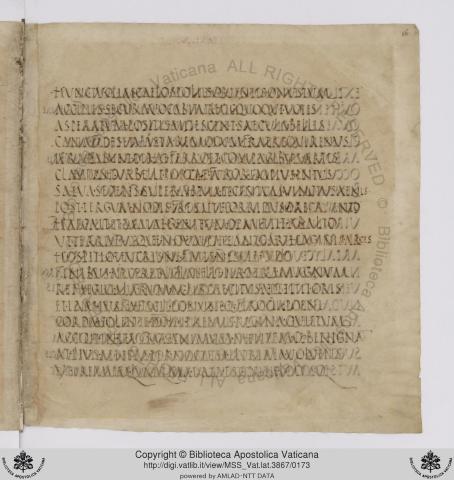
Haec ait et Māiā genitum dēmittit ab altō,
ut terrae utque novae pateant Karthāginis arcēs
hospitiō Teucrīs, nē fātī nescia Dīdō
fīnibus arcēret. Volat ille per āëra magnum300
rēmigiō ālārum ac Libyae citus astitit ōrīs.
et iam iussa facit, pōnuntque ferōcia Poenī
corda volente deō; in prīmīs rēgīna quiētum
accipit in Teucrōs animum mentemque benignam.
notes
Manscripts: M | P 297-299, 300-304 | R
Iuppiter sends Mercury to Carthage, to ensure that Dido shall treat the Trojans kindly (Austin).
"Almost immediately we are invited to see Dido and Aeneas together—to compare and contrast them—but we are also made aware, immediately, that however similar they may seem at times, they are not on equal footing..."
- read full essay by Meghan Reedy
-
[click here to open in new tab]
After Jupiter explains to Venus at some length the future of the Roman people for several hundred years to come (257–96), the one thing he does as soon as he finishes speaking (hic ait et …, 297) is send Mercury to Carthage to ensure that Dido will be nice to Aeneas (297–300). His doing this suggests that all of that long Roman future depends, somehow, on this Dido. Almost immediately we are invited to see Dido and Aeneas together—to compare and contrast them—but we are also made aware, immediately, that however similar they may seem at times, they are not on equal footing.
The imbalance between them is evident in Jupiter’s reason for sending Mercury to Carthage at all (297–300):
… Maia genitum demittit ab alto,
ut terrae, utque novae pateant Karthaginis arces
hospitio Teucris, ne fati nescia Dido
finibus arceret …
Jupiter sends Mercury for a positive purpose: in order that the Trojans be given aid and hospitality after their shipwreck (ut terrae … pateant hospitio Teucris), but also for a negative purpose: lest Dido keep them away from her borders (ne … Dido finibus arceret). Dido is a potential obstacle in the forward trajectory of the Romans-to-be.
Once Mercury has done his job (iam iussa facit, 302), we’re given a two-fold piece of information about the Phoenicians and about Dido, who is their queen and first among them (in primis regina …, 303): ponuntque ferocia Poeni corda volente deo (302–3). On the one hand, the Phoenicians (and thus Dido) have savage, fierce, ferocious hearts, ferocia corda; but on the other hand, for now, because Jupiter wants it so, they have set these ferocious hearts aside, ponunt … volente deo. So, we are informed of both a default setting, as it were, of hostility and fierceness, and of a temporary, god-induced, friendliness.
Shortly hereafter, when Venus visits Aeneas, we are invited to envision Dido and Aeneas together, and to compare them. First, we learn much more about Dido: we hear Venus, in disguise, explain to Aeneas who she is and how she came to be queen of Carthage (335–70). Then, when we hear Aeneas explain to Venus who he is and how he arrived in Libya (372–85), we also learn more about him.
Venus’ telling of Dido’s story involves three main characters: Dido, her husband Sychaeus, and her brother Pygmalion. The main events are Dido’s marriage to Sychaeus (343–45), Pygmalion’s murder of Sychaeus (346–49), and then, after Pygmalion has hidden his crime from her (350–52) and the ghost of Sychaeus has revealed it to her in a dream (353–56), Dido’s flight from Tyre with some companions and the founding of Carthage.
However, the plot is not, in a way, the main thing. More telling, and more significant for the narrative to come in Book 4, is the way these characters are described: their motivations, their feelings, the things they take with them. In this narrative, Dido, Sychaeus and Pygmalion are naturally differentiated: in particular Pygmalion is evil (scelere ante alios immanior omnes, 347; impius, 349), and Sychaeus and Dido are both his victims. He kills Sychaeus (Sychaeo … ferro incautum superat, 348–50) and deceives Dido (multa malus simulans, … lusit, 351–52). Our sympathy thus rests, naturally, with Dido as she finally escapes. Still, even this characterization is secondary. The two things most consistently emphasized throughout the narrative, regarding all three characters, are love and money.
Venus describes Sychaeus in terms of each one. Love first: he is the spouse of Dido, huic coniunx Sychaeus erat (343), and he is deeply loved by her, magno miserae dilectus amore (344). Money second: he is also the richest Phoenician, … Sychaeus erat, ditissimus auri Phoenicum (343–44). Later, when he appears to Dido as a ghost, he not only reveals to Dido how he was murdered by her brother—he also reveals to her a hidden treasury, recludit thesauros, ignotum argenti pondus et auri (358–59). Thus, when Dido leaves Tyre, she leaves in ships full of gold and other wealth, naves … onerantque auro: portantur … opes pleago (363–64). And a good thing too; upon arrival she buys land, mercati solum (367).
Dido is, of course, the misera who loves her husband so deeply in line 344. After her husband has been murdered, her brother exploits this love in order to conceal his crime. Pygmalion has no sympathy for her love, securus amorum germanae (350); he deceives her, the lover of Sychaeus, with vain hope, vana spe lusit amantem (352). Right away with miserae in 344 love’s potential to become lovesickness is introduced, and indeed while she is being deceived by Pygmalion, she is not just a lover, but sick, aegram (351).
Pygmalion’s evil is the result of love and money together: when he kills Sychaeus at the altar he is blinded by a love for money, auri caecus amore (349).
What about Aeneas and the Trojans?
Aeneas speaks briefly, and he omits the story of what drove him to leave (although he will tell it in Book 2, for all of Book 2), but what he does say is enough to indicate his motivations, his feelings, and the things he carries with him—and pietas is the single constant.
He introduces himself as sum pius Aeneas (378), and from the rest of what he says we begin to understand what being pius entails. He claims a reputation among the gods, fama super aethera notus. He drops in a mention that his mother is a goddess, and that she has pointed out the path to take, matre dea monstrante viam. He is following the fate he was given, data fata secutus (382). What he’s looking for is Italy—a home and a people from Jupiter himself, Italiam quaero patriam et genus ab Iove summo (380). And what does he take with him in his boat? His household gods: raptos … ex hoste Penates classe veho mecum (378–79).
As for material possessions, we hear only of losses. He started with twenty ships (bis denis … navibus, 381), but he is now down to seven (383). He is shut out of everywhere (Europa atque Asia pulsus, 385)—and destitute: Ipse … egens (384). However, this does not undermine his pietas; rather the reverse.
In sum, Dido is lovesick and rich, and Aeneas, on the other hand, is first and foremost pius (both here in his own phrase in 378 but also back in 305, and before that). But having noticed that Aeneas makes particular mention of following his fate, fata data secutus (382), perhaps we might now recall that Dido’s understanding of fate has also been mentioned—she has no understanding at all, fati nescia (299). Oh dear.
Further Reading
Feeney, D. The Gods in Epic: Poets and Critics of the Classical Tradition (Oxford: Oxford University Press 1991), pp. 182–4.
Greenwood, M.A. “Venus Intervenes: Five Episodes in the Aeneid.” Liverpool Classical Monthly no. 14 (1989): 132–6.
Harrison, E.L. “Why Did Venus Wear Boots? Some Reflections on Aeneid 1.314 f.” Proceedings of the Virgil Society no. 12 (1972–3): 10–25.
Horsfall, N. “Dido in the Light of History’ Proceedings of the Virgil Society no. 13 (1973–4): 1–13. Reprinted in Oxford Readings in Virgil’s Aeneid, ed. S.J. Harrison (Oxford: Oxford University Press 1990), pp. 127–44.
Khan, H. Akbar “Venus’ intervention in the Dido-affair: Controversies and Considerations.” In Studies in Latin Literature and Roman History 11. Collection Latomus 272, ed. C. Deroux (Brussels, 2003) 244–74
Reckford, K.J. “Recognising Venus I: Aeneas Meets his Mother.” Arion 3 (1995-6) 1–42.
297: Haec: = ita (Comstock). ait: sc. Iuppiter (Walpole). Maia genitum: abl. of origin (Wetherell) (AG 403.2a). The son of Maia, Mercury. Maia was one of the Pleiades, daughters of Atlas and Pleione (H-M). Mercury, messenger of the gods. (Wetherell) (Smith’s Dictionary, s.v. Hermes and Mercurius.
298-300: ut...pateant...ne...arceret: Pateant follows the tense of the vivid present demittit, while arceret is past, because ...arceret expresses not the direct object for which Mercury is sent, but the fear which was in Jupiter’s mind before he sent him at all (Page).
298: novae: with Karthaginis (P-H). Karthago or Carthage means “New town” (F-B).
299: hospitio Teucris: double dative (F-B) (AG 382.1). Both datives after pateant (Walpole). fati nescia: “ignorant of fate”; ignorant of the destiny of the Trojans, which decreed that they should settle in Italy, she might suppose they intended to make their abode in Africa, and, hence, repel them from her territories (Frieze). As Juno may interrupt the course of destiny, so too may Dido (F-B).
300: finibus: abl. of separation (Wetherell) (AG 401). arceret: sc. eos (Robertson). negative purpose after demittit (Carter). aëra: Gk. acc. of aër (Robertson) (AG 81.2).
301: remigio alarum: “by the oarage of wings.” Metaphors from the sea and ships are much more common in Greek than in Roman literature, and this one is first found in a Greek author (Aeschylus, Agamemnon 52) (F-B). oris: astare, “stand,” or “light upon,” takes either the ablative or dative (Frieze).
302: iussa facit: “executes the commands (of Jupiter).” Note the parataxis instead of a subordinate ut clause (F-B). ponuntque: often used in poetry for deponere (Frieze).
303: volente deo: “because the god wills it.” (Frieze). Abl. abs., “at the will of the god.” Mercury may here be meant, or the expression may apply to the gods generally (Robertson). in primis: “especially” (Carter).
304: in: “toward” (Carter). animum mentemque: “spirit and mind”; a poetical tautology (P-H).
vocabulary
Māia (dissyll.), ae, f.: one of the Pleiades or seven daughters of Atlas and Pleione, who became by Jupiter the mother of Mercury, 1.297.
dēmittō, mīsī, missus, 3, a.: to send down, 1.297; shed, 6.455; let down into, receive, admit, (of the mind or the senses), 4.428; consign, condemn, 2.85; convey, conduct, 5.29; transmit, hand down, 1.288; dēmittere mentem, to lose heart, sink into despair, 12.609.
altum, ī, n.: the deep; the lofty; the deep sea, the main, the deep, 1.3; the sky, heaven, air, 1.297; from far, far-fetched, remote, 8.395. (altus)
Karthāgō, inis, f.: a city built by Phoenician adventurers on the northern coast of Africa, opposite Sicily, a short distance N.E. of the modern Tunis, 1.13, et al. (Καρχηδών, new city)
hospitium, iī, n.: the relation of host and guest; hospitality, 10.460; friendly reception, entertainment; protection, hospitality, welcome, 1.299; guest-land, ally, 3.15; refuge, 1.540; alliance, 11.114. (hospes)
Teucrī, ōrum, m.: the Trojans, descendants of Teucer, 1.38, et al.; adj., Teucrian, Trojan, 9.779, et al. (Teucer)
nescius, a, um: adj. (nesciō), not knowing, unaware, ignorant, 1.299; that knows not how, that can not.
Dīdō, ūs or ōnis, f.: Dido, daughter of Belus, king of Phoenicia, who fled from her brother Pygmalion to Africa, where she founded the city of Carthage, 1.299.
arceō, uī, 2, a.: to inclose, shut in; restrain, bind, 2.406; debar, keep off, repel, 1.435; protect, save from, 8.73.
volō, āvī, ātus, 1, n.: to fly, 1.300, et al.; of rumor, to be spread rapidly, noised or spread abroad, 3.121.
rēmigium, iī, n.: a rowing; oarage, rowing movement, 1.301; body of rowers, oarsmen; a crew, 3.471; rēmigium ālārum = ālae, wings, 6.19. (rēmex)
āla, ae, f.: a wing, 1.301; the feather of an arrow, 9.578; the wing of an army; cavalry, 11.730; troop, battalion, 11.604; horsemen, mounted huntsmen, 4.121.
atque, or ac: (conj.), and in addition, or and besides; and, as well, and indeed, and, 1.575; freq.; even, 2.626; in comparisons, as, 4.90; than, 3.561.
Libya, ae, f.: Libya; northern Africa; by poetic license, Africa, 1.22, et al.
adstō, stitī, 1, n.: to stand at, near, or upon; alight, 1.301; stand, 9.677; be present, 3.150; stand or be ready, 3.123; impend, 3.194.
ōra, ae, f.: a margin, border, 12.924; coast, shore, 3.396; region, 2.91; rim, extremity, 10.477; pl., outline, compass, 9.528.
iussum, ī, n.: a thing ordered; command, injunction, order, 1.77, et al. (iubeō)
ferōx, ōcis: adj. (ferus), wild; impetuous; ferocious, fiery, fierce, 5.277; warlike, martial; proud, 12.895.
Poenī, ōrum, m.: the Carthaginians, 1.302; Africans, 12.4.
imprīmīs: (adv.), especially, chiefly, 1.303.
rēgīna, ae, f.: a queen, 1.9; princess, 1.273. (rēx)
quiēscō, quiēvī, quiētus, 3, n.: to rest, 7.6; repose, rest in death, 1.249; be hushed, still, quiet, 4.523; cease from action, 5.784; lie, 10.836; p., quiētus, a, um, at rest, quiet, 5.848; still, calm, tranquil, 5.216; peaceful, in repose, 4.379; gentle, friendly, 1.303. (quiēs)
benīgnus, a, um: (adj.), of a kindly spirit; benevolent, friendly, favorable, hospitable, 1.304.