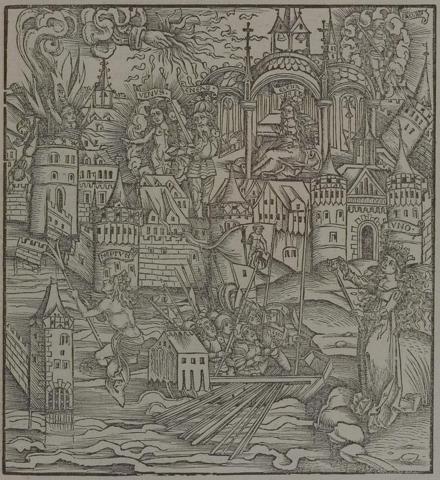
Iamque adeō super ūnus eram, cum līmina Vestae
servantem et tacitam sēcrētā in sēde latentem
Tyndarida aspiciō; dant clāram incendia lūcem
errantī passimque oculōs per cūncta ferentī.570
Illa sibi īnfestōs ēversa ob Pergama Teucrōs
et Danaüm poenam et dēsertī coniugis īrās
praemetuēns, Trōiae et patriae commūnis Erīnys,
abdiderat sēsē atque ārīs invīsa sedēbat.
Exārsēre ignēs animō; subit īra cadentem575
ulcīscī patriam et scelerātās sūmere poenās.
'Scīlicet haec Spartam incolumis patriāsque Mycēnās
aspiciet, partōque ībit rēgīna triumphō?
coniugiumque domumque patrēs nātōsque vidēbit
Īliadum turbā et Phrygiīs comitāta ministrīs?580
Occiderit ferrō Priamus? Trōia ārserit ignī?
Dardanium totiēns sūdārit sanguine lītus?
Nōn ita. namque etsī nūllum memorābile nōmen
fēmineā in poenā est, habet haec victōria laudem;
exstīnxisse nefās tamen et sūmpsisse merentēs585
laudābor poenās, animumque explēsse iuvābit
ultrīcis flammae et cinerēs satiāsse meōrum.'
notes
I chanced to see Helen hiding at the entrance of the temple of Vesta, where she had taken refuge fearing the wrath both of the Trojans and the Greeks. A passionate desire came over me to slay her as I thought of her returning in queenly state to Sparta while my country lay in ashes. “Surely,” I was saying to myself, “vengeance demands that I should kill even a woman” (Page).
These lines are absent from all the best MSS. Servius tells us that they were struck out by Tucca and Varius, the editors of the Aeneid, probably because Vergil himself had struck his pen through them, meaning to re-cast them. They are thoroughly Vergilian, and without them the transition is extremely abrupt. But perhaps the strongest argument for retaining them is the obvious reference to them in the speech of Venus which follows (594–601) (Storr). Aeneas could hardly see Helen from the roof, and does not descend until 632. On the other hand the passage is very fine and thoroughly Vergilian: and perhaps Vergil wrote it before the second book had assumed its present shape. If Vergil did not write it, who did? (Sidgwick). In my opinion this is a first attempt, lacking the final revisions of the poet, and for this reason it was set aside by Vergil himself, or omitted by his editor Varius; it clearly exhibits the form and many features of Vergil’s style, and it is so coherent with the narrative as a whole that it seems to be the product of one and the same conception (Conte).
"Reading or hearing or watching a story is a little bit like snorkeling: you put your face into the water, and as long as you keep it there you can see all the fish swimming about..."
- read full essay by Meghan Reedy
-
[click here to open in new tab]
Reading or hearing or watching a story is a little bit like snorkeling: you put your face into the water, and as long as you keep it there you can see all the fish swimming about. You enter the fishes’ world and expect the fish to act according to the underwater rules of fishes – of these particular fishes in this particular reef that you’re watching, amid the problems and perils and excitements that these particular waters bring.
But every now and then, something happens that makes you lift your head up and look at the fishes’ world from the outside; you look at the surface of the water, look at the larger contours of the coastline and the continental shelf.
The ‘Helen episode’ is an excellent place for us to look, find our bearings, and make sure we can get back to the beach. Page’s note on the text of ‘the Helen Episode’ encapsulates a representative range of the issues scholars wrestle with regarding this passage. His note reads as follows:
‘Lines 567-588 are found in very few good MSS., and are said by Servius to have been written by Vergil but omitted by Varius and Tucca, his literary executors, when editing the Aeneid after his death. It is an objection to them that a different account is given of Helen’s action (vi. 511–527), where she is described as guiding the Greeks, but in an unfinished and unrevised poem, in which incidents are borrowed from many sources, such discrepancies are natural. The question of style depends much on individual judgment, but Fox (quoted by Henry 2.277) justly says, “If the lines are spurious they are the happiest imitation of Vergil I ever saw.” Moreover in the speech of Venus (594) seems a clear reference to 575, and 601 to the description of Helen, and to be difficult of explanation if this passage be struck out,’ (Page).
But what does all that mean, and what difference does it make?
The first part of the note is what pulls us up:
‘Lines 567–588 are found in very few good MSS. (manuscripts), and are said by Servius to have been written by Vergil but omitted by Varius and Tucca, his literary executors, when editing the Aeneid after his death.’
The vast majority of the notes included in this commentary, as in most commentaries, focus attention on tricky grammatical structures, or odd meanings of words, or especially intricate layers of meaning. However, this note focuses our attention instead on whether or not the text of the passage we are about to read even belongs here. Therefore, even before we get to the short, disconcerting answer––which is that the Helen Episode in fact doesn’t belong here––we are being told that as we read this episode, we should be careful to wonder whether this part really fits.
Like all ancient texts, the text of Vergil’s Aeneid was transmitted in handwritten manuscripts, copied and re-copied by hand. There are thus very many opportunities for errors small and large to find their way into the text, not unlike the errors introduced in the whisper-passing game ‘telephone’. The business of textual critics (like Goold, Murgia, and Rowell, in the ‘Further Reading’ below) is to track down how the texts we read got here – and all the evidence they find indicates strongly that this passage is a forgery, written after Virgil’s death.
But what kind of evidence can show such a thing? Given that manuscripts are copied from prior manuscripts, hunting down the oldest manuscripts can be helpful. In this case, even though Virgil’s texts were all copied unusually frequently, none of the oldest manuscripts of the Aeneid contain this text at all. Another help that scholars use in the case of Vergil’s work is quotations of his text made by ancient scholars of Latin language and literature (usually referred to as ‘grammarians’). Regarding the whole of Aeneid Book 2, George Goold has counted up which lines are and aren’t quoted by at least one of these scholars, and what he found is this: ‘For the portion under scrutiny it emerges that … the largest unattested [unquoted] portion is of three lines (607–9), the largest doubly unattested portion of six (604–6). Except, of course, for the Helen Episode,’ (Goold, 163–65). Not a single one of these ancient scholars, who quoted or commented on virtually every line of Vergil, mentions lines 567–588.
These two things together––that the lines appear neither in the oldest manuscripts nor in the comments of the ancient grammarians––very strongly suggest that Vergil did not write this passage. It shouldn’t be here. Which is to say, cut it out and read around it.
But, you may well ask, if it shouldn’t be here why is it here? The remainder of Page’s note suggests a variety of answers to this question.
When Page touches on Servius’ report about Varius and Tucca, he is passing along a mechanical answer, so to speak. Servius was a scholar and teacher in the 4th Century CE who wrote commentaries on all of Vergil’s work––and because he included mention of these lines and this story about Varius and Tucca as justification, he became the mechanism by which subsequent texts started to include the forged lines. Servius claims a certain authority, and it seems to have been easy to believe that Servius was telling the truth, even though what he says is often problematic, even though the likelihood of this passage being Vergil’s is vanishingly small for all sorts of reasons, even though only Varius did the editing, and even though he seemed unwilling to omit much of anything. Indeed, it seems that Page is inclined to believe Servius.
Thus, the first-tier answer to the question of why the Helen Episode is there is that someone who seems like an authority said it should be.
However, there is more. Noticing and exploring how a given text works, how its elements come together, what the layers of a poet’s meaning might be––this sort of thing is the business of literary critics, and they too sometimes spot problems in a text. Literary critics (like Austin, Egan, Harrison, and Reckford in the ‘Further Reading’ below) all notice elements in this episode that are problematic––narrative inconsistencies, syntactical problems, turns of phrase that don’t sound like Vergil. However, they also try to work around the difficulties by finding ways in which the Helen episode can be thought of as fitting in. Page himself does the same.
He raises three issues:
He notes but forgives these lines’ inconsistency with Vergil’s other mention of Helen: ‘It is an objection to them that a different account is given of Helen’s action (vi. 511–527), where she is described as guiding the Greeks, but in an unfinished and unrevised poem, in which incidents are borrowed from many sources, such discrepancies are natural.’
(Yet, the discrepancy is substantial: in Book 2 she is tucked up in the citadel, hiding; in Book 6 she is providing active assistance to the invading Greeks, helping them out of the horse and getting them torches.)
He mentions style: ‘The question of style depends much on individual judgment, but Fox (quoted by Henry 2.277) justly says, “If the lines are spurious they are the happiest imitation of Vergil I ever saw.”’
(Yet, many aspects of Latin style have been carefully quantified. Goold (155–56) cites Austin’s substantial list of the instances of non-Vergilian Latin style––but among them is one which you can search out for yourself: ‘repetitive vocabulary and expression.’ How many words and constructions repeat in this Episode? How many repeat in the 20 lines before it, or after it?)
Lastly, Page points out two elements in the surrounding lines that seem to anchor the passage in its local context: ‘Moreover in the speech of Venus (594) seems a clear reference to 575, and 601 to the description of Helen, and to be difficult of explanation if this passage be struck out.’
(Even though the reference is fleeting and embedded in more significant concerns more appropriate to the scale of Venus’ intervention here.)
In short, the passage is also still here because people seem to like it here. The Helen Episode is a late addition, a forgery––a concrete pseudo-boulder stuck in among the rocks and coral––but the fishes swim around it so beautifully; it fits in so well, so perhaps it’s okay there even if the texture is a little off. Besides, now that so many people have seen it there, how can you really fully remove it? How do you un-read Helen, even if you should?
Further Reading
Egan, R.B. ‘A reading of the Helen-Venus episode in Aeneid 2’ Echos du monde classique 40 (1996) 379-95
Goold, G.P. ‘Servius and the Helen Episode’ Harvard Studies in classical Philology 74 (1970) 101-68
Harrison, E.L. ‘Divine action in Aeneid, book two’ Phoenix 24 (1970) 320-32, reprinted in Oxford Readings in Vergil’s Aeneid, ed S.J. Harrison (Oxford, 1990) 46-59
Murgia, C. ‘More on the Helen episode’ Classical Antiquity 4 (1971) 203-17
Murgia, C. ‘The date of the Helen episode’ Harvard Studies in Classical Philology 101 (2003) 405-26
Reckford, K.J. ‘Helen in Aeneid II and VI’ Arethusa 14 (1981) 85-99
Rowell, H.T. ‘The ancient evidence of the Helen episode in Aeneid II’ in the Classical Tradition: Literary and Historical Studies in Honor of Harry Caplan, ed. L. Wallach (Ithaca, NY, 1966) 210-21
567: iamque adeō: “and so now,” barely enclitic (Sidgwick); “now at last” (Howson); “and just at this moment” (G-K). super ūnus eram: super…eram is tmesis (AG 640) for supereram, “I alone survived” (Pharr).
567–568: līmina Vestae servantem: “lurking in the entrance of Vesta’s temple” (Comstock); “keeping close to,” for the sake of sanctuary (G-K). Servantem, i.e., “keeping” in the sense of close uninterrupted abiding, rather than of protecting (Carter).
568: Notice the accumulation: tacitam, sēcrētā, latentem, all emphasizing the idea—“silent, hiding in the dark recess” (Sidgwick). Take tacitam as an adverb, “silently” (Carter).
569: Tyndarida: = Helenam, a feminine patronymic (AG 244), Greek accusative form (AG 81) of Tyndaris, “daughter of Tyndarus” (Pharr). According to others, Helen was the daughter of Leda and Jupiter (Storr). Paris carried her off from her husband Menelaus king of Sparta (or joint king of Argos), the cause of the Trojan War (Sidgwick). dant clāram incendia lūcem: explains why Aeneas could see Helen (Pharr). The light of the burning city shone into the temple and rendered her visible in her hiding place (Carter).
570: errantī: supply mihi (Pharr). As Aeneas only descends at line 632 we must suppose him still on the roof: it is on the roof that he is “wandering and casting his glance everywhere over all things” in vague uncertainty what to do, when he sees Helen (Page). passim oculōs…ferentī: “as I cast my glance hither and thither” (Comstock). Now that he is hastening home, Aeneas is anxious to escape the Greeks (Carter).
571: illa: Helen; “she, fearing for herself the Trojans who were hostile to her on account of the overthrow of Troy” (H-H). sibi…praemetuēns: the rare word praemetuō, “forecasting in her fear” (G-K); “fear anticipating the consequences” (Conington); “dreading,” i.e., in advance (G-K), suggests two ideas, (1) fear of a thing, here of “the hostile Trojans etc.” (2) a desire to take precautions against the evil anticipated (in which case it takes a dative of the person on whose behalf the “cautious fear” is shown). Here it has both constructions, for sibi does not go with infestōs but with praemetuēns, its position being due to the Latin tendency to bring pronouns together—“she in cautious fear for herself, yes, fearing the hatred of the Trojans…” (Page). ēversa Pergama: “Troy’s overthrow” (Comstock).
572: Danaum: = Dana[ōr]um by syncope; subjective genitive (AG 348) with poenam (Pharr), i.e., punishment “inflicted by the Greeks” (Sidgwick). dēsertī coniugis: = Menelaī; subjective genitive (AG 348) with īrās. Menelaus hesitated at first whether to kill Helen with his own hand; but her old fascination prevailed, and later she appears in the Odyssey in full honor as his queen (G-K).
573: Erīnys: “curse,” “scourge” (Comstock), lit. one of the Erinyes.
574: ārīs: supply in, ablative of place where (AG 421) (Pharr); i.e., on the steps of the altar (Carter). invīsa: this word may either be (1) the participle of invideō, “she was crouching, a hateful [being],” or (2) from in- and vīsus—“she was crouching [so as to be] unseen.” (The word is so used by Caesar and Cato (Sidgwick)). Vergil’s use of the word in 601 and 647 as “hateful” is strongly in favor of the former meaning here: moreover it is very harsh to describe her as “sitting unseen” at the very moment she is discovered, whereas the description of her as “hateful” naturally precedes the outburst of hate described in the next line (Page).
575: exarsēre ignēs animō: “the fire [of anger] kindled in my soul” (Page). subit īra: supply mentem meam; “an angry longing prompts [me],” followed by the complementary infinitives (AG 456) ulcīscī and sūmere (Pharr), which may be taken in apposition with īra (Conington). Īra impies a “desire” for revenge (Sidgwick), “a wrathful impulse” (Comstock).
576: scelerātās sūmere poenās: “to take unholy vengeance” (Storr); “to exact” or “inflict the punishment for her crime.” Scelerātās poenās = sceleris poenās (Pharr). A strong instance of the transferred adjective: the “guilt” is transferred from the wicked woman to the vengeance: “exact the penalty of guilt” (Sidgwick). The punishment is called “accursed” because he was about to inflict it on one who was a suppliant at the altar, and a woman to boot (Carter).
577: scīlicet: lends a scornful (Sidgwick) and ironical tone (Carter): “doubtless,” “of course,” marking strongly the indignant bitterness of the words which follow. The sentence is really affirmative in form, and its interrogative character is imported to it by the tone in which it is uttered. Conington renders it “So she is to see Sparta again in safety?” (Page). The question particle is often omitted in rapid narration (Comstock). Spartam patriāsque Mycēnās: is here put for “Greece.” Vergil is fond of putting the particular for the general (Chase). Tyndarus, father of Helen, was king of Sparta till he resigned the throne to his son-in-law (Storr). According to Vergil’s usual version, Menelaus was king of Sparta, his brother Agamemnon king of Mycenae. This is the Homeric tale. Aeschylus makes Agamemnon and Menelaus both joint kings in Argos (Mycenae was close to Argos and is often confused with it). Here Vergil seems to mix the two tales (Sidgwick).
578: partō triumphō: ablative absolute (AG 419). Pario is frequently used with such expressions as: honōrem parere, laudem parere, decus parere, victōriam parere (Conington). ībit rēgīna: “she will march as a queen” (Storr); “she will go in queenly state,” i.e., not as a captive, like the other women of Troy (Howson).
579: coniugium: “wedlock” and so “her husband” (Page); abstract for concrete (Howson). domum: = familiam suam (Chase). patrēs: = parentēs suōs; apparently only Tyndarus the father of Helen was alive (Page). This line has been objected to for various trivial reasons: e.g. that Helena has only one child, Hermione; that coniugium is abstract; that patrēs has no -que, etc. But really it is perfectly natural, especially in the mouth of a foe, who cannot be expected to know the domestic history of Helena (Sidgwick). According to Euripides (Orestes 473) Tyndarus and Leda are represented as being alive after the death of Clytemnestra, but Homer (Odyssey 11.298) introduces Leda in the shades (H-H). nātōs: Homer gives her only one daughter, Hermione; Hesiod adds a son, Nicostratus.
580: turbā…comitāta ministrīs: ablatives of accompaniment (AG 413) with the participle comitāta, which, though deponent, here has a passive meaning, as often in poetry (Sidgwick); “attended by a throng and attendants” (Comstock). Īliadum: “of Trojan women” (Chase); the captive Trojan women would become her “attendants” (ministrīs) (Page).
581–582: occiderit, ārserit, sūdārit: the future perfect is often used to express indignation that an event spoken of as future should be realized (H-H). Translate as “Shall it be for this [i.e., that this result might follow] that Priam has fallen by the sword?” Wagner notices the balance of the three questions aspiciet? ībit? vidēbit? with the three questions occiderit? ārserit? sūdārit? and that they correspond to one another in inverse order: her home happy / my king murdered; she in triumph / Troy in flames; she safe at Sparta / the Dardan coast reeking with blood (Page).
582: totiēns: “so many times,” referring to the whole course of the war (Conington). sūdārit: = sūdāverit by syncope (Chase): “reeked” (Storr).
583: nōn ita: supply erit: “it shall not be!” (Pharr). nūllum memorābile nōmen: “no glory worth remembering” (G-K).
584: fēmineā in poenā: adjectives ending in –eus are often equivalent to an objective genitive (Carter): “punishment [exacted] of a woman” (Howson); “punishment [wrought on a] woman” (Carter); “in taking vengeance on a woman” (Sidgwick). habet: “brings with it” (H-H). victōria: supply fēminea, “victory [over a woman]” (Pharr).
585–586: exstinxisse…laudābor: = laudābor quod exstinxī, or quī exstinxerim (Chase): “I shall be praised for having destroyed…” (Pharr). Laudābor is here = cum laude dīcar and so is followed by an infinitive (Page). The perfect infinitive is used for quod with perfect indicative, “for having…” (Comstock). sumpsisse merentēs…poenās: “for having exacted punishment from [one] deserving it” (Chase); “to have exacted punishment which she deserves” (Comstock).
585: nefās: = nefāriam, contemptuously (Chase); = nefastam, “the wicked one” (H-H); “guilt,” put with great force for “a guilty creature” (Page).
586–587: animumque…meōrum: “and it shall be my joy to have filled my soul with avenging fire [or “fury”] and to have satisfied the ashes of my kindred” (Page). iuvābit: used impersonally with explēsse (= explēvisse by syncope) et satiāsse (= satiāvisse by syncope) (Pharr): “it will give me pleasure to have....”
587: ultrīcis flammae: genitive with the special verb expleō: “to have sated my soul with the vengeful flame” (Pharr). The expression “avenging flame” (ultrīcis flammae) is vigorous and perfectly clear, the ideas of “fire” and “fury” being closely akin (Chase). Conington observes that the collocation of flammae…cinerēs is not a happy one (Howson). The genitive is not infrequent after words of “filling” in Latin (AG 409), though the ablative is the commoner usage. The genitive becomes more frequent later, perhaps through the influence of Greek (Sidgwick). cinerēs satiāsse: = satiā[vi]sse by syncope, “to have appeased” (Chase). Vengeance is imagined to be a satisfaction to the spirits of the dead, a very old idea (G-K). meōrum: used substantively, “of my [people]” (Pharr).
vocabulary
super: (adv.), above, 4.684, et al.; above, from above, 10.384; moreover, 4.606; besides, 1.29; more than enough, 2.642; remaining, surviving, left (with ellipsis of esse), 3.489, et al.; still (or above), 4.684; of time, in, during, 9.61.
Vesta, ae, f.: Vesta, daughter of Saturn, and granddaughter of Vesta, wife of Coelus; goddess of the hearth and household, 2.296, et al.; (meton.), the hearth, the fire.
sēcrētus, a, um: separated, apart, retired, solitary, 2.299; secret; unnoticed, 4.494. (sēcernō)
Tyndaris, idis, f.: a daughter of Tyndarus; Helen, 2.569.
incendium, iī, n.: a burning, conflagration; flame, fire, 2.706; desolation, 1.566; fiery material, firebrand, 9.71. (incendō)
passim: (adv.), here and there, in all directions; everywhere, 2.364, et al. (passus)
īnfestus, a, um: infested; unsafe, hostile, inimical, 2.571; dangerous, mortal, 2.529; fatal, pernicious, destructive, 5.641.
ēvertō, vertī, versus, 3, a.: to upturn, 1.43; overthrow, demolish, destroy, 2.603.
Pergama, ōrum, n., Pergamum, ī, n., and Pergamus (-os), ī, f.: 1. The citadel or walls of Troy, 3.87; Troy, 4.344, et al. 2. The Trojan citadel of Helenus in Epirus, 3.336.
Teucrī, ōrum, m.: the Trojans, descendants of Teucer, 1.38, et al.; adj., Teucrian, Trojan, 9.779, et al. (Teucer)
Danaī, ōrum, m.: the Greeks, 2.327.
praemetuō, 3, a. and n.: to fear beforehand, dread, 2.573.
Trōia, ae, f.: 1. Troy, the capital of the Troad, 2.625, et al. 2. A city built by Helenus in Epirus, 3.349. 3. A part of the city of Acesta in Sicily, 5.756. 4. The name of an equestrian game of Roman boys, 5.602.
Erīnys, yos, f.: a fury, 2.337; pest, scourge, curse, 2.573.
abdō, didī, ditus, 3, a.: to put away; with the point or place where, in the abl. alone or with a prep., the acc. with prep., or the dative; to hide, shut up, 1.60; to bury, plunge, thrust, 2.553.
invīsus, a, um: unseen, 2.574.
exārdēscō, ārsī, ārsus, 3, inc. n.: to begin to burn; (fig.), to be roused to anger; kindle, burn, 2.575; 5.172.
subeō, iī, itus (p. subiēns, euntis), 4, n. and a.: to go or come under, into, or up to; alone, or with acc. and prep., or with dat.; without a case, come up, 2.216; go under, bend, stoop down under, 10.522; come after; follow, 2.725; take one's place, 12.471; enter, 1.171; come into or upon the mind, suggest itself, occur, 2.560; with acc. and prep., go, advance towards, 8.359; with dat., come or go up to, down to, into, 5.203; succeed to, 5.176; come after, follow, 10.371; with acc., approach, enter, 1.400; go under a burden, bear, with abl. of instrument, 2.708; go under the yoke, draw, 3.113; enter the mind of, strike, occur to, 9.757; approach, reach, 3.512; approach, 7.22; meet, encounter, 10.798; attack, 9.344.
ulcīscor, ultus sum, 3, dep. a.: to take revenge for, to avenge, 2.576.
scelerō, no perf., ātus, 1, a.: to make impious; desecrate, pollute, 3.42; p., scelerātus, a, um, foul with crime; polluted, impious, wicked, 2.231; accursed, 6.563; pertaining to the guilty or to guilt, due to wickedness, 2.576; sacrilegious, 9.137. (scelus)
Sparta, ae, f.: Sparta, or Lacedaemon, in Laconia.
incolumis, e: (adj.), uninjured; unharmed, safe, 2.88.
patrius, a, um: adj. (pater), pertaining to one's father or ancestors; a father's, 2.658; paternal, natural to a father, 1.643; exacted by a father, 7.766; due to, felt for a father or parent, 9.294; ancestral, hereditary, 3.249; of one's country, native, 3.281; belonging to the nation, of the country, 11.374.
Mycēnae, ārum, and Mycēna, ae, f.: Mycenae, an ancient city of Argolis; the abode of Danaus, Pelops, and Agamemnon, 1.284, et al.
rēgīna, ae, f.: a queen, 1.9; princess, 1.273. (rēx)
triumphus, ī, m.: the grand procession at Rome awarded to a victorious general; a victory, 2.578.
coniugium, iī, n.: a joining together; marriage, wedlock, 4.172; (meton.), husband, wife, consort, 2.579; 3.296. (coniungō)
Īlias, adis, f.: a daughter of Ilium or Troy; pl., Īliades, um, Trojan women, 1.480.
Phrygius, a, um: Phrygian, Trojan, 1.381; subst., Phrygiae, ārum, f., Phrygian or Trojan women, 518. (Phryx)
comitor, ātus sum, 1. dep. a.: to accompany, attend, follow, 3.660; p., comitātus, a, um, attended, accompanied, 1.312, et al. (comes)
minister, trī, m.: a subordinate; an attendant, minister, waiter, servant, 1.705; helper, creature, tool, agent, 2.100. (cf. minus)
occidō, cidī, cāsus, 3, n.: to go down; set; fall, perish, 2.581; die. (ob and cadō)
Priamus, ī, m.: 1. Priam, son of Laomedon, king of Troy, 1.458, et al. 2. A Trojan youth, son of Polites and grandson of King Priam, 5.564.
Dardanius, a, um: adj. (Dardanus), Dardanian, Trojan, 5.711; subst., Dardanius, iī, m., the Dardanian; the Trojan, 12.14.
totiēns (totiēs): num. adj. (tot), so many times, so often, 1.407, et al.
sūdō, āvī, ātus, 1, n. and a.: to sweat, w. abl., 2.582, et al.; ooze out, distill.
etsī: (conj.), even if, although, though, 2.583.
memorābilis, e: adj. (memorō), deserving to be remembered; memorable, remarkable, famous, honorable, 2.583.
fēmineus, a, um: adj. (fēmina), pertaining to women; female, 9.142; a woman’s, of a woman, 2.584; of women, 4.667; fit for a woman, 12.53.
exstinguō, stīnxī, stīnctus, 3, a. (pluperf. extīnxem, for extīnxissem, 4.606): to extinguish, put out, quench, 8.267; blot out, extinguish, 6.527; extirpate, kill, destroy, 4.682; p., exstīnctus, a, um, lost, 4.322.
mereō, uī, itus, 2, a. and n.: to deserve, merit, 2.585; earn, gain, win, 11.224; deserve well, 6.664; bene merēre, to deserve well, 4.317.
expleō, plēvī, plētus, 2, a.: to fill completely; fill up; gorge, 3.630; satisfy, 1.713; finish, complete, 1.270; w. gen., satiate, glut, 2.586.
ultrīx, īcis: adj. (ulcīscor), avenging, 2.587.
satiō, āvī, ātus, 1, a.: to satisfy; appease, 2.587. (satis)
meī, m. pl.: my kindred, friends, countrymen, descendants, etc., 2.587, et al.; mea, ōrum, n., my possessions, enjoyments, 12.882. (mē)