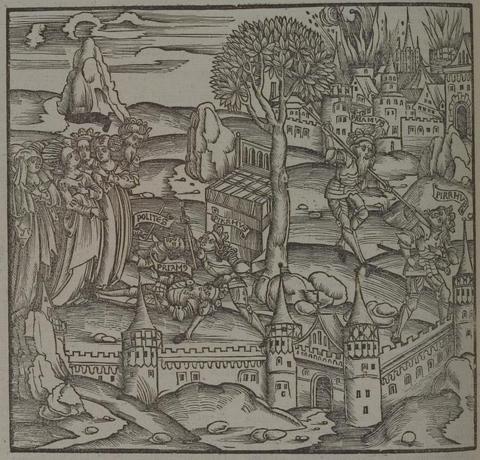
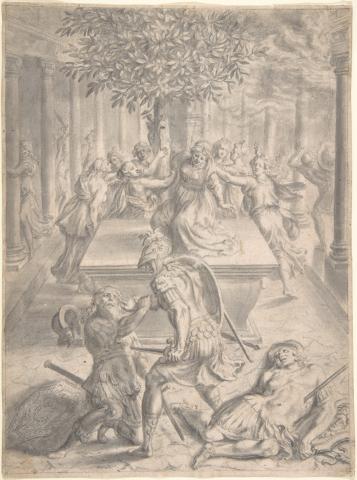
Forsitan et Priamī fuerint quae fāta requīrās.
Urbis utī captae cāsum convulsaque vīdit
līmina tēctōrum et medium in penetrālibus hostem,
arma diū senior dēsuēta trementibus aevō
circumdat nēquīquam umerīs et inūtile ferrum510
cingitur, ac dēnsōs fertur moritūrus in hostēs.
Aedibus in mediīs nūdōque sub aetheris axe
ingēns āra fuit iūxtāque veterrima laurus
incumbēns ārae atque umbrā complexa Penātēs.
Hīc Hecuba et nātae nēquīquam altāria circum,515
praecipitēs ātrā ceu tempestāte columbae,
condēnsae et dīvum amplexae simulācra sedēbant.
Ipsum autem sūmptīs Priamum iuvenālibus armīs
ut vīdit, 'Quae mēns tam dīra, miserrime coniūnx,
impulit hīs cingī tēlīs? aut quō ruis?' inquit.520
'Nōn tālī auxiliō nec dēfēnsōribus istīs
tempus eget; nōn, sī ipse meus nunc adforet Hector.
Hūc tandem concēde; haec āra tuēbitur omnēs,
aut moriēre simul.' Sīc ōre effāta recēpit
ad sēsē et sacrā longaevum in sēde locāvit.525
notes
Manuscripts: M | P 506-507, 508-525
The old king had put on his armor and was on his way to meet death at the hands of the enemy when Hecuba prevailed on him to seek sanctuary with her and her daughters at the altar. (Williams).
"Just as he prepared us carefully for his own leap into the chaotic violence of that night (250–317), so too Aeneas here prepares us carefully for Priam’s death..."
- read full essay by Meghan Reedy
-
[click here to open in new tab]
Aeneas (Vergil) takes time to tell the story of Priam’s last moments, suspecting that Dido (that we) might want to know: forsitan et Priami fuerint quae fata requiras (506). Just as he prepared us carefully for his own leap into the chaotic violence of that night (250–317), so too Aeneas here prepares us carefully for Priam’s death: after announcing it here in 506, he spends almost 50 lines working up to the moment Priam is killed, in 553.
This scene begins with a retelling of the capture of Troy. However, whereas in 250–67 it was told from outside, from a bird’s eye view, this time it is told from deep inside––from the perspective of Priam himself, vidit (507). What Priam saw is what we already know (city captured, overrun by enemies), but Priam is the city’s political center, looking out from its physical center, and when he sees how the enemy have come all the way in, he sees too that both his city and his life are at an end.
Priam sees that he must die, and so he puts his armor on, but as he grabs his arms to go to his death, he is utterly pitiable: he is very old, senior; his weapons are long unused, arma diu… desueta; his arms tremble with age, trementibus aevo … umeris; his sword is useless, inutile ferrum (509–10). This is an ‘arming scene,’ the sort of scene which Homer used effectively for sending people like Achilles into battle, and which still features in any action film. The buckling on of protective gear, the stomping of boots on hard, dusty ground or into splashing mud, the checking and testing of swords/knives/guns/rocket-launchers/web-shooters/laser-eyes/whatever––all of this usually emphasizes and glamorizes how strong the soldier/warrior/contestant is. Not so this time. This scene with Priam is a parody of an arming scene, and it exposes ever more clearly this king’s pathetic lack of strength.
It is his wife, Hecuba, who puts this into words. She is sitting at the huge central altar, in the very center of the center of the city, exposed to the naked axis of the sky, aedibus in mediis nudoque sub aetheris axe ingens ara fuit … hic Hecuba (512–15), and she says, ‘what are you doing, and where are you rushing off to?’; she addresses him as ‘pathetic/miserable/pitiful spouse,’ miserrime coniunx, (519–20). She talks him down and makes room for him to sit with her, sic ore effata recepit ad sese et sacra longaevum in sede locavit (524–25). Thus, the first way we see Priam’s extreme old age, his physical frailty, is gently filtered through his affectionate interaction with his wife, Hecuba.
The second and more extensive way we see it is harshly refracted through his despairing, angry, and violent interaction with Achilles’ son, Pyrrhus/Neoptolemus.
We are commanded to look at Polites’ and Pyrrhus’ entrance, ecce (526)––and the first thing we see is that Pyrrhus is berserk, caught up in and committed to bloody slaughter, elapsus Pyrrhi de caede Polites (526); the second is that he is chasing Polites, one of Priam’s sons, Polites uno natorum Priami (527). The third is that the two men move, running and bloody, from the periphery to the center: in 507–8 Priam saw the violence coming … now it is here. Moreover, when Polites arrives, the emphasis is on his proximity not to the physical center of Troy, the altar, but to the city’s political center and the center of his own family––his parents: ante oculos … et ora parentum, he is in front of their eyes and their faces (531). Here, at the center of the center of the center, is where Pyrrhus kills him.
Now, as Hecuba put into words the weakness of Priam, so Priam, surrounded by and on the brink of death, in media iam morte (533), puts into words the immorality and the weakness of character of Pyrrhus, Achilles’ son.
Even in the midst of a war, Priam maintains, fathers should not be forced to witness their sons’ deaths directly like this (538–39). He puts this first criticism sarcastically in terms of piety and divinity, obligations and reparations (di … pietas … grates dignas et praemia … debita, 537–38).
Next, he compares Pyrrhus’ egregious act (he calls it a scelus, 535) with Pyrrhus’ father Achilles’ behavior: Achilles respected the father-son bond by returning Hector’s body to Priam for burial; Pyrrhus has blatantly disrespected the father-son bond by killing Polites right in front of him (540–43). Pyrrhus, Priam says, ought to be ashamed of himself.
Priam speaks forcefully, and as we saw, Pyrrhus’ entry was already bloody. We have been prepared to see Pyrrhus as Priam does. Surprisingly, Pyrrhus too accepts Priam’s interpretation of his behavior. When he replies, he defiantly owns the accusation that he is not like his father: illi mea tristia facta degeneremque Neoptolemum narrare memento (558–59) he says. Priam is right, his father is right; he Pyrrhus, Neoptolemus, is a degenerate, degenerem Neoptolemum.
He kills Priam directly following this interchange, and when he does so it is as if he is demonstrating just how immoral he is: Pyrrhus drags Priam onto the city’s main altar to do it (550–51). Here we see again the physical weakness that was so pitifully highlighted earlier and so tenderly handled by Hecuba; Priam is trembling, trementem (550), as Pyrrhus drags him onto the altar. Another awfulness in this moment is the way he keeps slipping in his own son’s blood, multo lapsantem sanguine nati (551). Then, Pyrrhus kills Priam in a terrible inversion of the priestly action (552–53), and so the righteously indignant old king is killed by the vicious, godless young soldier. Still, I am afraid it is worse than this.
Priam measures his indignation and his judgement of Pyrrhus by Achilles, citing the way that he and Achilles managed to find a respectful, positive dialogue in the wake of Achilles’ killing of Priam’s son Hector. However, this comparison is terribly unfair to Pyrrhus, and sadly untrue of himself. Consider:
When Hector was killed by Achilles in Book 22 of the Iliad, it was on the battlefield, a place set aside for killing people, where death could be expected and legitimized. Priam was not there when it happened.
Thereafter, Achilles kept the body of Hector for several days––horribly mutilating it, taking out his anger on it. While Priam is frenzied with grief in the closing scene of Book 22, wanting to run straight out the gate to Achilles––he is prevented from doing so; he must wait, and calms down. In between Achilles’ killing of Hector and Priam’s visit to retrieve Hector’s body, both men have time to spend their violent first reactions and prepare for the meeting. Achilles, throughout Book 23, formally mourns and buries Patroclus, whose death at Hector’s hand drove Achilles’ to pursue Hector so viciously. Moreover, early in Book 24 the goddess Thetis intervenes to persuade Achilles to accept Priam’s request. For his part, Priam waits, and plans his approach carefully. He too prays to Zeus for mercy and is led on his way to Achilles’ tent––and given advice––by Hermes himself.
However, in this situation, there is no distinction between ‘battlefield’ and ‘citadel’. Where could Priam’s son run to but home? When Pyrrhus chases him down and kills him––as Achilles chased down Hector––where else can that killing happen but in front of Priam? Thus, there can be no space at all between Polites’ killer and Polites’––no physical space between Priam and his son’s death, or between Pyrrhus and his killing, and no space of time between that death and the moment when Priam must confront his son’s killer, when Pyrrhus confronts his victim’s father. There is no legitimate place for killing, and neither man can step back, consider, or collect himself. No gods step in to help them.
Then too, after Hector’s death, Priam was so careful to keep Achilles’ sense of honor intact. He left his own fortified walls and went as a suppliant to Achilles’ stronghold; he went there alone and powerless; he went at night so that others would be less likely to see the interaction; he took a cartload of valuable goods to offer him as ransom. Now, he does the opposite: he stands in the center of his palace, where everyone is awake and active, whatever the time; he offers Pyrrhus nothing; he insults Pyrrhus to his face; he tries to kill him. Therefore, what Priam wants is impossible: he wants Pyrrhus not to have killed Polites… he wants his world not to be collapsed. He wants more from Pyrrhus than he asked of Achilles.
Thus, while the old man sees that Pyrrhus’ actions are indeed not Achilles’, he fails to notice that he himself is not what he once was––neither the wise Priam who approached Achilles so skillfully, nor the arrogant young Priam who could taunt an enemy and then strike him down. This Priam’s hollow taunting only goads Pyrrhus and makes a bad situation horrible.
This is a bleak scene. The violence Priam saw moving from the periphery into the center has engulfed him too.
So the center shifts.
After witnessing Priam’s death, Aeneas begins to really see what is happening: at me tum primum saevus circumstetit horror. Obstipui … (559–60)––and he sees that where he is standing, next to the dead king in the middle of the burning palace, is no longer central for him. He remembers his own family (561–63), whom he left when he charged off to help save Troy. He looks around him at his men – quae sit me circum copia lustro – and they are finished; they are doing what Priam did, flinging themselves at death, corpora saltu at terram misere aut ignibus aegra dedere (564–65).
Thus, the world is inverted over the course of this night. Aeneas began the night at the very edge of things, asleep in his secluded house (303); now he stands at the center … only the center is now just an edge, all loss and carnage, while the edge is now his center.
Further Reading
Bowie, A.M. ‘The death of Priam: allegory and history in the Aeneid’ Classical Quarterly 40 (1990) 470-81
Gantz, Early Greek Myth: A Guide to Literary and Artistic Sources Two volumes (Baltimore, 1993) 649-57
Kenney, E.J. ‘Iudicium transferendi: Virgil Aeneid 2.469-505 and its antecedents’ in Creative Imitation and Latin Literature, eds. D. West and A.J. Woodman (Cambridge, 1979) 103-20
Ross, D.O. ‘Images of fallen Troy in the Aeneid in Style and Traditions: Studies in Honor of Wendell Clausen, eds. P. Knox and C. Foss (Stuttgart and Leipzig, 1998) 121-9
506: forsitan requīrās: “perhaps you may ask” (Bennett); in Vergil forsitan takes the subjunctive: forte, forsan, the indicative: fortasse, once the indicative, otherwise the subjunctive (H-H) (AG 447a). et Priamī: put at the beginning of its clause for emphasis (Bennett). The fate of Priam has just been indicated in general terms, but it is natural to ask the particulars of his death (Frieze). fāta: “the fate,” plural of majesty (Carter).
507: uti: of time, as ut, in 67 (Frieze). cāsum: “destruction” (Carter).
508: līmina: “doors” (Knapp). medium: a poetic variation for mediīs (F-B); more lively than mediīs, as agreeing with hostem, but it is required also by the metre (G-K). penetrālibus: the penetrālia of a house were ordinarily entered only by the members of the family. Note then the juxtaposition of contrasts in penetrālibus hostem (Knapp).
509 ff.: The pitiful details are piled up to show the hopelessness of Priam’s bravery in his helpless age. The juxtaposition of dēsuēta with senior is effective, and senior is deepened by trementibus aevō; the elision with nequiquam suggests his failing strength, and inūtile marks it further; dēnsōs shows the impossible odds against him; moritūrus (here surely of conscious intention, as in 9.400, 554, not ambiguous like peritūrus in 408, nor of unconsciousness of peril as in G. 4.458, moritūra puella) shows his determination to die a soldier’s death, not as a feeble victim. The terrible picture gains in intensity if we set against it the glowing brutality of Pyrrhus in his prime, as Vergil has shown him in 469 ff. (Austin).
509: diū: with dēsuēta (Bennett). senior: “very old.” More emphatic than senex (F-B).
510: umerīs: dative indirect object of a compound verb, circumdat (AG 370). ferrum: accusative, after cingitur, by a Greek construction, instead of ablative; “he girds on his unavailing sword” (Frieze) (AG 397c).
511: fertur: note the conative sense, “tries to rush,” “starts to rush” (F-B) (AG 467); “is hurrying” (Frieze). moritūrus: = peritūrus, 408 (Knapp) (AG 499).
512: aedibus in mediīs: “in the midst of the palace”; in the inner court (Frieze). nūdō sub aetheris axe: “under the open vault” or “sky” (Frieze); in a Roman house the Penates were kept by the family hearth and altar, in the ātrium, or principal hall, but not in the open air; here, however, is apparently meant a great hall or court, which had a larger opening than the atrium, and contained a garden, or at least a tree or two (G-K). The description is modelled on that of a Roman house, mediā axe, i.e., where the impluvium stood in the centre of the ātrium (Howson).
513: Vergil has done more than merely “romanize” the Greek tradition; he has made an essentially domestic picture, and his quiet sanctuary, with its “ancient bay, bending over the altar and enfolding the Penates in its shade,” is in striking contrast to the tumult and desolation all around (Austin). veterrima laurus: The aged bay carries back the mind to the good old times, when all was tranquility and peace (Anthon).
514: complexa: has the force of a pres., “embracing” (Knapp).
515: nēquīquam: just as Priam’s recourse to the sword was of no avail, so here the women take refuge in the sanctity of the altar in vain (Carter); for, in the end, its sacredness failed to save them (Frieze).
516: praecipitēs: “driven headlong” (Bennett); for se praecipitantēs (Frieze). tempestāte: abl. of means depending on the idea of “driven” contained in praecipitēs (G-K).
517: condēnsae: expressive word, “huddled” (Sidgwick). div(ōr)um: the Penates of 514 (Knapp). amplexae simulācra: in the manner of suppliants (Carter).
519: mēns: “purpose,” “thought,” “resolution” (Chase).
520: cingī tēlīs: In prose, accingor gladiō (Storr). aut: this usage, found often in Plautus, merely introduces another question not necessarily alternative to the first (Williams).
521: nōn tālī auxiliō: the emphasis rests on nōn tālī—“not such is the help which the occasion calls for.” Hecuba’s thought is that the altar is their only hope of safety (Bennett). dēfēnsōribus istīs: i.e., those arms of yours, istīs being the demonstrative of the second person (F-B) (AG 297c).
522: nōn: scil. egēret from the eget preceding (H-H). The principal verb is easily understood, “would arms avail us” or something of the kind (Sidgwick). adforet: = adesset. The apodosis is not expressed; “even his arms would be of no avail” (F-B).
523: hūc concede: hūc concēde or the like is frequent in Comedy when one person asks another to withdraw for a confidential talk. Vergil has adapted the idiom for his own purpose, making Hecuba speak to Priam just as any ordinary person might speak to another when there is something important to tell him or something urgent for him to do. It is a fine illustration of Vergilian sensitivity to language and tone (Austin). tandem: a word of entreaty or impatience, used here as in questions (G-K) (AG 333a). concēde: observe the double meaning implied in concēde, “come away,” and “give up” (Anthon). omnēs: emphatic, as is simul in the next line: they will all live or die together (Page).
524: simul: i.e., along with us (Bennett). recēpit: sc. eum, Priam (Carter); the verb suggests loving care, like locāvit in 525 (Austin).
525: sacrā longaevum in sēde locāvit: i.e., on the altar, or steps of the altar (Frieze).
vocabulary
Priamus, ī, m.: 1. Priam, son of Laomedon, king of Troy, 1.458, et al. 2. A Trojan youth, son of Polites and grandson of King Priam, 5.564.
requīrō, quīsīvī or quīsiī, quīsītus, 3, a.: to seek much or earnestly; seek out, search for, 3.170; demand; ask, question, 2.390; inquire, 2.506; speak with regret of, mourn, 1.217. (re- and quaerō)
convellō, vellī, vulsus, 3, a.: to pull violently; pluck, tear, pull up, 3.24; wrench forth, 12.774; cut off, 6.148; p., convulsus, a, um, rent, shattered, 1.383; convulsed, 5.143.
penetrālis, e: adj. (penetrō), innermost, inner, 2.297; subst., penetrālia, ium, n., the interior of a house; sanctuary, shrine, chapel (of a dwelling or temple), 2.484, et al.
senex, senis: (adj.), old, aged, hoary, 7.180; (comp.) senior, ōris, older; very aged, 5.179; hoary, 5.704.
dēsuēscō (in poetry trisyll.), suēvī, suētus, 3, a. and n.: to become unaccustomed; p., dēsuētus, a, um, unaccustomed, unused, 6.814; neglected, unfamiliar, unpracticed, 2.509; unused to love; dormant, 1.722.
tremō, uī, 3, n. and a.: to tremble, quake, shake, quiver, 5.198; tremble at, fear, dread, 8.296.
circumdō, dedī, datus, dare, 1, a.: to put or throw around; (with abl.), to encircle, surround, encompass, inclose with, 1.368; of dress, gird, 9.462; adorn, 6.207; set, 1.593; border, 4.137; (with dat.), throw around, 2.792; twine or coil around, 2.219; put round, 2.510.
nēquīquam: (adv.), in vain, to no purpose, 2.515.
umerus, ī, m.: the upper bone of the arm; the shoulder, 1.501, and freq.
inūtilis, e: (adj.), useless, 2.510; helpless, 10.794.
atque, or ac: (conj.), and in addition, or and besides; and, as well, and indeed, and, 1.575; freq.; even, 2.626; in comparisons, as, 4.90; than, 3.561.
dēnsus, a, um: (adj.), thick, dense, crowded, compact, in close array, serried, 2.383; frequent, 5.459.
axis, is, m.: an axle; synecdoche, car, chariot, 5.820; the axis of the heavens, the sky, the heavens, 4.482; the pole; the north pole, the north.
iūxtā: (adv. and prep. w. acc.), near, close, near by, 2.513; at the same time, 2.666; near to, 3.506.
laurus, ī, f.: the laurel or bay tree, 2.513; a laurel crown or wreath, 3.81.
incumbō, cubuī, cubitus, 3, n.: to lay one's self upon; lean or recline upon; (w. dat.), lie on or stretch over, 2.205; fall upon, 1.84; bend to, ply, 5.15; hasten, urge, press on, 2.653; overhang, 2.514; press or bend toward, 5.325; (w. ad and acc.), lean, hang, incline, 8.236; absolute, bend to, urge on the work, 4.397.
complector, plexus sum, 3, dep. a.: to embrace; cover, 2.514; hold, 5.31; seize, grasp, 11.743.
Penātēs, ium, m.: gods of the household; hearth-, fireside gods, 2.514, et al.; tutelary gods of the state as a national family, 1.68; (fig.), fireside, hearth, dwelling-house, abode, 1.527. (penus)
Hecuba, ae, f.: daughter of Dymas and wife of Priam, 2.501, et al.
nāta, ae: a daughter, 1.256. (nascor)
altāria, ium, n.: the upper part of an altar; a high altar, 7.211; an altar, 2.515. (altus)
circum: (adv.), about, around; (prep. with acc.), around, about.
praeceps, cipitis: adj. (prae and caput), head foremost; headlong, 2.307; deep, 11.888; hurried, hasty, quick, speedy, 4.573; flying, running swiftly, 2.516; 3.598; rash, impetuous, fiery, 9.685; prolept., ready to sink, 10.232; subst., praeceps, n., a steep, precipice, verge, 2.460; in praeceps, headlong; downwards, 6.578.
āter, tra, trum: (adj.), black; dark, gloomy, 1.60, et al.; smoky, lurid, 7.456; 4.384; clotted, dark, 3.622; soiled, blackened, 2.272; (fig.), sad, fatal, 6.429; venomous, deadly; of the odor of smoke, 12.591.
ceu: (adv. and conj.), as, just as, 5.88; as if, 2.438, et al. (ce-ve)
columba, ae, f.: a pigeon, dove, 2.516.
condēnsus, a, um: (adj.), thick, crowded, close together, 2.517.
amplector, amplexus sum, 3, dep. a.: to embrace, clasp, 3.607; wind, pass around, 5.86; encircle, coil around, 2.214; (fig.), comprehend, embrace, in description.
simulācrum, ī, n.: an effigy, an image, 2.172; phantom, specter, ghost, apparition, 2.772; representation, image, 5.585. (simulō)
iuvenālis, e: adj. (iuvenis), pertaining to youth; youthful, 2.518.
dīrus, a, um: (adj.), accursed; portentous; fearful, dreadful, awful, dire, cruel, horrible, freq.; accursed, 2.261; unhallowed, impious, 6.373; foul, carrion, 3.262; wild, furious, ardent, 9.185; pl., dīra (adv.), fearfully, 10.572.
impellō, pulī, pulsus, 3, a.: to push, thrust, drive to or upon; push onward, impel, 5.242; push, open, 7.621; smite, 1.82; ply, 4.594; put in motion, urge on, 8.3; shoot, 12.856; move, disturb, 3.449; (w. inf.), lead on, impel, induce, persuade, 2.55; force, compel, 1.11.
ruō, ruī, rutus, 3, n. and a.: to fall with violence; tumble down, fall, freq.; fall in battle, 10.756; of the sun, go down, set, 3.508; rush forward, 2.64; of the chariot of Nox, hasten up; ascend, rise, 2.250; advance, 10.256; plunge, rush, 2.353; flee, 12.505; tremble, quake, 8.525; hasten, pass away, 6.539; cause to fall; cast down, 9.516; plow, 1.35; cast, throw up, 1.85; throw up or together, 11.211.
nec or neque: (adv. and conj.), and not; neither, nor, 1.643, et al.; in prohibition, 3.394, et al.; neque (nec) — neque (nec), neither — nor, 5.21, et al.; nec — et, or -que, may be rendered neither — nor, 12.801; 2.534; nec nōn, and also, nor less, 6.183; nec nōn et, and also, 1.707.
dēfēnsor, ōris, m.: a defender, protector; applied also to inanimate things, 2.521. (dēfendō)
tempus, oris, n.: 1. Time in general, a period, time, 1.278; interval or space of time, 4.433; crisis, circumstance, juncture, 7.37; season, fitting time, opportunity, proper moment, 4.294; ex longō (tempore), in or for a long time, 9.64. 2. The temple of the forehead, 9.418; commonly pl., 2.684; of animals, 12.173.
egeō, uī, 2, n.: to be in want or need; (w. abl. or gen.), to want, need, 2.522; to be poor, destitute, 1.384; to feel the need of, be desirous of, 5.751.
adsum, adfuī, esse, irreg. n.: to be near or by; to be present, at hand, or here, 1.595; to have arrived, 2.132; to be with, attend, 2.701; aid, accompany, 10.547; be propitious, 3.116; to beset, 2.330; inf., adfore, to be about to come, destined to come, 7.270. (imp. subj., adforem, -ēs, -et, -ent)
Hector, oris, m.: son of Priam, and chief defender of Troy, 1.99, et al.
concēdō, essī, essus, 3, a. and n.: to retire; come away, come, 2.523; go away, depart, 2.91; subside, come to an end, terminate, 8.41; allow, yield, grant, concede, 5.798; give up to, abandon, 7.305.
tueor, tuitus or tūtus sum, 2, dep. a.: to look at, gaze upon, behold, regard, 4.451, et al.; watch, guard, defend, maintain, protect, 1.564, et al.; p., tūtus, a, um, secure, safe; in safety, 1.243; sure, 4.373; subst., tūtum, ī, n., safety, place of safety, 1.391; pl., tūta, ōrum, safe places, safety, security, 11.882; adv., tūtō, with safety, safely, without danger, 11.381.
effor, fātus sum, 1, dep. a. and n.: to speak forth; speak, say, 6.560. (ex and for)
longaevus, a, um: adj. (longus and aevum), of advanced age; aged, 2.525, et al.
locō, āvī, ātus, 1, a.: to place, put, 1.213, et al.; lay, 1.428; found, 1.247. (locus)