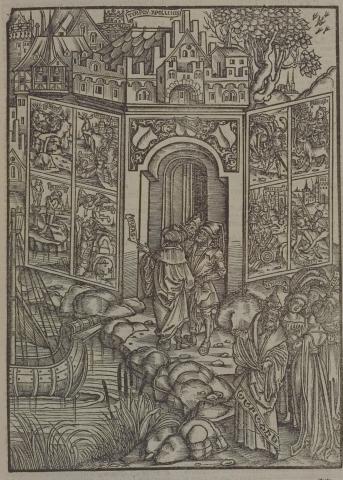
CORE VOCABULARY
lacrimō, āvī, ātus, 1, n. and a.: to shed tears, weep, 1.459. (lacrima)
immittō, mīsī, missus, 3, a.: to send upon or to; drive to, 6.312; bring upon, 4.488; let in, 2.495; let fly, go, loosen, 6.1; hurl, fling, cast, 11.562; (with sē), rush into, 6.262; p., immissus, a, um, of the reins of horses, let loose; hence, (fig.), swiftly running, 5.146; unchecked, unbridled, 5.662; of the hair or beard, descending, left growing, neglected, long, 3.593.
habēna, ae, f.: a rein, 1.63, et al.; strap, thong, 9.587; whip, 7.380; immissīs or laxīs habēnīs, with all the reins let out, without restraint, unchecked, 5.662; pressīs or adductīs habēnīs, with tightened reins, 12.622. (habeō)
Euboicus, a, um: (adj.), of Euboea, an island on the eastern coast of Greece; Euboean, 6.2.
Cūmae, ārum, f.: Cumae, an ancient Greek town of Campania, west of Naples, 6.2.
adlābor, lāpsus sum, 3, dep. n.: to glide to; (with dat., rarely acc.), sail to, reach, 3.569; advance, glide (with abl. of manner), 10.269; fly to, 9.474; descend, fall upon, 12.319.
ōra, ae, f.: a margin, border, 12.924; coast, shore, 3.396; region, 2.91; rim, extremity, 10.477; pl., outline, compass, 9.528.
obvertō, vertī, versus, 3, a.: to turn towards, 6.3; turn round (towards the sea), 3.549; p., obversus, a, um, turned or turning, wheeling, 11.601; turning against; directly opposite, facing towards, 9.622.
pelagus, ī, n.: the sea; open sea, main, 1.138; flood, 1.246.
prōra, ae, f.: the extreme forward part of a ship; the prow, 1.104.
dēns, dentis, m.: a tooth, 3.664; the fluke of an anchor, 6.3.
tenāx, ācis: adj. (teneō), holding on or fast; tenacious; adhering to, persistent in, w. gen., 4.188.
ancora, ae, f.: an anchor, 1.169.
fundō, āvī, ātus, 1, a.: to make or lay the bottom of anything; to found, erect, build, 4.260; establish, render stable, organize, 6.811; of ships, hold to the bottom, fasten, moor, hold, 6.4. (fundus)
curvus, a, um: (adj.), curved, bent, bending, 2.51; winding, 2.748; crooked.
praetexō, texuī, textus, 3, a.: to weave in front; to fringe, 6.5; (fig.), palliate, cloak, 4.172; conceal, 4.500.
puppis, is, f.: the hinder part of a ship; the stern, 5.12; (by synecdoche), a vessel, boat, ship, 1.69; (meton.), crew, 8.497.
ēmicō, uī, ātus, 1, n.: to leap, spring forth, 6.5; to dart, bound, or spring upward, 2.175; run, rush, dart forward, 5.319.
ārdēns, entis: burning, hot, sparkling, flaming, 5.637; bright, 4.482; impassioned, ardent, eager, 1.423; spirited, fiery, 1.472; glowing, lofty, 6.130; fierce, furious, 2.529; angry, 6.467. (ardeo)
Hesperius, a, um: (adj.), of Hesperus; western (as related to Asia and Greece); Hesperian, Italian, 3.418.
sēmen, inis, n.: seed; (fig.), a spark, an element, 6.6; pl., sēmina, seeds of things, vital germs, elements, 6.731. (1. serō)
abstrūdō, trūsī, trūsus, 3, a.: to push or thrust off; to conceal, hide, 6.7.
vēna, ae, f.: a vein, 4.2.
silex, icis, m. and f.: a hard stone, flint, 1.174; rock, 6.602; crag, 6.471.
dēnsus, a, um: (adj.), thick, dense, crowded, compact, in close array, serried, 2.383; frequent, 5.459.
mōnstrō, āvī, ātus, 1, a.: to show, point out, indicate, 1.444; inform, tell, 1.321; direct, incite, 9.44; ordain, appoint, prescribe, 4.636. (mōnstrum)
Aenēās, ae, m.: 1. A Trojan chief, son of Venus and Anchises, and hero of the Aeneid, 1.92. 2. Aenēās Silvius, one of the Alban kings, 6.769.
Apollō, inis, m.: Apollo, son of Jupiter and Latona; the god of prophecy, medicine, music, poetry, and archery, 2.430; met., a temple of Apollo, 3.275.
praesideō, sēdī, 2, n. and a.: to sit before; preside over, rule over, w. dat., 3.35. (prae and sedeō)
horrendus, a, um: to be shuddered at; dreadful, fearful, 2.222; awe-inspiring, venerable, 6.10; strange, wonderful, 8.565; fierce, warlike, 11.507. (horreō)
sēcrētum, ī, n.: anything apart; a solitary place, recess, cave; pl., sēcrēta, ōrum, solitude, chamber, 8.403; secret abode, 6.10. (sēcernō)
Sibylla, ae, f.: a prophetess, a sibyl; the Cumaean sibyl, Deiphobe, 3.452, et al.
antrum, ī, n.: a cave, cavern, grotto, 1.166.
immānis, e: (adj.), vast, huge, immense, 1.110; wild, savage, barbarous, 1.616; cruel, ruthless, 1.347; unnatural, monstrous, hideous, 6.624; (adv.), immāne, wildly, fiercely, 12.535.
Dēlius, a, um: adj. (Dēlos), of Delos; Delian, an epithet of Apollo, who was born in Delos, 3.162.
īnspīrō, āvī, ātus, 1, a.: to breathe into; inspire, impart, 1.688; instill, 7.351.
Trivia, ae, f.: an epithet of Hecate or Diana, whose images were placed at the forks of roads, 6.13, et al. (trivium)
lūcus, ī, m.: a consecrated wood; sacred grove, 6.259, et al.; in general, a grove, wood, forest.