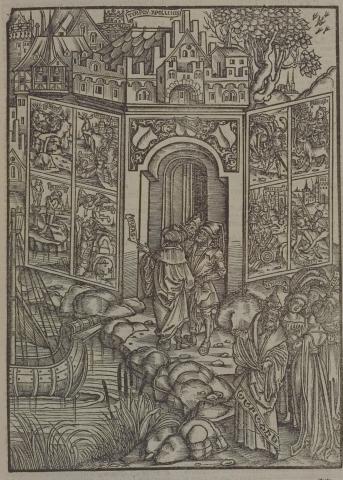
CORE VOCABULARY
Daedalus, ī, m.: Daedalus, the father of Greek sculpture; supposed to be of the time of Minos and Theseus; employed by Minos to build the Cretan Labyrinth, 6.14.
Mīnōius, a, um: adj. (Mīnōs), pertaining to Minos, king of Crete; of Minos, 6.14.
praepes, etis: (adj.), hastening before, swift, fleet, 3.361; winged, 5.254.
penna (pinna), ae, f.: a feather, 12.750; wing, pinion, 3.258; in the form pinna, a pinnacle, battlement, palisade, 7.159.
īnsuētus, a, um (trisyll.): (adj.), unaccustomed; unused, unwonted, 6.16; (pl. n. as adv.), īnsuēta, strangely; hideously, 8.248.
gelidus, a, um: adj. (gelū), frosty, ice-cold; cold, cool, icy, chilling, 2.120; chilled, 3.30.
ēnō, āvī, ātus, 1, n. and a.: to swim out or away, (fig.), to fly away, 6.16.
Arctos, ī, f.: the constellation of the Great and Little Bear, or of the Great Bear alone; the north, 6.16.
Chalcidicus, a, um: (adj.), of Chalcis, the chief town of Euboea; Chalcidian, 6.17.
adstō, stitī, 1, n.: to stand at, near, or upon; alight, 1.301; stand, 9.677; be present, 3.150; stand or be ready, 3.123; impend, 3.194.
Phoebus, ī, m.: Phoebus or Apollo, 1.329, et al.
sacrō, āvī, ātus, 1, a.: to set apart to the gods; devote, consecrate, 2.502; w. acc. and dat., devote, 10.419. (sacer)
rēmigium, iī, n.: a rowing; oarage, rowing movement, 1.301; body of rowers, oarsmen; a crew, 3.471; rēmigium ālārum = ālae, wings, 6.19. (rēmex)
āla, ae, f.: a wing, 1.301; the feather of an arrow, 9.578; the wing of an army; cavalry, 11.730; troop, battalion, 11.604; horsemen, mounted huntsmen, 4.121.
immānis, e: (adj.), vast, huge, immense, 1.110; wild, savage, barbarous, 1.616; cruel, ruthless, 1.347; unnatural, monstrous, hideous, 6.624; (adv.), immāne, wildly, fiercely, 12.535.
foris, is, f.: a door; often in the pl. with reference to double doors, 1.505; door or entrance. (rel. to θύρα)
lētum, ī, n.: death, destruction, 2.134, et al. (cf. dēleō)
Androgeōs, eō, and Androgeus, eī, m.: 1. Androgeus, a son of the Cretan king Minos, murdered by the Athenians, 6.20. 2. A Greek chief at Troy, 2.371.
Cēcropidēs, ae, m.: a son or descendant of Cecrops; pl., the Athenians, 6.21.
septēnī, ae, a: distrib. num. adj. (septem), seven by seven, seven each; as a cardinal, seven, 5.85.
quotannīs (or quot annīs): (adv.), every year, yearly, 5.59.
urna, ae, f.: a water-vessel, an urn, 7.792; an urn for casting lots, 6.22; of judges, 6.432.
efferō, extulī, ēlātus, ferre, irreg. a.: to bear, or bring out or forth, 2.297; bear away, rescue, 3.150; raise, elevate, lift up or high, 1.127; elate, puff up, 11.715; efferre gressum or pedem, walk, go, come forth, 2.753; efferre sē, arise, 3.215. (ex and ferō)
Cnōsius, a, um: adj. (Cnōsus or Gnōsus), of Knossos, a city in Crete; Knossian, Cretan, 3.115.
crūdēlis, e: adj. (crūdus), unfeeling, ruthless, cruel, inhuman, 2.124; relentless, 1.547; unnatural, 6.24; mortal, deadly, 2.561; bloody, 1.355; bitter, 1.361.
taurus, ī, m.: a bull, steer, ox, bullock, 2.202, et al.
suppōnō, posuī, positus, 3, a.: to put, place under, 6.24; put to the throat, thrust under, 6.248. (sub and pōnō)
fūrtum, ī, n.: that which is stolen; (meton.), the act of stealing; theft; secrecy, concealment, 4.337; artifice, deceit, fraud, deception, 6.24; treacherous deed (adultery), 10.91; stealthy attack, stratagem, 9.350; fūrta bellī, an ambuscade, 11.515. (fūr)
Pāsiphaē, ēs, f.: Pasiphaë, daughter of Helios, wife of Minos, and mother of Androgeos, Phaedra, Ariadne, and the Minotaur, 6.25.
prōlēs, is, f.: that which springs forth; offspring, race, progeny, 1.75; lineage, 3.180.
bifōrmis, is: adj. (bis and fōrma), of twofold shape or form, two-formed, 6.25.
Mīnōtaurus, ī, m.: the Minotaur; the offspring of Pasiphae, born with the head of a bull and body of a man, and confined by Minos in the Cretan Labyrinth, 6.26.
īnsum, fuī, esse, irreg. n.: to be in or on; be represented on, 6.26.
Venus, eris, f.: Venus, goddess of love and beauty, identified by the Romans with Aphrodite, daughter of Jupiter and Dione, 1.411, et al.; (meton.), love, lust, 6.26.
monumentum, ī, n.: a means of admonishing, reminding, or instructing; a memorial, 3.486; record, tradition, 3.102; memento, 12.945; token, 6.512. (cf. moneō)
nefandus, a, um: adj. (nē and farī), not to be spoken; impious, execrable, accursed, abominable, 5.785; perfidious, 4.497; subst., nefandum, ī, n., wrong, 1.543.
inextrīcābilis, e: (adj.), inextricable, intricate, 6.27.
rēgīna, ae, f.: a queen, 1.9; princess, 1.273. (rēx)
miseror, ātus sum, 1, dep. a.: to express, manifest, or feel pity for; compassionate, pity, 1.597. (miser)
ambāgēs, is, f.: a going about; a winding, 6.29; (fig.), details, particulars, story, 1.342; mysteries, 6.99. (in good usage in the abl. sing. and all cases of pl.) (ambigō, go about)
resolvō, solvī, solūtus, 3, a.: to untie, loosen, unbind, 3.370; break apart, 9.517; dispel, 8.591; of the lips, open, 3.457; of the body, relax, unbend, extend, 6.422; of separation of body and spirit, dissolve, separate, release, 4.695; unravel, disclose, 6.29; break, violate, 2.157.
fīlum, ī, n.: a thread, 6.30.
Īcarus, ī, m.: the son of Daedalus, 6.31.
bis: (adv.), twice, 1.381. (in composition bi-)
effingō, fīnxī, fīctus, 3, a.: to mold out, shape forth; form, fashion; portray, represent, 6.32; counterfeit, imitate, 10.640. (ex and fingō)
patrius, a, um: adj. (pater), pertaining to one's father or ancestors; a father's, 2.658; paternal, natural to a father, 1.643; exacted by a father, 7.766; due to, felt for a father or parent, 9.294; ancestral, hereditary, 3.249; of one's country, native, 3.281; belonging to the nation, of the country, 11.374.
perlegō, lēgī, lēctus, 3, a.: to scan narrowly; survey, examine, 6.34.
praemittō, mīsī, missus, 3, a.: to send before, in advance, or forward; dispatch, 6.34.
Achātēs, ae, m.: Achates, a companion of Aeneas, 1.174, et al.
ūnā: (adv.), in one place or at one time, together with, at once, at the same time, 3.634, et al.; with -que following, 11.864.
Trivia, ae, f.: an epithet of Hecate or Diana, whose images were placed at the forks of roads, 6.13, et al. (trivium)
Dēiphobē, ēs, f.: a name of the Cumaean Sibyl, daughter of Glaucus and priestess of Apollo and Diana, 6.36.
Glaucus, ī, m.: a fabled fisherman of Boeotia, one of the Argonauts, who was transformed into a sea-god, 5.823. 2. The father of Deiphobe, the Cumaean sibyl, 6.36. 3. A Lycian prince, allied with Priam, and slain by Ajax, son of Telamon, 6.483.
spectāculum, ī, n.: a striking object of sight; a sight, show, spectacle, 6.37. (spectō)
grex, gregis, m.: a herd, 6.38; flock; litter; the young, 8.85.
intāctus, a, um: (adj.), untouched, unbroken, 11.419; unhurt, 10.504; untouched by the yoke, unyoked, 6.38; pure; a virgin, 1.345.
septem: (num. adj.), seven, freq.
māctō, āvī, ātus, 1, a.: to magnify by worship; to sacrifice, immolate, 2.202; slay, slaughter, 8.294, et al.
iuvencus, a, um: adj. (iuvenis), young; subst., iuvencus, ī, m., a young bullock, 3.247, et al.; iuvenca, ae, f., a heifer, 8.208, et al.
totidem: (num. adj. pron., indecl.), just, even so many; as many, 4.183, et al.
bidēns, entis: adj. (bis and dēns), having two teeth or two complete rows of teeth; subst., f. (sc. victima), an animal suitable for the altar; a sheep with two conspicuous teeth supplanting two of the milk-teeth; a sheep, 4.57.
adfor, fātus sum, 1, dep. a.: to speak to; address, 1.663; beseech, supplicate, 2.700; bid adieu, farewell to, 2.644.