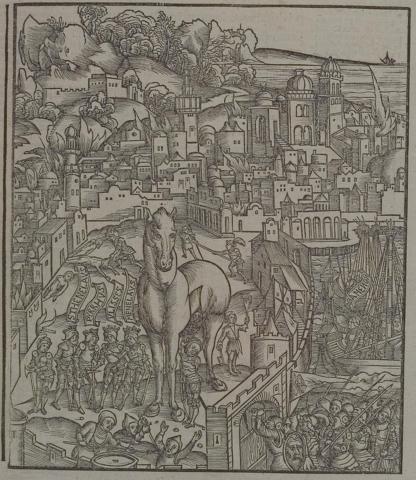
Vertitur intereā caelum et ruit Ōceanō nox250
involvēns umbrā magnā terramque polumque
Myrmidonumque dolōs; fūsī per moenia Teucrī
conticuēre; sopor fessōs complectitur artūs.
Et iam Argīva phalānx īnstrūctīs nāvibus ībat
ā Tenedō tacitae per amīca silentia lūnae255
lītora nōta petēns, flammās cum rēgia puppis
extulerat, fātīsque deum dēfēnsus inīquīs
inclūsōs uterō Danaōs et pīnea fūrtim
laxat claustra Sinōn. Illōs patefactus ad aurās
reddit equus laetīque cavō sē rōbore prōmunt260
Thessandrus Sthenelusque ducēs et dīrus Ulixēs,
dēmissum lāpsī per fūnem, Acamāsque Thoāsque
Pēlīdēsque Neoptolemus prīmusque Machāōn
et Menelāus et ipse dolī fabricātor Epēos.
Invādunt urbem somnō vīnōque sepultam;265
caeduntur vigilēs, portīsque patentibus omnēs
accipiunt sociōs atque agmina cōnscia iungunt.
notes
Manuscripts: M 250-263, 264-267 | P 250-254, 255-267
The Greeks emerge from the horse and take possession of the city (Bennett).
"Over the course of fifty or so lines, Aeneas narrates two separate streams of events: He tells us what is happening in the city as a whole (250–67), and he tells us what is happening inside one Trojan sleeper’s dreams..."
- read full essay by Meghan Reedy
-
[click here to open in new tab]
Over the course of fifty or so lines, Aeneas narrates two separate streams of events: He tells us what is happening in the city as a whole (250–67), and he tells us what is happening inside one Trojan sleeper’s dreams (268–97). Then, in 297–302, the two streams merge until the sleeper, Aeneas, wakes.
Each time he is about to begin one of these versions, he begins with a description or indication of the time, and each one is calibrated to the scale of events that follow. When he is about to narrate the events on a large scale––events that take place across the whole city––he begins with a large, all-encompassing description of the night: Vertitur interea caelum et ruit Oceano nox / involvens umbra magna terramque polumque / Myrmidonumque dolos (250–52). The preceding events and comments were the festivities the Trojans held in honor of the horse; they were dressing the city up with leafy swags––and interea celebrating keeps going while the heavens keep turning, vertitur caelum, and as night rushes up, rushes in from the encircling Ocean, it covers everything. With its huge darkness it rolls over the earth and the sky and the traps of the Myrmidons. What a trio of things: the earth and the sky and the traps of the Myrmidons. The passage first expands our view and then focuses our attention, even in the dark: the whole sky turns; the night’s darkness is huge, umbra magna, and then it covers the whole earth and even the topmost part of the sky. Then, we are reminded of the horse, which is small compared to the sky, and how it too is wrapped in deep night.
It is in this enveloping darkness that the Trojans sprawl sleeping on the fortifications, fusi per moenia, … , sopor fessos complectitur artus (252–53). In this darkness Sinon opens the horse, laxat claustra Sinon (259), and a series of named and famous Greeks emerge from its belly (261–4); they kill the guards, caeduntur vigiles (266); according to plan, they let in their friends, accipiunt socios (267). However, as is fitting in such a deep night, they do it all quietly––and the quiet is so thoroughly established at the start of this passage that it holds even when they do things like kill the guards. First of all, the Trojans are silent as they sleep, fusi per moenia Teucri conticuere (252–53). As the ships come over from Tenedos, they do so in the friendly silence of a soundless moon, tacitae per amica silentia lunae (255). When Sinon opens up the horse he also does that quietly and carefully, furtim (258). In 265, just as the last details of the plan are going into place, the whole city’s quiet is re-emphasized and deepened: urbem somno vinoque sepultam; Troy is quiet as the grave.
Then, with the great dark night and all this silent activity fresh in our minds, Aeneas restarts. He is about to describe one person’s––his own––dreams, and this time he begins with a small, gentle description of just one moment of night: Tempus erat quo prima quies mortalibus aegris / incipit et dono divum gratissima serpit (268–69). It’s that moment when sleep first comes, and look how welcome it is, how lovely: quies … dono divum gratissima. Rest comes as a gift from the gods, and it is the most pleasing thing, the most welcome to aching mortals. Our attention is drawn to how nice sleep feels when you’re tired––but then look too at that snakey verb, serpit; sleep slithers in, like the water-snakes slithered out of the sea, like the horse slithered into the city. With serpit a teeny chink is opened for the way sleep, as good as it feels, also leaves a person vulnerable.
But one doesn’t notice. No, one slips right through and into dreaming, which is where Aeneas takes us now: in somnis ecce ante oculos … (270). Even though we know oodles of activity goes on while Aeneas is having this dream, the dream moves at its own deliberate pace. Aeneas looks at Hector a long time, describes him and his wounds in great detail (270–80; only three fewer lines than the whole description of the Greeks’ furtive invasion in the prior passage). He speaks to Hector at great length (281–86, another six lines) but he says nothing important; he only voices his own muddled wonderings about why Hector looks so terrible and where he has been all this time. Then Hector, ignoring Aeneas’ empty questions, me quaerentem vana (287), speaks, also at length, explaining that Troy is busy being invaded and that he, Aeneas, should really leave (289–95, starting with heu, fuge, nate dea!). In the following two lines Hector brings some things out of the sanctuary … Aeneas’ dream continues …
Then, after the large blackness of night, filled with silent action; after the small welcome feeling of falling asleep, and the dreams it brings, the city and the sleeper finally come together in 298–302:
Diverso interea miscentur moenia luctu,
et magis atque magis, quamquam secreta parentis
Anchisae domus arboribusque obtecta recessit,
clarescunt sonitus armorumque ingruit horror,
excutior somno …
Here again, interea, meanwhile, puts what is about to be described into time simultaneously with what has been described in the lines immediately prior to these. While Aeneas has been dreaming, the quality of the action in the city has changed. It was quiet and deliberate––get out of the horse, kill the guards, let in the others––but now it is a free-for-all. The fortifications are all mixed up in changeable grief: diverso miscentur moenia luctu, and it is getting worse. It gets to be more and more, magis atque magis, and it gets all the way to Aeneas’ father’s house, where he’s sleeping, even though the house is secluded and tree-shaded, quamquam secreta parentis Anchisae domus arboribusque obtecta recessit (299–300). Finally, for the first time, it gets noisy, clarescunt sonitus, and the dreadfulness of armed violence gets closer and closer, armorumque ingruit horror (301). Notice how we only hear the noise of this nighttime invasion when Aeneas does, when he is suddenly shaken out of sleep, excutior somno (302).
What does this particular, repetitive way of telling this part of the story do? We see and hear his dream; we do not hear the mayhem until he suddenly does. However, we enter his experience with the added benefits of hindsight, or oversight. We know that Hector is appearing in Aeneas’ dream even as Troy is being overrun by Greeks. We feel the poignant tragedy of this coincidence––as Aeneas didn’t at the time; as he does now that he is telling the story afterwards.
Even once Aeneas tells us that he has woken up––finally shaken out of sleep by the clamor––still he does not quite know what is happening; all is confusion (diverso … luctu; miscentur 298). He climbs the roof and, having been woken by noise, stands with his ears pricked, listening, arrectis auribus adsto (303). What he hears sounds like a natural disaster––a crop-fire whipped up by wind (in segetem … flamma, 304), or a flood (rapidus … torrens, 305). It is difficult to wrap one’s mind around such extraordinary events. As would a shepherd witnessing fire or flood, so Aeneas stands frozen, uncomprehending: stupet inscius (307). Only in 309–10 does understanding dawn. Notice, however, how what he understands first is the overview, the general idea of what is happening––not a fire, not a flood, but Greek treachery, Danaum patescunt insidiae. Only then, having drawn us towards it all through this long, careful series of perspectives, does he describe actual buildings burning and name someone who has died.
Thus, after the bird’s eye view of 250–67, after the private dream of 268–97, and after the simile of 304–8, we are fully primed for Aeneas’ wild scrambling into the fray, arma amens capio … (314), ready to follow him, to forgive him anything, because we can feel what he feels when from 309 onwards the individual, Aeneas, is plunged into the bigger picture, Troy overrun.
Further Reading
Gransden, K.W. ‘The Fall of Troy’ in Virgil. Greece & Rome Studies, eds I. McAuslan and P. Walcot (Oxford, 1990)
Johnson, W.R. ‘Dis aliter visum: self-telling and theodicy in Aeneid 2’ in Reading Vergil’s Aeneid: An Interpretive Guide, ed. C. Perkell (Norman, OK, 1999) 50-63
Putnam, M. ‘The Poetry of the Aeneid’ (Cambridge, MA, 1965) 28-37
Ross, D.O. ‘Images of fallen Troy in the Aeneid in Style and Traditions: Studies in Honor of Wendell Clausen, eds. P. Knox and C. Foss (Stuttgart and Leipzig, 1998) 121-9
Rossi, A. ‘The fall of tTroy: between tradition and genre’ in Clio and the Poeets: Augustan Poetry and the Traditions of Ancient Historiography, eds. D.S. Levene and D.P. Nelis (Leiden, 2002) 231-51
Rossi, A. Contexts of War: Manipulations of Genre in Virgilian Battle Narrative (Ann Arbor, 2004) 17-53
250: vertitur: i.e., westward: the whole sky seems to move (Sidgwick). The ancients believed that the heavens consisted of two hemispheres, one of light and the other of darkness, and by the revolution of those light and darkness were produced (H-H). Ōceanō: ablative of separation (AG 400), or dative of goal (AG 428h)? Narrative context and literary antecedents point to a time before midnight and therefore to night coming on, from the Ocean, comparable to Homeric οὐρανόθεν (Horsfall). Night rises in her chariot from the eastern ocean when the sun sinks in the west (Frieze). ruit: ruit can indicate swift, forwards motion (Horsfall).
251: the prevalence of spondees in this line is admirably suited to the sense (Bennett).
252: Myrmidon(ōr)um: = Graiōrum (Frieze). fūsī: (> fundo) describes the attitude of one who lies down anyhow, without any care or fear of being disturbed (Page). per moenia: “throughout the city”; not here the fortifications merely (Frieze).
254: et iam Argīva: Vergil likes the grammatical pattern of iam with a verb in the imperfect followed by a clause introduced by cum (so 5.159 f., 7.25 ff., 9.371 f., etc.). phalanx: used here to mean simply “army” (Carter).
255: tacitae...lūnae: “through the friendly silence of the peaceful moon.” Vergil dwells on the “light” and “quiet” which make their passage easy, and ignores the danger which attends an attack by moonlight (Page). The utter stillness of the moonlight is well shown (Austin). amīca: “friendly,” because favorable for the attack (F-B). The peaceful moonlight, so beautiful, abets the horrid scheme (Austin).
256–259: cum…extulerat...laxat: Extulerat like laxat is in the inverted cum clause (AG 546a): “they were proceeding when suddenly Agamemnon had given the signal and Sinon is releasing the Greek…” (Williams). The indicative is rightly used after cum, because cum is here purely relative = quo tempore (Sidgwick). Both verbs go with cum, the principal verb being ibat. The shifting of tense is due to the pluperf. (to be translated as if extulit) being used to express an instantaneous act, and to the historical pres. being used for vividness’ sake (C-R). The indicative extulerat is here used for extulisset…, a form not available for the hexameter. (F-B).
256: flammās: here a fire-signal. Signals by light, beacon fires, and smoke were much used by the ancients (Knapp). rēgia puppis: i.e., Agamemnon’s, the leader of the Greeks (C-R). Here puppis = “ship,” as carinae does in 23, 179 (Knapp).
257: defēnsus: i.e., from discovery and punishment (Knapp). iniquīs: i.e., to the Trojans (F-B). It is only on account of divine injustice that Sinon has survivied his evil plotting (Horsfall).
259: laxat: this verb is adapted to both objects, Danaōs and claustra, by zeugma (Frieze). Notice too that the natural sequence is inverted, for the fastenings must be undone before the Greeks are released. The figure is know as hysteron proteron (Bennett). The word-order here is admirable; the whole long sentence, with its complicated structure, leads up to a deliberate climax in Sinon’s name, and the pause that follows is like a sigh after the suspense.
260: sē prōmunt: for prodeunt (Frieze). The Greeks cheerfully decant themselves from the Horse’s depths; the dactylic rhythm and the faintness of the pause at the fourth-foot caesura (cavō sē rōbore is virtually a unit) combine to give an effect of speed (Austin).
261 f.: The men in the horse are in groups of three, each containing one of the leading Greek generals — Ulysses, Neoptolemus, Menelaus. Thessandrus was a son of Polynices, Sthenelus a close friend of Diomedes, Acamas a son of Theseus, Thoas a Homeric hero (Iliad 2.638 f.), Machaon a surgeon, Epeos—as Vergil tells us (cf. Hom. Od. 8.493)—the maker of the horse which Ulysses had planned (Williams).
261–262: Sthenelus and Thoas are from the Iliad: the other names in these two lines are either from other versions of the tale, or are invented (Sidgwick). Thessandrus: not mentioned by Homer; according to other accounts he was killed at the beginning of the Trojan War and hence could not have been present in the Horse (Carter). Sthenelus: son of Capaneus and Evadne, companion of Diomedes (Carter). Acamas: son of Theseus (Howson). Thoās: a leader of the Aetolians (Carter).
263–264: Machāōn, Menelāus, Epēos: notice Gk. quantities (Comstock).
263: Neoptolemus: son of Achilles, whose father was Peleus, hence Pelides (Sidgwick). He was the only hero in the Horse who did not weep, and whose knees did not knock together with fear: so Odysseus told Achilles’ ghost (Od. 9.526 ff.) (Austin). prīmus Machāōn: son of Aesculapius, himself a good physician (Howson). This should probably be understood literally, and then would only show that the speaker, in mentioning the names rapidly, was reminded at the moment when this one occurred, that he was said to have issued first from the horse (Frieze). It is difficult to see if Machaon was the first to issue from the horse why he should be mentioned seventh. It may be an imitation of Homer, Iliad 2.505. Hence some translate it “peerless” (H-H).
264: Epēos: a Greek nom. = Epeus (C-R), whose chief claim to fame lies in his having constructed the wooden horse (Carter).
265: somnō vīnōque sepultum: It is best to make somnō vīnōque an example of hendiadys = somnō vinōsō (H-H). sepultum is an exaggeration for victam or superātam, used to heighten the pathos (Knapp). “Weighed down” rather than the dictionary “buried” (though with a strong hint that this sleep was to be a grave to many) (Horsfall).
266: caeduntur: the passive, interposed between invadunt and accipiunt, is more than just a variation of phrasing; it throws stress on the inertia of the “watch,” who are butchered in their log-like sleep (Austin).
267: agmina conscia iungunt: i.e., those outside with those inside (Sidgwick). conscia: implying that those already in the city and those just arrived have a mutual understanding of the plan of attack (Frieze).
vocabulary
intereā: (adv.), amid these things; meanwhile, in the meantime, 1.418, et al.
ruō, ruī, rutus, 3, n. and a.: to fall with violence; tumble down, fall, freq.; fall in battle, 10.756; of the sun, go down, set, 3.508; rush forward, 2.64; of the chariot of Nox, hasten up; ascend, rise, 2.250; advance, 10.256; plunge, rush, 2.353; flee, 12.505; tremble, quake, 8.525; hasten, pass away, 6.539; cause to fall; cast down, 9.516; plow, 1.35; cast, throw up, 1.85; throw up or together, 11.211.
Ōceanus, ī, m.: the god Oceanus; the waters encompassing the lands; the ocean, 1.287; distinguished as eastern and western, 7.101.
involvō, volvī, volūtus, 3, a.: to roll on or in; cast upon, 12.292; roll along, carry, 12.689; cover up, obscure, 3.198; conceal, involve, 6.100.
polus, ī, m.: the terminating point of an axis; the celestial pole; (meton.), the heavens, sky, 1.90; air, 1.398.
Myrmidones, um, m.: the Myrmidons, Thessalian followers of Achilles, once dwelling in Aegina, where they had been transformed from ants to men in answer to the prayer of Aeacus, grandfather of Achilles, 2.7, et al.
Teucrī, ōrum, m.: the Trojans, descendants of Teucer, 1.38, et al.; adj., Teucrian, Trojan, 9.779, et al. (Teucer)
conticēscō, ticuī, 3, inc. n.: to become still; be still, hushed, silent, 2.253. (com- and taceō)
sopor, ōris, m.: sleep; sound, deep slumber, 2.253; personified, 6.278.
complector, plexus sum, 3, dep. a.: to embrace; cover, 2.514; hold, 5.31; seize, grasp, 11.743.
artus, ūs, m.: a joint of the body of man or beast, 5.422; a limb, 2.173, et al.; part, member, 6.726; frame, body, 9.490. (generally in the pl., except in later writers)
Argīvus, a, um: adj. (Argos), belonging to Argos; Argive; Greek, 2.254; subst., Argīvī, ōrum, Argives, Greeks, 1.40.
phalanx, ngis, f.: a body of troops in compact array; a battalion, army, host, 6.489; of a fleet, 2.254.
īnstruō, strūxi, strūctus, 3, n.: to build upon; build up; arrange, draw up ships or troops, 2.254; 8.676; prepare, 1.638; furnish, equip, supply, 3.231; support, 6.831; instruct, train, 2.152.
Tenedos, ī, f.: an island in the Aegean about five miles from shore in sight of Troy, 2.21.
silentium, iī, n.: of the absence of any kind of sound; noiselessness, silence, stillness, 1.730; pl., 2.255. (silēns)
puppis, is, f.: the hinder part of a ship; the stern, 5.12; (by synecdoche), a vessel, boat, ship, 1.69; (meton.), crew, 8.497.
efferō, extulī, ēlātus, ferre, irreg. a.: to bear, or bring out or forth, 2.297; bear away, rescue, 3.150; raise, elevate, lift up or high, 1.127; elate, puff up, 11.715; efferre gressum or pedem, walk, go, come forth, 2.753; efferre sē, arise, 3.215. (ex and ferō)
inīquus, a, um: unequal; uneven in surface, rounding, 10.303; of the sun, torrid, 7.227; too narrow, dangerous, 5.203; treacherous, 11.531; morally, unfavorable, hard, inequitable, 4.618; unjust, cruel, 1.668, et al.
inclūdō, clūsī, clūsus, 3, a.: to shut in, inclose, 6.680; secrete, 2.19; for interclūdō, stop, choke, 7.534; to mount, set, inlay, adorn, 12.211. (1. in and claudō)
uterus, ī, m.: the womb, belly, 11.813; cavity, 2.38.
Danaī, ōrum, m.: the Greeks, 2.327.
pīneus, a, um: adj. (pīnus), of pine, made of pine, produced from pine, piny, 11.786; pine-, 2.258; piny, pine-growing, 11.320.
fūrtim: (adv.), by stealth, secretly, 2.18. (fūr)
laxō, āvī, ātus, 1, a.: to loosen, slacken; unfasten, undo, open, 2.259; uncoil, let out, 3.267; open, clear, 6.412; of the body, relax, 5.836; of the mind, relieve, 9.225. (laxus)
claustra, ōrum, n. pl: fastenings; bolts, bars; barriers, 1.56; narrows, straits, 3.411. (claudō)
Sinōn, ōnis, m.: a Greek, son of Aesimus, 2.79, et al.
patefaciō, fēcī, factus (pass, patefierī), 3, a.: to open, 2.259. (pateō and faciō)
cavus, a, um: (adj.), hollow, 1.81; concave, 8.599; arching, vaulted, 2.487; cavae manūs, the palms of the hands, 12.86.
rōbur, oris, n.: hard oak or wood, 6.181; a tree, 8.315; (meton.), timber, a wooden structure; fabric, 2.260; (fig.), sturdiness, strength, firmness, courage, vigor, 2.639; pl., rōbora, wood, timber, 4.399; vigor, flower, 8.518.
prōmō, prōmpsī, prōmptus, 3, a.: to take, give, bring forth, exhibit, put forth, 5.191; with sē, come forth, 2.260. (prō and emō)
Thessandrus, ī, m.: Thessandrus, a Greek chief, 2.261.
Sthenelus, ī, m.: 1. Sthenelus, an Argive chief, charioteer of Diomedes, 2.261. 2. A Trojan slain by Turnus, 12.341.
dīrus, a, um: (adj.), accursed; portentous; fearful, dreadful, awful, dire, cruel, horrible, freq.; accursed, 2.261; unhallowed, impious, 6.373; foul, carrion, 3.262; wild, furious, ardent, 9.185; pl., dīra (adv.), fearfully, 10.572.
Ulixēs, is, eī or ī, m.: Ulysses, son of Laertes, king of Ithaca, and one of the Greek chiefs at Troy, distinguished for shrewdness and cunning, 2.44, et al.
dēmittō, mīsī, missus, 3, a.: to send down, 1.297; shed, 6.455; let down into, receive, admit, (of the mind or the senses), 4.428; consign, condemn, 2.85; convey, conduct, 5.29; transmit, hand down, 1.288; dēmittere mentem, to lose heart, sink into despair, 12.609.
lābor, lapsus sum, 3, dep. n.: to slide, glide down, or slip, freq.; fall down, 2.465; ebb, 11.628; pass away, 2.14; descend, 2.262; glide, sail, skim along, 8.91; flow, 3.281; fall, perish, 2.430; decline, 4.318; faint, 3.309.
fūnis, is, m.: a rope, 2.239, et al.; cord, string, 5.488.
Acamās, antis, m.: Acamas, a son of Theseus and Phaedra, 2.262.
Thoās, antis, m.: 1. Thoas, a Greek chief, 2.262. 2. An Arcadian, follower of Pallas, 10.415.
Pēlīdēs, ae, m.: 1. The son of Peleus, Achilles, 2.548. 2. Neoptolemus or Pyrrhus, grandson of Peleus, 2.263, et al.
Neoptolemus, ī, m.: Neoptolemus or Pyrrhus, the son of Achilles, 3.333. See also Pyrrhus.
Machāōn, onis, m.: a Greek prince, surgeon of the Greeks at Troy, and said to have been the son of Aesculapius, 2.263.
Menelāus, ī, m.: son of Atreus, king of Sparta and husband of Helen; who joined his brother Agamemnon in the war against Troy, and after its capture returned with Helen to Sparta, 2.264, et al.
fabricātor, ōris, m.: a constructor, contriver, framer, artificer, builder, 2.264. (fabricō)
Epēos, ī, m.: Epeius, a Greek architect, designer of the wooden horse, 2.264.
invādō, vāsī, vāsus, 3, a. and n.: to go into; enter, 3.382; enter upon, 6.260; invade, violate, 6.623; rush into, 12.712; attack, assail, 2.414; address, accost, 4.265; undertake, adventure, 9.186.
sepeliō, pelīvī or peliī, pultus, 4, a.: to perform the rites of sepulture, whether by interring (humāre), or cremation (cremāre); to bury, 3.41; p., sepultus, a, um, buried, 4.34; of slumber, 6.424, et al.
vigil, ilis: adj. (vigeō), awake, on the watch; sleepless, 4.182; perpetual, 4.200; subst., vigil, ilis, m., a watchman, guard, sentinel, 2.266, et al.
cōnscius, a, um: adj. (com- and sciō), having complete knowledge; conscious, 5.455; conscious of, 2.141; conscious of guilt, guilty, 2.99; witnessing (w. dat.), 4.167; having knowledge in common, or a mutual understanding; confederate, 2.267.