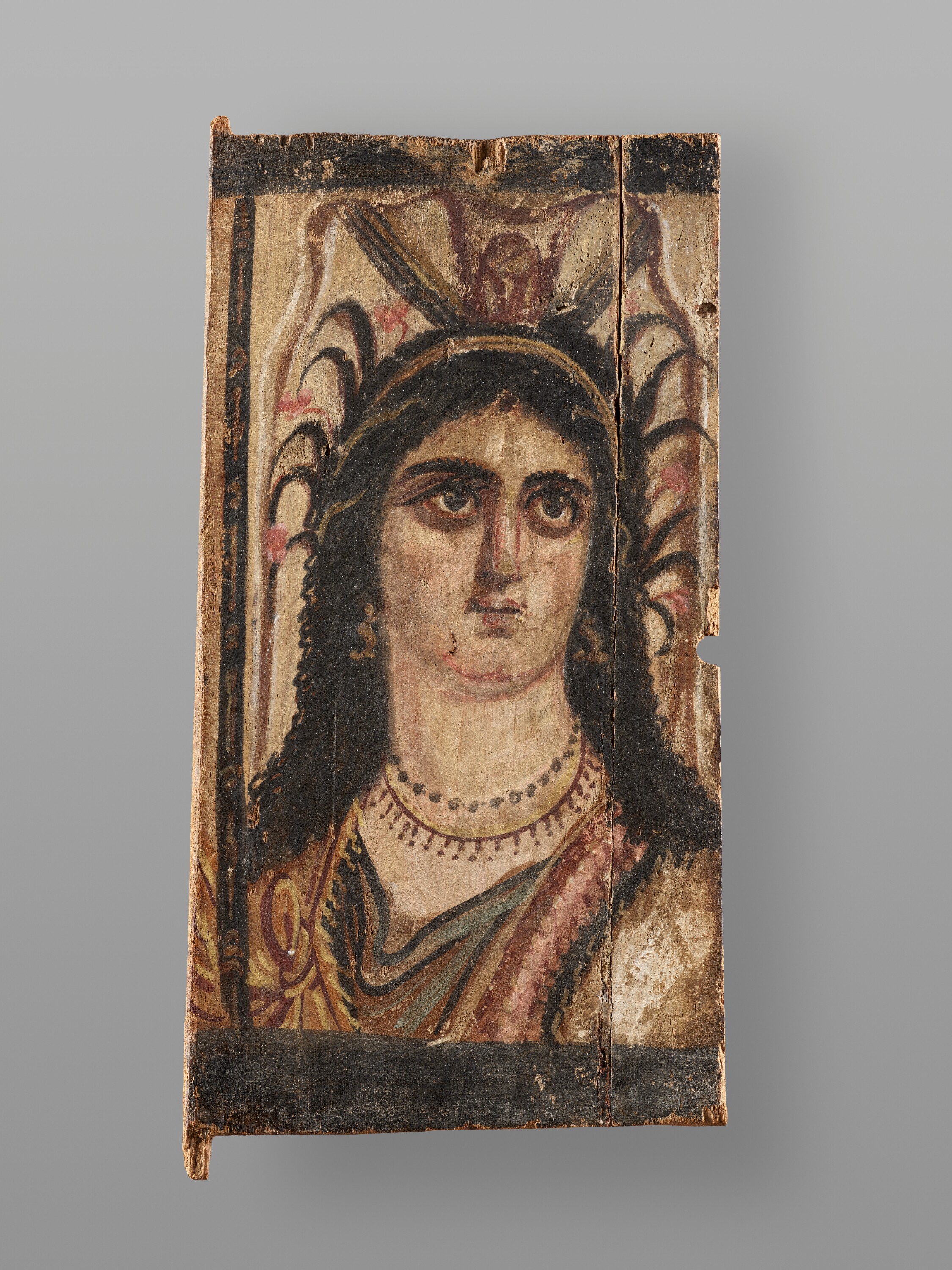
Panel with Painted Image of Isis

    Romano-Egyptian painted panel of the Egyptian goddess Isis in tempera (animal glue) on a fig wood panel. This pairs with the Serapis panel (74.AP.21, with which it is currently displayed) having been cut from the same piece of wood and painted by the same hand. Together with that panel, it originally served as the right door (to Serapis’s left) of a small devotional shrine, the sides and back of which are now missing. The panel’s good surface condition indicates it must have been protected by its closed position facing inward. It has been Carbon 14 dated to the first century BC-AD, but its stylistic date of around 180-200 indicates a secondary use may be possible for the original wooden panel at the time it was fabricated into two doors.

    Isis was a principal and original goddess of Egypt, wife/sister of Osiris and mother of Horus. Having resurrected Osiris and given birth to their son Horus, Isis was seen as a royal goddess possessing supernatural powers over motherhood, the land, and fertility in general. By the Hellenistic period, the worship of Isis had spread across the Mediterranean and after the annexation of Egypt by Rome following the battle of Actium in 31 BC, Isis was worshipped throughout the Roman Empire. When united with Serapis, as here, the divine couple reflected the religious needs of a combined Greek and Egyptian culture beginning in the Ptolemaic period (323-30 BC) and continuing into Roman Egypt (AD 30-330). Their worship was centered at the Serapeum in Alexandria, revered as the traditional home of Isis.

    Isis is presented in three-quarter view, eyes upturned and gazing outward (in contrast to the direct gazes of contemporary human mummy portraits to which this is stylistically related). Isis’s many roles are communicated by insignia of identification and rank. She is crowned by a uraeus (sacred snake conferring royalty) supported by the horns of Hathor, a maternal goddess whose attributes are often taken over by Isis. In front of this is a diadem supporting olive leaves extending down each side of her head. The entirety is veiled by a transparent cloth outlined in white and ocher tempera. Framed by luxuriant black curls falling thickly to her shoulders, Isis’s pale complexion (in contrast to the ruddy complexion of Serapis) is highlighted by touches of pink and red on her cheeks and lips (Getty Museum).
    Associated Passages
    Subjects
    Type
    Image
    License
    Creative Commons Attribution-ShareAlike
    Date
    A.D. 100–200
    Dimensions
    40 × 19 × 1.3 cm (15 3/4 × 7 1/2 × 1/2 in.)
    Location
    J. Paul Getty Museum
    Image Credit

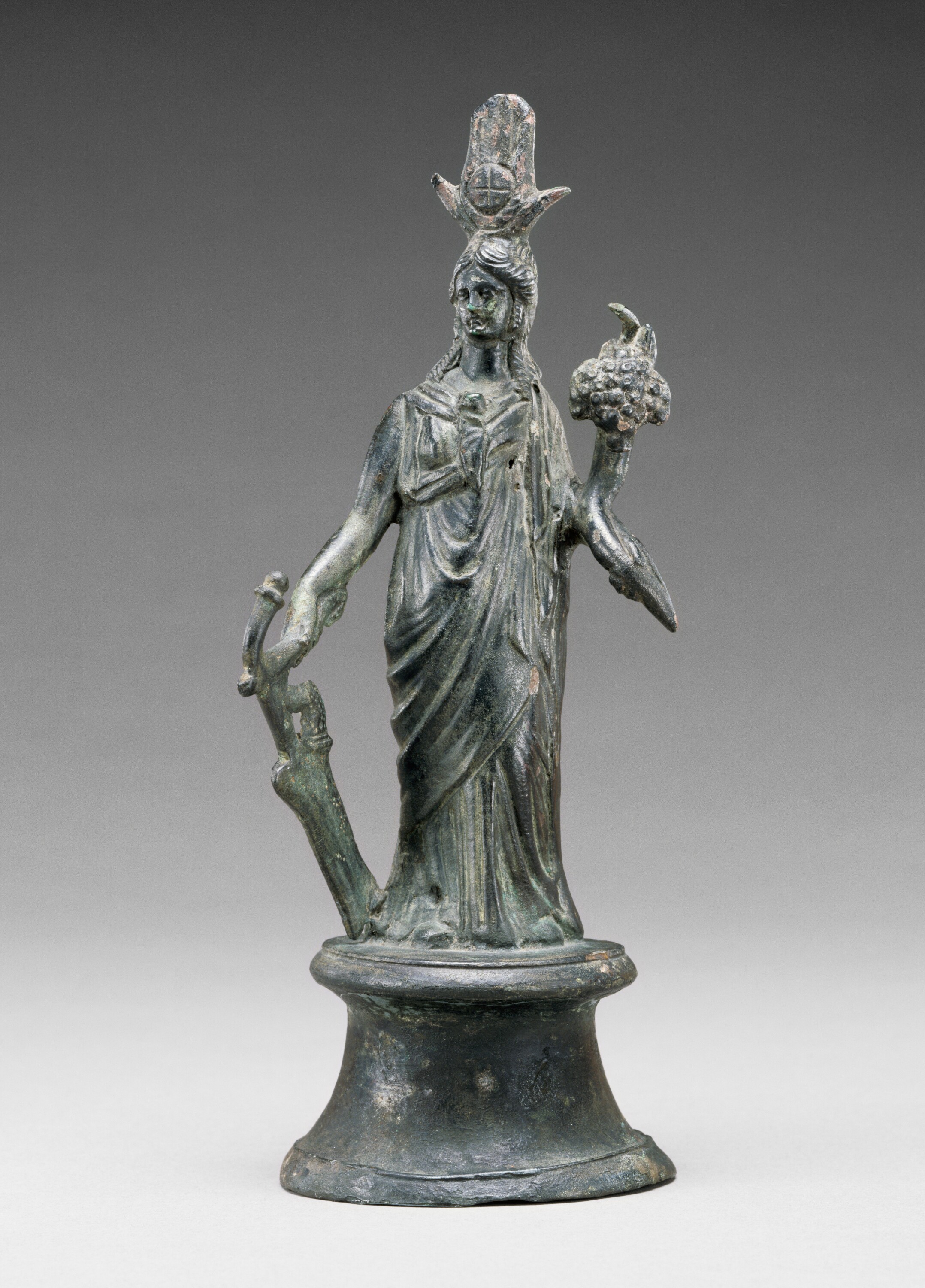
    Statuette of Isis-Fortuna

      The Egyptian goddess Isis was adopted into Roman religion in the first century B.C. She possessed a wide range of powers, including the ability to offer her followers a better afterlife. In Roman religion, she was often merged with other Roman goddesses, creating new composite deities. This statuette portrays Isis combined with Fortuna, a fertility goddess who controlled the fate of both individuals and cities. This statuette has attributes of both goddesses: she wears the elaborate headdress of Isis, a lunar disk between horns or feathers, and the front of her long dress is tied in a knot on her chest, the so-called Isis knot. She also holds the usual attributes of Fortuna: the rudder in her right hand refers to her control over the course of human lives, and the cornucopia in her left arm is a symbol of abundance and prosperity (Getty Museum).

      Associated Passages
      Subjects
      Type
      Image
      License
      Creative Commons Attribution-ShareAlike
      Date
      2nd century A.D.
      Culture
      Medium
      Dimensions
      19 cm (7 1/2 in.)
      Location
      J. Paul Getty Museum
      Image Credit

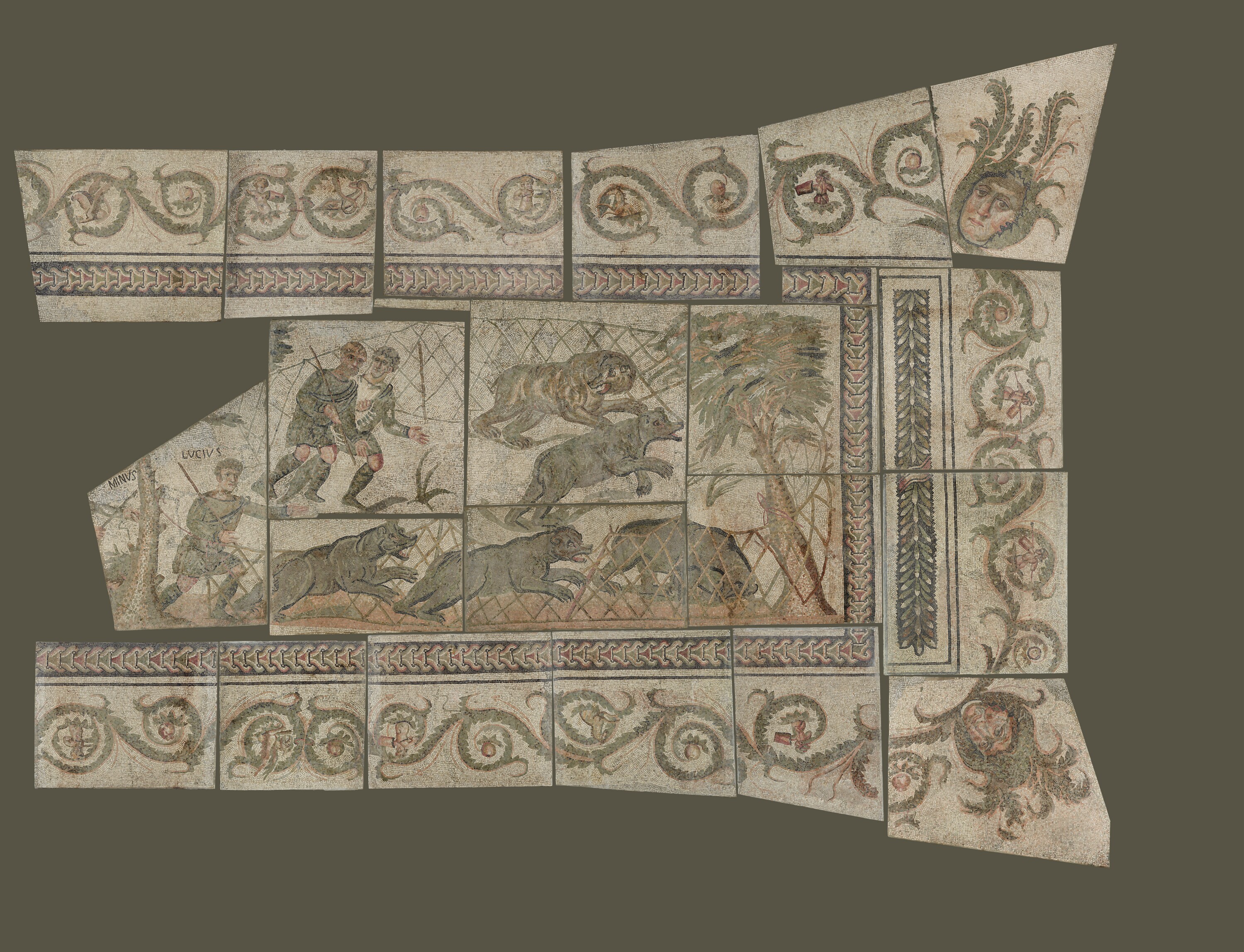
      Fragmentary Mosaic Floor with Bear Hunt

        Enough of the fragmentary floor survives to identify the subject as a bear hunt. The figures of three hunters are preserved, and one of them has his name, Lucius, inscribed above his head. The arm of another hunter is preserved along the left edge, along with his name, Minus. The hunters are driving four bears into a net; a fifth has already been captured. The net is set in a semi-circle and tied to trees at the right and left edges of the scene. The hunting scene is surrounded on three sides by a border of loop guilloche, and another vertical border of a foliate garland with a central ribbon frames the right end. The outermost border is a luxurious acanthus scroll. Heads emerge from elaborate leaf complexes in the corners, and smaller figures of erotes with armor, fruits and animals (both real and imaginary) are tucked into the scrolling acanthus along the edges (Getty website).

        Getty Museum 72.AH.76

        Subjects
        Type
        Image
        License
        Creative Commons Attribution-ShareAlike
        Date
        4th century AD
        Culture
        Dimensions
        661 × 869 cm (260 1/4 × 342 1/8 in.)
        Inscription
        Inscribed near the head of the beardless figure in the lower left, "LUCIUS", and on the other side of the tree behind this figure, inscribed "MINUS".
        Location
        "Stufe di Nerone", near Lago Lucrino, near Pozzuoli, Italy (Place Found)
        Image Credit

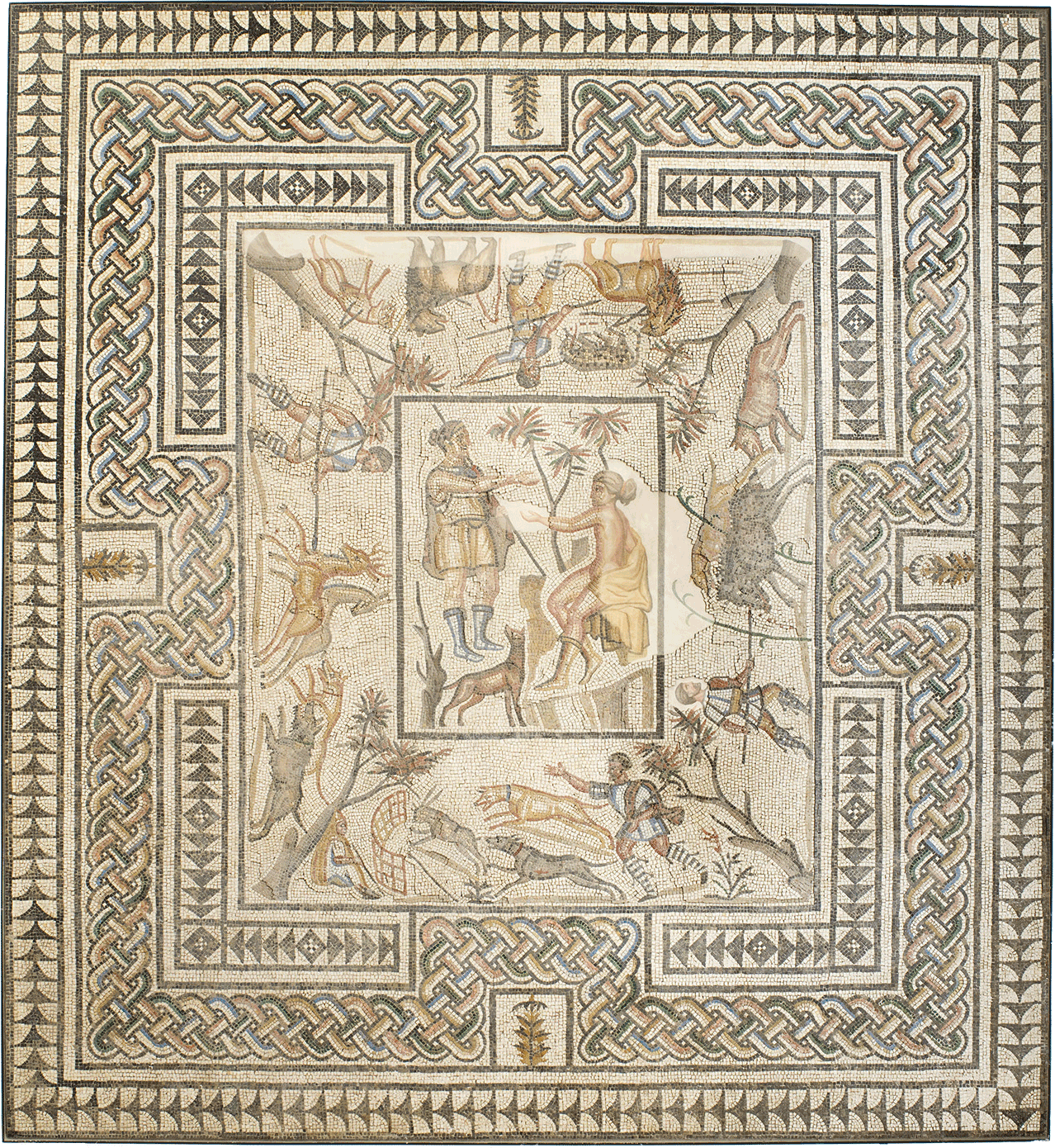
        Mosaic Floor with Diana and Callisto Surrounded by Hunt Scenes

          Mosaic Floor with Diana and Callisto Surrounded by Hunt Scenes, Gallo-Roman, AD 175–200. Found in Villelaure, France, 1832. Stone and glass tesserae, 300 × 270 cm. Los Angeles County Museum of Art, M.71.73.99

          Comments

          Scenes of hunters forcing bears and other animals into nets and traps are depicted on mosaics throughout the Roman Empire, including examples from Carthage, El Kef, Hippo Regius, and Utica in North Africa; Centcelles in Spain; and this one, found in Villelaure in France; and Rome (including one from the Esquiline Hill) and Ravenna in Italy. (Getty Museum Catalogue)

          Associated Passages
          Subjects
          Type
          Image
          License
          Creative Commons Attribution-ShareAlike
          Date
          AD 175–200
          Dimensions
          300 × 270 cm
          Location
          Los Angeles County Museum of Art, M.71.73.99
          Image Credit