Sīc pater Anchīsēs, atque haec mīrantibus addit:
'Aspice, ut īnsignis spoliīs Mārcellus opīmīs855
ingreditur victorque virōs superēminet omnēs.
Hic rem Rōmānām magnō turbante tumultū
sistet eques, sternet Poenōs Gallumque rebellem,
tertiaque arma patrī suspendet capta Quirīnō.'
Atque hīc Aenēās (ūnā namque īre vidēbat860
ēgregium fōrmā iuvenem et fulgentibus armīs,
sed frōns laeta parum et dēiectō lūmina vultū)
'Quis, pater, ille, virum quī sīc comitātur euntem?
Fīlius, anne aliquis magnā dē stirpe nepōtum?
quī strepitus circā comitum! Quantum īnstar in ipsō!865
Sed nox ātra caput trīstī circumvolat umbrā.'
Tum pater Anchīsēs lacrimīs ingressus obortīs:
'Ō gnāte, ingentem lūctum nē quaere tuōrum;
Ostendent terrīs hunc tantum Fāta nec ultrā
esse sinent. Nimium vōbīs Rōmāna propāgō870
vīsa potēns, superī, propria haec sī dōna fuissent.
Quantōs ille virum magnam Māvortis ad urbem
Campus aget gemitūs! vel quae, Tiberīne, vidēbis
fūnera, cum tumulum praeterlābēre recentem!
Nec puer Īliacā quisquam dē gente Latīnōs875
in tantum spē tollet avōs, nec Rōmula quondam
ūllō sē tantum tellūs iactābit alumnō.
Heu pietās, heu prīsca fidēs invictaque bellō
dextera! Nōn illī sē quisquam impūne tulisset
obvius armātō, seu cum pedes īret in hostem880
seu spūmantis equī foderet calcāribus armōs.
Heu, miserande puer, sī quā fāta aspera rumpās,
tū Mārcellus eris. Manibus date līlia plēnīs
purpureōs spargam flōrēs animamque nepōtis
hīs saltem accumulem dōnīs, et fungar inānī885
mūnere.' Sīc tōtā passim regiōne vagantur
āëris in campīs lātīs atque omnia lūstrant.
Quae postquam Anchīsēs nātum per singula dūxit
incenditque animum fāmae venientis amōre,
exim bella virō memorat quae deinde gerenda,890
Laurentēsque docet populōs urbemque Latīnī,
et quō quemque modō fugiatque feratque labōrem.
notes
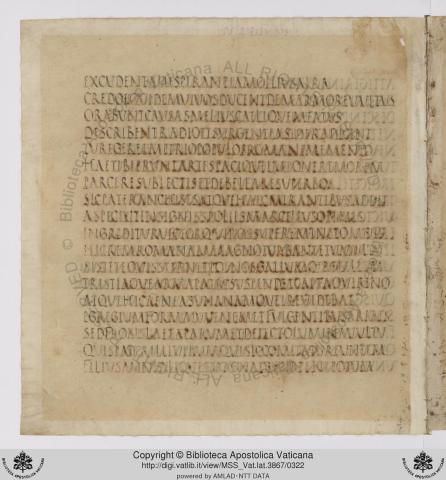
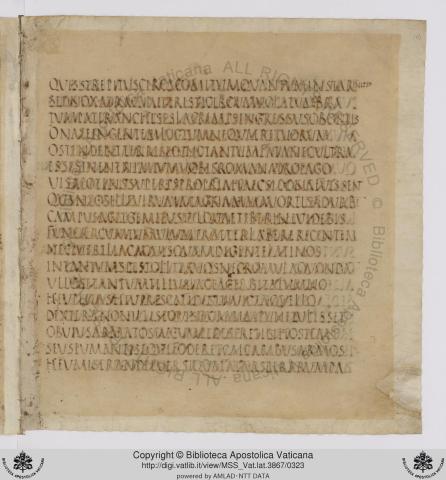
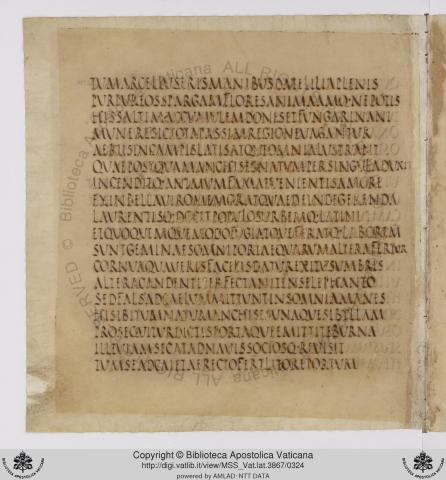
Manuscripts: M 854-871, 782-892 | P 854, 855-877, 878-892 | R 854-864, 865-882, 883-892
Anchises points out the elderly Marcellus, who is attended by a younger spirit. Aeneas inquires who the youth is, and learns that he is destined to die young, amid the general grief of the Roman people (Conington).
"Anchises points out just one more person at the end of his run-through of the key players in the history of Rome-to-come..."
- read full essay by Meghan Reedy
-
[click here to open in new tab]
Anchises points out just one more person at the end of his run-through of the key players in the history of Rome-to-come. He takes a breath, and we get that tiny aside: sic pater Anchises, atque haec mirantibus addit (854). About Anchises, the line reminds us that he was the speaker of what preceded, and addit lets us know that he will be the speaker of what is to follow. About Aeneas, we are reminded that he is still in the same state of awe, making the same wide-eyed effort to comprehend what he sees, as he was when he first saw the dead crowding up to the shore. Here in 854 he is mirantibus; back there he was Aeneas miratus (317).
In both moments, he really is striving to comprehend. Back on the bank, as the dead crowded up and Charon took some and not others, the description of Aeneas as miratus came just ahead of his questions to the Sibyl (quid petunut animae? quo discrimine … hae linquun, illae … verrunt? 318–20), and once he heard her answer he really thought about it (multa putans, 332), and it upset him, and he felt a poignant, powerless sadness about it: sortem animo miseratus iniquam (332).
In the moment that concerns us now, he is again really striving to comprehend. We see the reminder that he is mirans in 854, then the ‘one more’ that Anchises adds to his already extensive list (855–59 on a Marcellus who won the spolia opima; M. Claudius Marcellus himself killed the leader of the Insubrian Gauls)—and then, as he did in 318, Aeneas asks a question.
As before, his question is about something he has seen and doesn’t comprehend – in this instance, something his father Anchises has not pointed out to him. What Aeneas sees is described in a parenthesis (860–62): it’s someone going along at the same time as the Marcellus he was just told about, an outstandingly good-looking young man with beautiful armor and weapons, una namque ire videbat egregium forma iuvenem et fulgentibus armis (860–61). What is different, and leads to his question, is that this astonishing person also looks sad, and his face is downcast: sed frons laeta parum et deiecto lumina vultu (862).
Having noticed him, Aeneas asks, quis, pater, ille, virum qui sic comitatur euntem? (863), and goes on to point out to Anchises what drew his notice—his magnificence (865) and the black cloud over his head (nox atra caput tristi circumvolat umbra, 866).
It is here that Anchises weeps, lacrimis ingressus obortis (867), and it is perhaps interesting that his weeping is described using the same phrase that described Dido’s first weeping, when she first told Anna how she was struggling with her feelings for Aeneas: sinum lacrimis implevit obortis. As Dido was, Anchises is swamped with tears that well up unbidden.
Anchises—although he will go on to talk about this other Marcellus (tu Marcellus eris, 883) at length—doesn’t want to think about it. In particular he doesn’t want Aeneas to think about it: o gnate, ingentem luctum ne quaere tuorum (865). Don’t seek out, don’t ask about the huge grief of your people, son, he says. There is that word again, ingens; remember how Aeneas was ingens stepping into the boat, 413; Cerberus, guard-dog of the underworld, was ingens, 417, 423; that first awful, infant wailing was also ingens, 426; and now this huge grief—the last thing Aeneas hears about in the underworld is, like the first thing, ingens.
In Anchises’ speech from 788–859, there are occasional exclamations. He states things emphatically, sometimes—as at 791, when he repeats hic vir, hic est … as he’s introducing Augustus Caesar. When he has finished discussing Augustus he closes with a rhetorical question, et dubitamus adhuc …? (806–7) that amounts to an exclamation, as happens again in 841 and 841–44. In the longish passage that glances at and hints around the civil war between Julius Caesar and Pompey Magnus, he reaches his most emotional; it is here that the one use of heu! appears: heu quantum inter se bellum …(828).
By contrast, Anchises’ response to Aeneas’ question about who this young, sad man is befits the welling tears of 867; this speech is overflowing with emotion. He starts with O! (875), and uses the exclamation heu! three times, twice within a single line (heu pietas, heu prisca fides …!, 878) and once as part of an apostrophe (direct address) to Marcellus himself, heu, miserande puer,… (882). He addresses so many different things, calls on them on after another: the gods collectively, superi (871); then the river Tiber, Tiberine (873); then pietas and old-fashioned loyalty, heu pietas, heu prisca fides (878), as well as the boy’s right hand unconquered in war, invictaque bello dextera (878–79)––as well as the poor young man, the boy, himself, miserande puer … tu Marcellus eris (882–83). Lastly, he tells Aeneas, us, any and everyone, what to do: give him lilies with full hands, manibus date lilia plenis (883)—and he finally says what he will do, useless as it is: scatter flowers, heap gifts, occupy himself with empty service, purpureos spargam flores animamque nepotis his saltem accumulem donis, et funger inani munere, (884–86).
Aeneas doesn’t respond; Anchises doesn’t say or do anything more about Marcellus. They keep moving, walk all over the place, and take it all in together: sic tota passim regione vagantur aeris in campis latis atque omnia lustrant (886–87). But what does that last word mean, lustrant? On the one hand, it’s ‘take in’, as in ‘look over’ ‘observe’ or ‘examine’; with Anchises, Aeneas examines everything. But also, even primarily, it’s ‘purify’ or ‘cleanse’—and while their looking around seems in keeping with the broad scheme, this wander also perhaps cleanses everything—helps wash off the grief, wash out the sadness of knowing young Marcellus will bloom only to die.
After another three little lines, reported indirectly, wherein we are told that Aeneas is given detailed advice about what he will face when he gets to Italy (890–93), he and the Sibyl leave.
Their departure is oddly easy and abrupt—there are two gates out (893–96), and they go through one (897–98), and then Aeneas is on his way back to his ships and his people, ille viam secat ad navis sociosque revisit (899).
As easy as it is for them, these two gates are also troubling; the gates come with implications, it seems, that suggest it matters in some indefinable way which one you use. Rather, which one Aeneas used. One wonders about them on so many levels.
In what ways, for example, are the gates actually different and similar?
It seems like this should be simple. The differ in materials, one is horn (altera … cornea, 893–4); the other is ivory (altera … perfecta … elephanto, 895). So far so good.
But it gets complicated immediately. One—the gate of horn—is associated with truth, cornea, qua veris… (894); the other—the gate of ivory—appears to be associated with falsehood, altera … perfecta … elephanto, sed falsa… (895–96). Although, why is the description of the first one so clearly linked—it’s a relative clause of description, with altera cornea the clear antecedent of qua—and the second is linked with sed, which is adversative? Presumably, sed emphasizes the contrast between the horn and the ivory, the true and the false. However, other things don’t quite match either: what leaves the gate of horn are veris … datur exitus umbris, ‘true shadows’ or ‘true shades’; and they are ‘given a way out’—the true shadows just leave, apparently. But from the other gate? falsa ad caelum mittunt insomnia Manes (896); the shades send false nightmares/dreams to the sky—so here the shades don’t leave at all, they send out falsa insomnia … to the sky.
The two gates are made of different things, associated with truth (horn) and falsehood (ivory), and they also work differently.
So then: his ibi tum natum Anchises unaque Sibyllam prosequitur dictis portaque emittit eburna (897–98). Anchises is talking up to the last, his … prosequitur dictis, and he sends them out, emittit, through the ivory gate, porta … eburna. So a shade sends them out, as though they were dreams/nightmares … because that is what shades send out that way. They don’t just go, just get ‘given exit’, through the horn gate—that is where true shades … real ghosts get out. But of course, Aeneas and the Sibyl are neither ghosts nor nightmares/dreams … they are living people, in living bodies. So, what do you make of it? Does it imply that living people are dream-like? Are all dreams false? Or are true dreams somehow always real shades, and only false dreams are what we think of as ‘dreams’ at all? Was that Anchises telling Aeneas and Sibyl about the gates, or no, was that Vergil telling us about them? What difference does it make?
Or maybe none of it matters, maybe that’s just the way out if you’re a living visitor to the underworld, and Aeneas and Sibyl jostled along, two bulky physical bodies among the flimsy dreamlings being sent on their way, until they were out in the night air, same as they stepped into that leaky old boat on the way in.
Further Reading
Brenk, F. E. ‘Aurorum spes et purpurei flores:the eulogy of Marcellus in Aeneid VI’ American Journal of Philology 107 (1986) 218-28
Brenk, F. E. ‘The gates of dreams and an image of life: consolation and allegory at the end of Vergil’s Aeneid VI’ Collection Latomus: Studies in Latin Literature and History VI (1992) 277-94
Gotoff, H. ‘The difficulty of the ascent from Avernus’ Classical Philology 80 (1985) 35-40
Johnson, W.R. Darkness Visible: A Study of Vergil’s Aeneid (Berkeley, 1976) 104-8
Kraggerud, E. ‘Vergiliana (II): What is wrong with the somni portae? (Aen. 6.893-898)’ Symbolae Osloenses 77 (2002) 128-44
O’Hara, J.J. ‘An unconvincing etymological argument about Aeneas and the Gates of Sleep’ Phoenix 50 (1996) 331-4
Reed, J. ‘Anchises reading Aeneas reading Marcellus’ Syllecta Classica 12 (2001) 146-68
Segal, C. ‘Aeternum per saecula nomen: the golden bough and the tragedy of history. Part 2’ Arion 5 (1966) 34-72
854: mīrantibus: supply eīs (i.e. Aenēae et Sibyllae) (Pharr): “to his wondering hearers” (Comstock). Aeneas and the Sibyl are spell-bound with the glory of the revelation (F-B).
855-856: aspice ut ... ingreditur: “look at how he enters.” Compare 779: viden ut stant (“see how they stand”) (Bennett).
855: Marcellus: M. Claudius Marcellus (the elder), called the “Sword of Rome” (G-K), five times consul, in his first consulship (222 B.C.) slew Viridomarus king of the Insubrian Gauls and so won the spolia opīma (Page). Later he fought against Hannibal in the Second Punic War with varying success, but was eventually defeated by him (P-H). [See Bret Mulligan on Nepos, Life of Hannibal 5.3]. Marcellus is singled out for the sake of his namesake and descendant, soon to be mentioned (860 ff.) (Conington). spoliīs opīmīs: i.e., the leader’s spoils (Comstock); arms and other booty taken on the field of battle by the victorious general from the vanquished general, whom he has slain with his own hand. These were won before by Romulus and Cossus (see line 841) (Pharr). Spoliīs is ablative of respect / specification with īnsignis (AG 418).
857: hic rem Rōmānam ... sistet: rem = rem pūblicam: “this man will cause the Roman state to stand firm (sistet) when a great upheaval shakes it; his steed will trample (sternet)...” (Ganiban et al.). Join rem Rōmānam with both turbante and sistet (Knapp). magnō turbante tumultū: “when a great upheaval shall disturb it,” the reference being to the Gallic revolt and the Second Punic War (Bennett). Tumultus contains the idea of a sudden invasion, a war near at hand, alarm, strictly, the name for civil war (G-K) or, as Cicero explains (Phil. 8.3), it denoted something more serious than bellum, and was applied technically to any rising in Italy itself, or in Gaul (P-H).
858: eques sternet: “with his horsemen will uphold,” literally, “as a horseman will uphold” (F-B). Marcellus’ battle with the Gauls was largely a cavalry fight; he may have won fame in like manner against the Carthaginians (he fought with distinction against Hannibal), but we have no certain evidence to that effect (Knapp). Poenōs: i.e., the Carthaginians. Under Marcellus, the Romans won their first victory over Hannibal at Nola (F-B). Gallum rebellem: in its strict sense of “renewing the war,” for before the battle of Clastidium the Insubrians had sued for peace (F-B). The Insubrian Gauls, whose capital was Mediolanum, the modern Milan. Marcellus defeated them at Clastidium in 222 B.C., the occasion on which he won the spolia opīma (Bennett). The Insubrian Gauls had sued for peace, but their overtures were rejected, upon which they combined with another tribe, the Gaesatae, took the field in great force, and laid siege to Clastidium where the battle happened (Conington).
859: tertia arma: “the third set [of spolia opīma]” (Knapp). Adjective with the force of an adverb, “a third time.” The tradition was that the spolia opīma were won only three times in Rome’s history: (1) by Romulus, (2) by Cossus (line 841), and (3) by Marcellus (Comstock). patrī Quirīnō: the first set of spolia opīma were dedicated to Jupiter Feretrius; the second to Mars; the third to Quirīnus (i.e., the deified Romulus (F-B)) (Knapp), since he was their first winner (P-H). The spolia opīma are usually spoken of as dedicated to Jupiter Feretrius and not to Quirinus, but a statue of Quirinus may have stood beside that of Jupiter (Page). Quirinus was the Sabine god of battles, identified by the Romans with the deified Romulus (G-K). suspendet: “will dedicate” (Comstock).
860: Aenēās: supply dīcit (Pharr), ait or exclāmat (Knapp). ūnā īre vidēbat: supply cum Marcellō (Pharr): “he saw coming with him” (F-B); “he saw coming at the hero’s side (Comstock).
861: formā…armīs: ablative of respect / specification with ēgregium (AG 418). iuvenem: the “young” Marcellus was the son of Octavia, the sister of Augustus, and C. Marcellus. Augustus adopted him as his son in 25 B.C. and gave him (at the age of 18 (P-H)) his only child Julia in marriage. He was marked out as the emperor’s successor, but died in the 20th year of his life (23 B.C.) (Page).
862: frōns laeta parum: supply erat (Pharr): “his brow far from joyous,” i.e., the “shadow of death” was on it (Comstock). Note the litotes of laeta parum; the phrase belongs also with lūmina. His sorrow was due to a premonition of his early death. Thus, like Ancus Martius (815, 816), he displays already the characteristics which belong rather to his destined life in the world above (Knapp). et lūmina dēiectō vultū: = et lūmina (erant) dēiecta; lūmina = oculī, as often (Pharr): “his eyes downcast” (Bennett). Vultū is ablative of place where (AG 421).
863: pater: addressing Anchises (Carter). ille: i.e., the younger Marcellus (Pharr). virum: the elder Marcellus (Pharr) of lines 855–859 (Knapp). sīc: i.e., as we see (F-B).
864: anne: for the simple an is not very common in the best prose but occurs in both independent and dependent questions (Knapp). nepōtum: supply nostrōrum (Knapp).
865: quī strepitus circā comitum: already in the underworld the shade of Marcellus is surrounded by troops of admiring and devoted friends (Bennett). Marcellus has his admiring attendants (comitum) now, even as the great on earth have them. In Vergil’s day comes was practically a technical term for the members of the suite of a prince of the ruling house; strepitus points to the number of the comitēs (Knapp). quantum instar: instar is only here used without a genitive (cf. 2.15 instar montis equum, “a horse [the] like[ness of] a mountain”, et al.). In those cases the person or thing to which it is applied is described as “worthy to be compared with” something else (in the genitive), which is always something great and grand. When used absolutely, as here, it describes that which is the ideal of shape, the standard of beautiful. The rare and peculiar use of the word is no doubt intentional (Page). I would suppose the meaning to be, “how commanding is his presence,” which is suggested by the context (Conington). “What true greatness!” (Knapp); “what majesty!” (Chase). in ipsō: i.e., in him independently of his great ancestor, in whose company he is, or of his comitēs (Knapp).
866: sed nox…umbrā: the line describes Night as hovering round him on ghostly wings and already casting over his bright and youthful form the shadow of the grave (Page). Note the similarity to 2.360 nox ātra cavā circumvolat umbrā (Knapp).
867: ingressus: supply est (Pharr) and dīcere (F-B). It matters little whether it be taken here as a participle or as a finite verb (Conington).
868: gnāte: the archaic form of nātus is well suited to an emotional passage (F-B). quaere: here = inquīre, “search into,” “probe” (Knapp).
869: ostendent tantum: the young Marcellus died in his twentieth year (Frieze). Tantum is used adverbially, “merely,” “only.” Fate will “only allow a glimpse” of him, nothing more (Page).
869-870: neque ultrā esse sinent: “and they will not allow [him] to live longer,” than this brief space (Comstock). Ultrā, “beyond” this mere glimpse (Conington).
870-871: nimium…fuissent: the construction seems to be Rōmāna prōpagō vīsa (est) nimium potēns (futūra fuisse) (Conington); “too mighty you thought the Roman race would be (literally ‘the race seemed to you’), had such a gift [i.e., as this youth] been lasting” (Comstock); “too mighty, ye gods, it seemed the Roman stock would be, were these gifts lasting.” The omission of esset being very rare, it is better to regard vīsa as the perfect indicative, vōbīs vīsa est being equivalent to putāvistis. The sī fuissent is due to the resulting indirect discourse (AG 585), and represents sī fuerint, (sit potēns) of the direct discourse (F-B).
871: propria: “its own,” refers back to Rōmāna (870) (Knapp); “enduring,” permanent (Chase); “lasting” (Bennett). superī: note the apostrophe, and again with Tiberīne (872). haec dōna: Marcellus, who is conceived of as a gift to the state (Bennett).
872-873: Marcellus was buried with extraordinary funeral honors (funera, 874) in Augustus’ Mausoleum on the Campus Martius, adjacent to the Tiber; the word Mavortis goes with urbem but also defines the meaning of campus (Williams). ille…campus: ille suggests the “well-known” title Martius (P-H). In connection with “the city of Mavors,” “that Field” is the Campus Martius on the banks of the Tiber near Rome, where the city’s whole populace assembled to celebrate the funeral of the young Marcellus (Pharr). virum: syncopated form of vir(ōr)um (Pharr). magnam Māvortis ad urbem: Mavortis urbs = Rōma, founded by Romulus, a son of Mars (Pharr). Compare Mavortia…moenia, “the walls of Mars” (1.276–277), also said of Rome (Knapp). aget: “shall bear,” “shall send forth” (F-B).
873–874: vel quae…fūnera: “or what a funeral-train will you see…!” (Comstock). Fūnera is the poetical plural for singular (Knapp) to enhance the dignity of the thought (Conington). We are told that in the funeral procession of young Marcellus there were six hundred couches containing the images of his illustrious kindred (G-K). Tiberīne: the address is to the god of the river (apostrophe) (Knapp).
874: tumulum praeterlābēre recentem: praeterlābēre = alternate form of praeterlābēris, future tense; the long word has a picturesque effect (F-B). The magnificent Mausoleum of Augustus was erected in the Campus Martius by the emperor four years before the death of Marcellus (in 27 B.C.) (Pharr). Marcellus’ ashes were deposited in this tomb on the banks of the Tiber (Bennett). The ruins of the immense tomb are still to be seen beside the Tiber (Frieze).
876: in tantum…avōs: i.e., shall so exalt in hope his Latin grandsires, literally “to such a height” (Comstock). Avōs, his “sires,” his dead ancestors who look forward with pride to his future greatness, even as Anchises himself has been dwelling on that greatness (Knapp). spē tollet: “will raise high in hope,” “will inspire with such high hopes” (P-H). quondam: = umquam (Bennett): “in days to come” (Fletcher); “ever”; the word is rarely used of the future (Knapp).
877: sē tantum iactābit: “will take such pride in” (Knapp). alumnō: = fīliō, which is metrically impossible (F-B).
878–879: heu pietās…fidēs…dextera: a rhetorical and forceful way of intimating that Marcellus possessed all these qualities (Knapp): “Oh for his goodness! Oh for his old-world honor! Oh for his [mighty] right hand!” (F-B); i.e., alas that we have lost these qualities in Marcellus! (Bennett). prisca fidēs: “ancient honor”; priscus is always used as “worthy of the good old days” (Bennett). It reminds us that Augustus wished to be regarded as the restorer of ancient virtues (Conington).
879: illī: = Marcellō; emphaic (Bennett); dative with obvius (880). sē impunē tulisset obvius: i.e., sī vīxisset (Comstock): “would have met him unscathed,” with obvius for obvium by attraction (F-B). No one would have been his match in fight, had he been destined to live (Conington). Tulisset is subjunctive in a contrary to fact apodosis, with the condition implied (Pharr).
880: pedes: nominative singular, “as a foot-soldier” (F-B); “on foot” (Comstock).
881: armōs: “flanks” (of a horse), repeating the allusion of line 858 (G-K).
882–883: sī quā fāta aspera rumpās, tū Marcellus eris: for quā supply viā (Pharr). “If you should in any way break the cruel [bonds of] fate, you will indeed be a true Marcellus,” i.e., the noblest Marcellus of them all. The change of mood marks a change of vividness (Comstock). The conditional sentence is mixed in form, because Anchises expresses a wish as well as a condition; in other words, apart from the wish, we should have rumpēs or rūperis, but even as he utters the thought, Anchises realizes its hopelessness. To “burst the harsh bonds of fate” means, of course, to escape the early death to which he is doomed (F-B).
883: manibus plēnīs: i.e., “handfuls of” (Comstock); ablative of means (AG 409). date līlia: date followed by a jussive subjunctive (spargam, etc.), like many verbs of permitting, granting, allowing: date [ut] spargam manibus plēnīs lilia… (“let me scatter lilies with full hands…”). The verb dare is preferred to sinere because “lilies” must be “given” to Anchises for his purpose. The flowers are conceived as the objects of date, but constructed otherwise (as the accusative object of spargam) (Page). Anchises is transported by his emotion to the scene which will transpire centuries hence, and imagines himself scattering flowers before the tomb of Marcellus (G-K).
884: purpureōs flōrēs: = līlia (883). Purpureōs may either be understood generally as “bright,” or in its strict sense of “purple” (Conington). animam nepōtis: “shade” or “spirit of my descendant” (Knapp). nepōtis is used vaguely (Conigton).
885: accumulem: “let me load” (Comstock); “let me heap” (F-B). Animam accumulem dōnīs is poetic for animae accumulem dōna, “heaps gifts upon the shade” (Bennett).
886: inānī mūnere: mūnus used of funeral rites (Conington); “a vain tribute” because the flowers cannot recall the dead to life (Bennett); “a vain office,” vain because the dead receives no benefit from it, and because the boy would never come to maturity (G-K). Ablative object of fungar (AG 410). sīc: i.e., marking the various shades and holding converse as to their future (Knapp); i.e., engaging in such conversation (Bennett). vagantur: supply Anchīsēs et Aenēās et Sibylla (Pharr). They seem to have left the mound on which they were standing in 754 (Carter).
887: āëris campīs: “shadowy plains” (Comstock); “misty fields” (Knapp). It seems to be a general expression for the place of the dead, with aër probably including the notion of mist as well as of air. Elsewhere Elysium has aethēr and light as the rest of the infernal regions have darkness; here a neutral word is chosen (Conington).
888–892: A prophecy of the impending wars and difficulties of Aeneas in Italy (Pharr). Anchises explains to Aeneas what awaits him in Italy (Conington).
889: venientis: “future” (Carter). He was to be inspired with a passion for the long line of historic glories which depended on his valor in Italy (Conington).
890: virō: “his hero son” (Knapp). Either indirect object with memorat (AG 365) or dative of agent with gerenda (sint) (AG 374)—or possibly both. deinde: “from this time” (Comstock); “hereafter” (Bennett). gerenda: supply sint (Pharr); future passive periphrastic expressing necessity (AG 196).
891: Laurentēs populōs: the inhabitants of Laurentum, a Latin town near Ostia, the capital of king Latinus (Comstock); the towns of the Laurentian territory (Conington). docet: supply eum: “he tells [him] about,” he informs [him] of.”
892: quemque: from quisque (Comstock). quō..modō fugiat: the indirect form of the question quōmodo fugiam? “how am I to avoid?” (Page). Practically identical to 3.459 (et quō quemque modō fugiāsque ferāsque labōrem?) where it is said that the Sibyl will tell Aeneas of his fortunes in Italy. Here this task is performed by Anchises—a slight inconsistency which Vergil would probably have removed, if he had lived to complete the work (P-H). fugiat…ferat: subjunctives in indirect questions (AG 575) (Pharr); deliberative subjunctives (AG 444) (Carter). Note the alliteration and interlocked word order (quō quemque modō…labōrem).
vocabulary
Anchīsēs, ae, m.: son of Capys and Themis, and father of Aeneas by Venus, 2.687, et al.
ut (utī): (adv., interrog.), in what manner, how? 1.466, et al.; sometimes with indic. in a dependent question, 6.855; how gladly, 8.154.
īnsīgnis, e: beautiful, 3.468; splendid, adorned, 4.134; conspicuous, 6.808; marked, renowned, distinguished, 1.10; illustrious, glorious, 10.450. (in and sīgnum)
spolium, I, n.: that which is taken from the body of a slain man or beast; spoil, trophy, 1.289; spolia opīma, the arms or spoils taken by a victorious general from the body of a hostile commander slain in battle, 6.855.
Mārcellus, ī, m.: the name of a Roman family in which the most illustrious were Marcus Claudius Marcellus, the first successful opponent of Hannibal, and the conqueror of Syracuse (212, B.C.), 6.855; and his descendant, C. Claudius Marcellus, a son of Gaius Claudius Marcellus and Octavia, sister of Augustus; who was adopted by that emperor and died in early youth, 23 B.C., 6.883.
opīmus, a, um: adj. (ops), rich, fertile, 1.621; sumptuous, 3.224; spolia opīma, the arms taken by a general from a general slain in battle, 6.855.
superēmineō, 2, n. and a.: to rise above, tower above, 1.501.
Rōmānus, a, um: adj. (Rōma), belonging to Rome; Roman, 1.33; subst., Rōmānus, ī, m., a Roman, 1.234.
tumultus, ūs, m.: commotion; uproar; outcry, 9.397; shouting, cries, 3.99; haste, 11.447; uprising, 6.857. (tumeō)
sistō, stitī, status, 3, a. and n.: to cause to stand, put, set, place, w. abl. of place, 2.245, et al.; place before one, bring, 4.634; fix, plant, 10.323; stop, 12.355; arrest, stay, 6.465; support, sustain, maintain, 6.858; set, place, 6.676; n., stand still, to stop, remain, abide, 3.7; stand in fight, 11.873.
sternō, strāvī, strātus, 3, a.: to spread out, spread, 1.700; stretch on the ground, strike down, slay, 1.190; cast down, prostrate, devastate, 2.306; make level, smooth, calm, 5.763; spread, cover, 8.719; strew, litter; overthrow, conquer, 6.858; pass. (in middle sense), sternor, ī, to stretch one's self, lie down, 3.509.
Poenī, ōrum, m.: the Carthaginians, 1.302; Africans, 12.4.
Gallus, ī, m.: a Gaul, 6.858; Gallī, ōrum, m., the Gauls, 8.656.
rebellis, e: adj. (re- and bellum), warring or making war again, 12.185; rebellious, insurgent, 6.858.
suspendō, pendī, pēnsus, 3, a.: to hang up, 6.859; hang, 1.318; p., suspēnsus, a, um, suspended, scarcely touching the ground or water, 7.810; hanging, 8.190; as adj., in suspense, uncertain, doubtful, in doubt, 6.722; anxious, 2.729; filled with awe, 3.372.
Quirīnus, ī, m.: Quirinus, the name of the deified Romulus, 1.292.
Aenēās, ae, m.: 1. A Trojan chief, son of Venus and Anchises, and hero of the Aeneid, 1.92. 2. Aenēās Silvius, one of the Alban kings, 6.769.
ūnā: (adv.), in one place or at one time, together with, at once, at the same time, 3.634, et al.; with -que following, 11.864.
fulgēns, entis: gleaming, flashing, 2.749; glowing, bright, 9.614. (fulgeō)
dēiciō, iēcī, iectus, 3, a.: to cast down, 6.581; strike down, slay, 11.642; drive down, 4.152; shoot or bring down, 5.542; deprive of, 3.317; dēicere vultum, to cast down the eyes, 3.320; (pass.), dēicī, to be disheartened, dismayed, 10.858. (dē and iaciō)
comitor, ātus sum, 1. dep. a.: to accompany, attend, follow, 3.660; p., comitātus, a, um, attended, accompanied, 1.312, et al. (comes)
fīlius, iī, m.: a son, 1.325. (rel. to fēmina)
annus, ī, m.: a year, freq.; a season, portion of the year; māgnus annus, a complete year, or the great annual circuit of the sun, 3.284.
stirps, stirpis, f.: the lower part of the trunk together with the roots of plants and trees; the extremity, end; root; trunk, tree, 12.770; (fig.), origin, descent, lineage, stock, race, 1.626, et al.
nepōs, ōtis, m.: a grandson, 2.702; pl., nepōtēs, um, grandchildren; posterity, descendants, 2.194.
strepitus, ūs, m.: a noise; an uproar; din, 6.559; stir, noise of festivity, 1.725; confused noise, 1.422. (strepō)
quantus, a, um: (interrogative adjective) how great; what, 1.719, et al.
īnstar, indecl., n.: an image; figure; noble or majestic form, majesty, 6.865; w. gen., likeness; the size of, as large as, 2.15; like, 3.637. (1. in and stō)
āter, tra, trum: (adj.), black; dark, gloomy, 1.60, et al.; smoky, lurid, 7.456; 4.384; clotted, dark, 3.622; soiled, blackened, 2.272; (fig.), sad, fatal, 6.429; venomous, deadly; of the odor of smoke, 12.591.
circumvolō, āvī, ātus, 1, a.: to fly around or surround in flying; hover round, swoop round, 3.233; enshroud, cover, 2.360.
oborior, ortus sum, 4, dep. n.: to arise, spring up; gush, burst forth, 3.492.
ō: (interj. expressing joy, grief, astonishment, desire, or indignation), O! oh! ah! w. voc., 2.281, et al.; w. sī and the subj., oh that, 11.415; sometimes placed after the word to which it relates, 2.281.
lūctus, ūs, m.: a mourning; sorrow, grief, woe, lamentation, 2.298, and freq.; personif., 6.274. (lūgeō)
tuī, ōrum, m.: your friends, kinsmen, countrymen, descendants, etc., 3.488; freq. (tuus)
propāgo, inis, f.: that which is fastened forward or along; the layer of a vine; offspring, progeny, race, lineage, 6.870; 12.827. (prō and pangō)
Mārs (archaic form, Māvors), Mārtis: Mars, son of Jupiter and Juno; the patron of war and tutelar god of the Romans, 1.274, et al.; (meton.), martial spirit, courage, warlike fury, 6.165; battle, conflict, 2.335, et al.
gemitus, ūs, m.: a groaning; a groan, 3.39, et al.; sigh, 1.485; lamentation, 2.486; cry, 2.413; noise, roaring, 3.555. (gemō)
Tiberīnus (Thӯbrinus, 12.35), a, um: adj. (Tiberis), pertaining to the Tiber; Tiberine, 1.13, et al.; subst., Tiberīnus, m., the river-god, Tiber; the Tiber, 6.873.
tumulus, ī, m.: a rising ground; a low hill, 9.195; a mound, 2.713; sepulchral mound, sepulcher, tomb, 3.304; 11.103. (tumeō)
praeterlābor, lāpsus sum, 3, dep. n. and a.: to glide, flow along by, 6.874; sail past or by, 3.478.
nec or neque: (adv. and conj.), and not; neither, nor, 1.643, et al.; in prohibition, 3.394, et al.; neque (nec) — neque (nec), neither — nor, 5.21, et al.; nec — et, or -que, may be rendered neither — nor, 12.801; 2.534; nec nōn, and also, nor less, 6.183; nec nōn et, and also, 1.707.
Īliacus, a, um: (adj.), belonging to Ilium; Ilian, Trojan, 1.97, et al.
Latīnus, a, um: adj. (Latium), of Latium; Latin, 1.6, et al.; Latīna, ae, f., a Latin woman, 12.604.
tantum: (adv.), so much, 6.877; just so much; only, 2.23; in tantum, to such a degree or height, so high, 6.876; tantum — quantum, so great (such, so much) — as.
avus, ī, m.: a grandfather, grandsire, 2.457; sire, father, ancestor, 6.840.
Rōmulus, a, um: adj. (Rōmulus), of Romulus; Romulean, 6.876.
iactō, āvī, ātus, 1, freq. a.: to throw often or much; toss to and fro; toss, freq.; hurl, cast, 2.459; thrust out, 5.376; aim, 5.433; (fig.), throw out words, utter, say, 1.102; of the mind, revolve, meditate, 1.227; sē iactāre, boast, exalt one's self, rejoice, glory, 1.140; prae sē iactāre, to make pretense of, 9.134; p., iactāns, antis, arrogant, assuming, ambitious, 6.815. (iaciō)
alumnus, ī, m.: a foster-son, 11.33, et al. (alō)
heu: (interj.), alas! ah! oh! 2.289, et al.
prīscus, a, um: (adj.), old, former, ancient, 7.706; Prīscī Latīnī, the ancient Latins, occupying Latium prior to the foundation of Rome, 5.598.
invictus, a, um: (adj.), unconquered; invincible, 6.365.
impūne: (adv.), without punishment or retribution; with impunity, 3.628; without harm, 12.559. (impūnis, unpunished)
obvius, a, um: adj. (ob and via), in the way; presenting one's self or itself; meeting, 1.314; against, 6.880; opposing, 9.56; in the way of; exposed to, 3.499; obvius fierī, to encounter, meet, 10.380.
armātus, a, um: armed, charged, 12.857. (armō)
pedes, itis, m.: one who goes on foot; as a footman; on foot, 12.510; a foot-soldier; collectively, infantry, soldiery, 6.516. (pēs)
spūmō, āvī, ātus, 1, n. and a.: to foam, 3.534, et al. (spūma)
fodiō, fōdī, fossus, 3, a.: to dig; pierce, 6.881.
calcar, āris, n.: a spur, 6.881. (calx)
armus, ī, m.: the shoulder, strictly at the shoulder blade; of beasts, shoulder, 11.497; flank, side, 6.881; of men, the shoulder, 11.644
miserandus, a, um: to be pitied, 11.259; p., unhappy, 6.882; wretched, 3.591; deplorable, direful, 3.138. (miseror)
quis, qua or quae, quid or quod: (indef. pron., adj., and subst.), any, some, 2.94, et al.; some one, any one, any body, anything, something, 1.413, et al.; sī quis, nē quis, etc., if any, lest any, etc., freq.; (adv.), quid, as to anything, in anything, at all, freq.; sī quid, if at all, freq.
asper, era, erum: (adj.), rough, 2.379; rugged, craggy, jagged, 6.360; chased, embossed, 5.267; (fig.), of the weather, stormy, 2.110; of temperament, spirit, or nature, barbarous, 5.730; formidable, fierce, 1.14; full of strife, warlike, 1.291; cruel, stern, 6.882; angry, 1.279; bitter, 2.96; displeased, 8.365.
manus, ūs, f.: the hand, 1.487; freq.; (meton.), action, movement of the hand; work, art, handiwork, 3.486; prowess, heroic deed, action, 2.434; force, violence, 2.645; a collection of persons; a band, crew, troop; an army, 2.29; forces, 5.623; multitude, 6.660; pl., manūs, workmen, 11.329; dare manūs, to yield, 11.558; extrēma manus, the finishing hand or touch, 7.572.
līlium, iī, n.: a lily, 6.709.
purpureus, a, um: adj. (purpura), of purple; purple-colored, scarlet, red, purple, 1.337; of blood, 9.349; ruddy, glowing, brilliant, 1.591.
spargō, sparsī, sparsus, 3, a.: to scatter, strew; cast in fragments, 3.605; disperse, 1.602; shower, hurl, 12.51; sprinkle, 4.512; besprinkle, bedew, stain, 8.645; infuse, 4.486; (fig.), spread abroad, disseminate, 2.98; bring over or upon, diffuse, 7.754.
saltem: (adv.), at any rate, at least, 1.557.
accumulō, āvī, ātus, 1, a.: to place heap on heap; heap up, load; honor, 6.885. (ad and cumulō)
fungor, fūnctus sum, 3, dep. n.: to perform, fulfill, discharge, pay, w. abl., 6.885.
inānis, e: (adj.), empty, void, 3.304; light; vain, idle, fruitless, 4.210; valueless, trivial; little, brief, 4.433; lifeless, unreal, 1.464; shadowy, 6.269; unsubstantial, shadowy, airy, phantom, 6.651; subst., ināne, is, n., void space, a void, 12.354.
passim: (adv.), here and there, in all directions; everywhere, 2.364, et al. (passus)
vagor, ātus sum, 1, dep. n. and a.: to wander about, 6.886; ride to and fro, career about, 5.560; to be rumored round, spread, 2.17. (vagus, wandering)
lūstrō, āvī, ātus, 1, a.: to purify by atonement, 3.279; go round the fields with the victims; hence to bless, ask for a blessing on; go or dance around an altar or the image of a god, 7.391; traverse, pass across, around, or over, 1.608; pass in review, parade before, 5.578; run through, 2.528; search, 1.577; observe, survey, 1.453; watch, mark, 11.763; of the sun, illuminate, 4.607. (lūstrum)
incendō, cendī, cēnsus, 3, a.: to set fire to, burn, 2.353; kindle, 3.279; illuminate, 5.88; (fig.), of the mind, fire, inflame, 1.660; arouse, rouse to action, 5.719; excite, irritate, enrage, madden, provoke, 4.360; disturb, rend, fill, 10.895.
veniō, vēnī, ventus: to come, freq.; come forth; approach, 6.755; rise, appear, 1.353; dawn, 10.241; to present one's self or itself, 5.344; descend, spring from, 5.373; impers., ventum est, we, they came or have come, 4.151.
exinde (abbrev. exin): (adv.), from that place; thence, of place; of time, thereafter; thereupon, then, 6.743, et al.
memorō, āvī, ātus, 1, a.: to call to memory; mention, rehearse, relate, 1.8; say, speak, 3.182; name, 1.327; mention proudly, boast of, 5.392. (memor)
Laurēns, entis: adj. (Laurentum), of Laurentum, the ancient capital of Latium; Laurentine, Laurentian, 5.797, et al., subst., Laurentēs, um, pl. m., the Laurentians, 7.63, et al.
Latīnus, ī, m.: Latinus, a king of Latium, whose capital was Laurentum, and whose daughter, Lavinia, became the wife of Aeneas, 6.891, et al. (Latium)